Certified Copyright and Digital IP Valuation
Copyrights, Software, and Digital IP Valuation
Introduction to Certified Copyright and Digital IP Valuation
Intellectual property (IP) is considered to be one of the most valuable assets that a business can have in the digital economy. These intangible assets enable competitive advantage, innovation and profitability (at the software code up to digital media and proprietary algorithm). With organizations becoming more dependent on technology and digital platforms, the need to comprehend how to appreciate such resources becomes more important in financial reporting, mergers, and acquisitions as well as strategic decisions.
The article examines the concept and procedures involved in the process of valuing copyrights, software, and other digital IP-related practices, which are aimed at how organizations may implement best practices to determine fair market value.
In the Digital Age, Understanding what Digital Intellectual Property is.
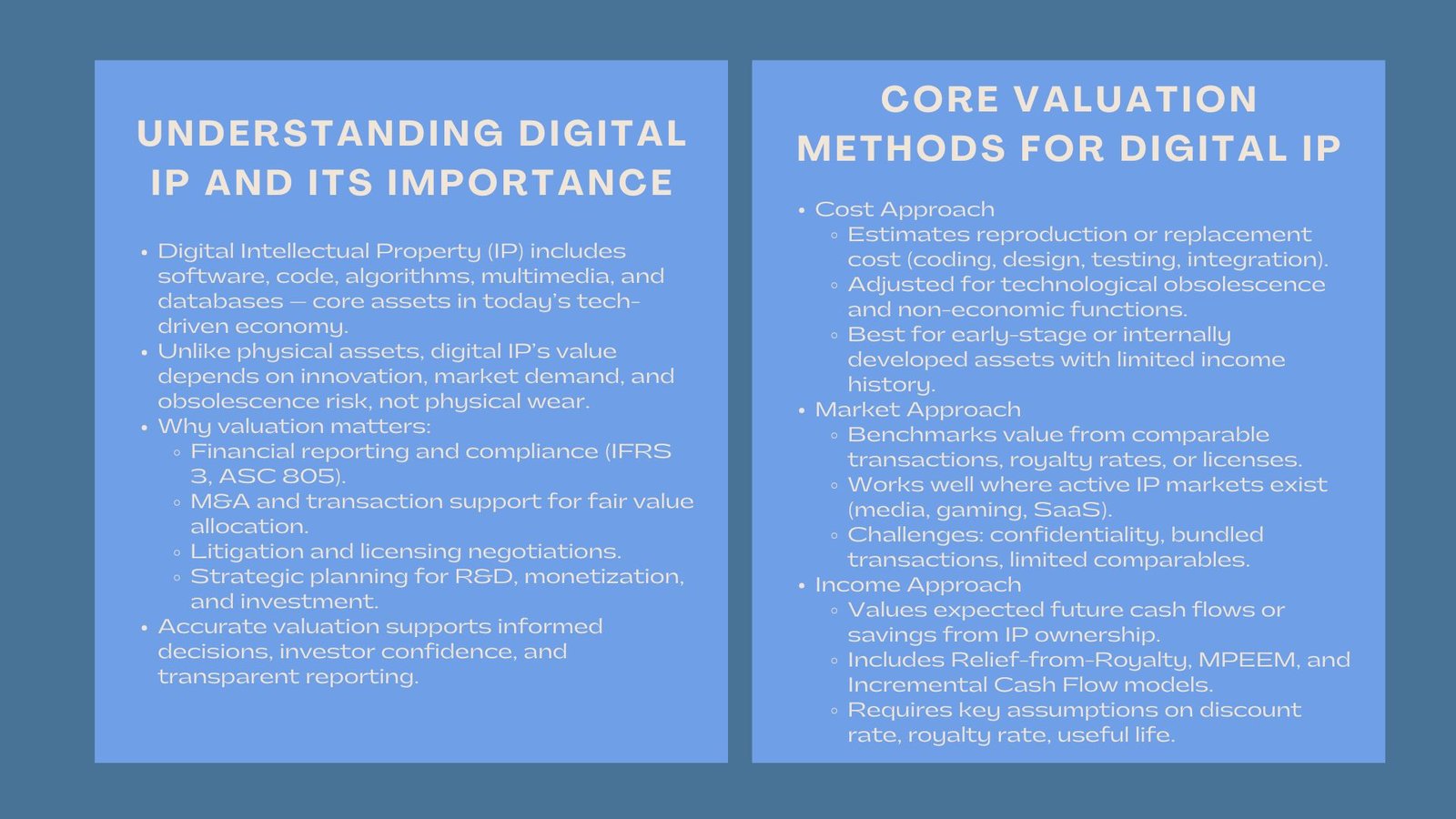
Digital IP is a broad category of assets that are developed, stored or shared in electronics. These can be software applications, databases, Web code, digital content repository, and multimedia resources. The protection of copyright is automatic upon creation and protects original works that may include source code, graphic works and written works.
Compared to physical assets, the value of digital IP does not diminish with use, but as technology becomes obsolete (or competitor products emerge) or the demand in the market changes it may decline at a rapid rate. This means that the task of valuation is not only demanding in terms of technical knowledge of technology but also a sound background in financial theory is necessary.
Most valuation experts look at the legal defense of the asset, its projected life, the possibility to commercialize it, and the economic returns of the same. As a matter of fact, the digital IP valuation may be more complicated than traditional types of intellectual property because of the speed of innovation and the inability to find credible comparables to the market.
Major Reasons why Digital IP is important to value.
Digital IP valuation is carried out by companies due to a number of reasons, such as:
- Financial reporting: Business combinations: Adherence to accounting standards, including IFRS 3 or ASC 805.
- Transaction support: The identification of fair value in acquisitions, licensing or transfer pricing.
- Litigation and dispute resolution: Development of damages in copyright infringement or misappropriation.
- Strategic planning: Evaluating the value of digital assets to the development of revenues and competitive advantage.
Such valuations assist companies in making sound investment and management decisions in addition to offering confidence to the investors, actuaries and regulators.
Digital IP Valuation Methodologies.
Copyrights, software and other digital property are usually valued in the same manner as other intellectual property, namely using cost, market and income as the three fundamental approaches. All of them have their own benefits, and they are chosen depending on the character of the asset and the presence of appropriate data.
The Cost Approach: Reproduction and Replacement Value Measurement.
The cost method is used to estimate the value of a digital IP asset by determining the cost involved to reproduce or substitute it with one of similar functionality. This approach is based on the principle of substitution- no rational buyer can pay a higher price on an already existing software asset, than it would pay to create an applicable one.
In the implementation of this approach, valuers will take into account both the direct costs of development, including design, coding, testing, documentation, and integration, and indirect costs, including the overhead and project management costs. Obsolescence adjustments are then made which indicate the use of old technology or functions which are not of economic value.
Cost approach is commonly suitable where the software assets are in use in the early life or other newly developed technologies that are yet to bring in a measurable income or in the market. It gives a consistent lower-bound estimate of value but can be inadequate in the context of ascertaining the future earnings of the asset.
The Market Approach: Determining Winning market comparable transactions.
The market approach is used to set the value of a digital IP asset in relation to similar transactions in the market. This entails the identification of similar assets that have been sold or licensed and the key terms that have been identified include royalty rates, size and term of transaction.
It may be difficult to find an appropriate comparables due to the fact that most IP transactions are confidential or they entail a package of assets. Nevertheless, industry databases, publicly-filed reports, and royalty rate surveys can be useful references. The strategy is most effective in markets where active licensing exists, e.g. entertainment media, gaming, or software-as-a-service (SaaS).
The market approach when properly applied gives a good signal of fair market value and matches the value with the real world market practices. A comprehensive understanding of industry benchmarks supports accuracy, as seen in digital IP valuation market comparables and royalty benchmarking frameworks used in technology transfer and licensing assessments.
The Income Approach: Forecasting Future Economic Benefits.
The income method is used to value the digital IP upon the basis of present value of future economic benefits of ownership or use of the asset. It is especially applicable to software and digital platforms that can earn a predictable revenue via licensing or subscriptions or advertising.
Some of the approaches that are classified under this approach include:
- Relief-from-royalty method: The method values the IP using the estimated amounts of royalties saved by owning, rather than licensing.
- Multi-period excess earnings method (MPEEM): The method allocates cash flows that can be specifically attributed to the IP without subtracting the returns on other assets.
- Incremental cash flow analysis: Becomes concentrated on the extra revenue or cost savings that are directly caused by the digital asset.
The income methodology involves critical choice of assumptions such as discount rates and royalty benchmarks and useful life estimates. Scenario analysis is frequently undertaken by the analyst in a bid to explain a technological disruption or competitive change. This framework is widely used in software and digital asset income-based valuation modeling for technology-driven companies, where recurring revenue and scalability play key roles in value creation.
Real-world Problems in the Valuation of Digital Assets.
Digital IP valuation has a number of challenges although it is important:
- Data availability: Making little data on good transaction information or cost breakdowns available.
- Technological obsolescence: Rapid innovation has a shortening economic life of digital assets.
- Complexity of law: No clear ownership, in particular where the code is created in collaboration or open-source form.
- Revenue attribution: The challenge in tracking the financial effect of a particular computer application/digital property.
Valuers will need to have technical expertise coupled with financial expertise to solve such problems. Documenting the assumptions and methodologies is of much essence to make the audit or legal action transparent and defensible.
Valuation as a part of Strategic Decision-Making.
Other than compliance and financial reporting, digital IP valuation has a strategic role. The quantification of software and digital content can help organizations improve the process of licensing strategy and plans, prioritizing R&D investments and monetization possibilities.
An example is the case of companies having immense software portfolios, valuation insights can help determine high-performing software to be commercialized or insignificant systems to be retired. Equally, investors and acquirers will use valuation analyses to determine the potential of returns and to negotiate reasonable terms of transaction.
Conclusion
With the global economy being increasingly computerized, there is no need to overemphasize the need to properly value copyrights, software, and any other digital IP. Whether it is strategic planning, financial reporting or transactions, having real insight into the true value of these assets allows businesses to make more smarter, data driven decisions.
Using the cost, market, and income methods in conjunction with professional judgment and strong analysis can ensure that the digital innovations in the organization are identified and used as a driver of long-term value appropriately.