Intellectual Property Asset Valuation Explained: A Practical Guide to Successful Valuation, Transactions, and the True Meaning of Intellectual Property Value
Introduction to Certified IP Valuation for Transactions
The nature of the contemporary global economy, which is filled with innovation, does not require physical resources only to determine the value of corporations. Enterprise value in almost all industries is currently a significant portion made up of brands, patents, software, proprietary technology, data and creative content. This change has transformed the intellectual property asset valuation as a specialised technical field to the centre stage of corporate finance, strategy and transactions.
Yet many executives and finance professionals still struggle to clearly interpret the intellectual property value meaning, quantify intellectual property rights value, and implement the valuation of intellectual property assets in a way that is credible to investors, regulators, and transaction counterparties. This article provides a focused, professional, and applied guide—grounded in real-world practice and informed by leading intellectual property asset valuation book chapters and every respected practical guide to successful intellectual property valuation and transactions—to explain how intellectual property is valued, why it matters, and how it shapes modern deal-making.

1. Intellectual Property Value Meaning in the Modern Economy
1.1 Defining Intellectual Property Value Meaning in Business Terms
The intellectual property value meaning extends beyond legal ownership of patents, trademark, copyrights and trade secrets ownership. Within economics, intellectual property value is the projected future gains that can be accrued as a result of exclusivity, control, or licensing of knowledge safeguarded. These advantages could be as a result of high prices, greater market share, economies of scale, entry barriers due to risks, and positioning in new markets.
As an instance, a pharmaceutical patent is not just a legal protection; it is a source of unique revenues as long as it is legally active. A global brand is not just an expression of marketing expenditure; it is also a symbol of customer confidence, pricing capabilities, and cash flow sustainability. In this sense, the intellectual property value meaning is inseparable from competitive advantage and long-term enterprise sustainability.
1.2 Why Intellectual Property Rights Value Now Dominates Corporate Balance Sheets
The economic relevance of intellectual property rights value has expanded dramatically over the past two decades. Technology, healthcare, media, and consumer goods all regularly have intangible assets that are much greater in value than the physical infrastructure. Investors are more evaluating companies on the basis of data possession, platform ecosystems, proprietary algorithms and customer analytics as opposed to factories or equipment.
This change has far reaching consequences on corporate valuation, acquisition prices, litigation and financial reporting. The growing dominance of intellectual property rights value requires more rigorous, defendable approaches to the valuation of intellectual property assets across all major financial decisions.
2. The Foundations of Intellectual Property Asset Valuation
2.1 What Intellectual Property Asset Valuation Really Measures
In essence, intellectual property asset valuation attempts to determine the future economic returns that can only be attributed to a recognizable intellectual property entitlement. It splits the worth of the IP out of the entire business by making an analysis of how the individual rights help lead to incremental cash flows, cost reduction, or mitigation of risk.
Intellectual property valuation is probabilistic and forward-looking unlike the traditional valuation of assets. It involves predictions of the acceptance of the market, technological obsolescence, competition reaction, regulatory transformation, and legal rights enforceability. These uncertainties explain why the valuation of intellectual property assets demands both financial rigor and strategic judgment.
2.2 Key Drivers in the Valuation of Intellectual Property Assets
The valuation of intellectual property assets is influenced by multiple interdependent variables. Enforceability and life left is defined by legal strength. The scalability of revenue is based on market potential. The technological differentiation will affect the risk of substitution. Royalty stability is affected by contractual protection. All these drivers need to be put into valuation models to display realistic commercial behavior.
Incidentally, two patents with closely related technical functionality might have radically different values in terms of geographic coverage, life to be retained and competitive environment of the innovator. This is so complicated that standardized valuation formulae cannot work without contextual professional judgment.
3. Practical Applications of Intellectual Property Asset Valuation
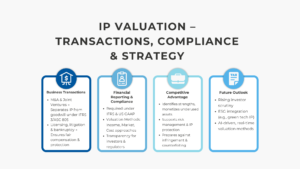
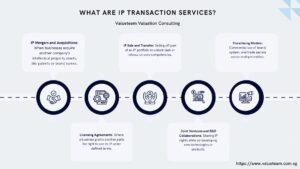
3.1 Intellectual Property Valuation in Mergers and Acquisitions
Intellectual property asset valuation is determinant in purchase price allocation, bargaining power and the post-acquisition earnings volatility in merger and acquisition transactions. Intellectual property obtained in the course of action can easily be the biggest single item in goodwill and identifiable intangible assets of the balance sheet.
An acquisition of a software company, such as one can also devote most deal value to proprietary platforms, customer contracts, and trademarks. The valuation of intellectual property assets in this context directly determines future amortization charges, tax deductions, and reported profitability. Mistakes during this phase may skew earnings over years and bring them under regulatory review.
3.2 Intellectual Property Rights Value in Licensing and Monetization
Beyond acquisitions, intellectual property rights value is central to licensing, franchising, and joint venture arrangements. The defensible IP valuation in the royalty negotiations is dependent upon the exclusivity, brand strength and technological differentiation.
A world consumer brand that is licensing a trademark to third world countries should come up with royalty rates that indicate actual brand worth without damaging the brand equity in the long term. Under such circumstances, the strong intellectual property asset valuation will protect the integrity of revenues as well as strategic brand positioning.
4. Learning from Intellectual Property Asset Valuation Book Chapters
4.1 Why Formal Literature Shapes Professional Valuation Practice
Every authoritative intellectual property asset valuation book chapter explains the theoretical underpinnings that guide applied valuation. Legal doctrines, financial valuation theory, market behavior, and accounting treatment are usually concerning chapters that are absorbed into a systematic analytical model.
To valuation professionals, these forms of literature have more than written formulas. It develops theoretical discipline in dealing with uncertainty, the choice of suitable discount rates, modeling of obsolescence curve and interpretation of regulatory directions. With the emerging complexity of intellectual property, including data and artificial intelligence models and digital platforms, these theoretical foundations cannot be ignored.
4.2 Bridging Academic Theory and Transactions
The use of real transaction evidence is becoming progressively more prominent in modern intellectual property asset valuation book chapters. The case examples show that the assumptions of valuation are challenged in licensing negotiations, tax audit, dispute amongst the shareholders, and cross-border takeovers. This theory-practice combination assists professionals to learn how valuation of intellectual property resists outside attack.
These discussions, which are based on cases, teach practitioners to defend valuation opinions in court, how to set the price of the royalty, and how to change the valuation assumptions in a significant way to change the price of a deal.
5. The Practical Guide to Successful Intellectual Property Valuation and Transactions
5.1 From Valuation Theory to Commercial Execution
A believable practical manual of successful intellectual property valuation and transactions is beyond technical modeling. It deals with the behavioral, legal, and negotiation relationships that eventually decide whether an intellectual property valuation is commercially successful.
Valuation is not at all accepted at face value in transactions. Buyers put into question growth assumptions, legal enforceability, and competitive moats. Sellers are also focusing on strategic synergies, network effects or brand dominance. An empirical manual coaches professionals to frame valuation stories, which withstand these adversarial politics.
5.2 Managing Valuation Risk in High-Stakes Transactions
Intellectual property risk is frequently more significant in massive technology deals than the physical asset risk. Disputed ownership, pending litigation, untested enforceability, and regulatory exposure can materially alter intellectual property rights value even after closing. A sound practical guide to successful intellectual property valuation and transactions equips deal teams to quantify these risks explicitly within valuation models rather than relegating them to generic risk disclosures.
This is an application of legal, market, and financial risk, which is ultimately disciplined that draws the distinction between theoretical and transaction-grade valuation.
6. Valuation of Intellectual Property Assets Across Key Industries
6.1 Technology and Software
In the case of software and digital platform companies, the valuation of intellectual property assets often focuses on proprietary code, algorithms, data architectures, and platform ecosystems. The IP value is often increasing exponentially above the cost of development because of network effects. The downside risk is however high in case of slow pace of innovation given the rapid pace of technological obsolescence.
Platform-based companies illustrate the dual nature of intellectual property value meaning: extraordinary upside potential combined with heightened competitive vulnerability.
6.2 Pharmaceuticals and Biotechnology
In life sciences, patents and regulatory exclusivity dominate the intellectual property rights value. The rest of the life of a drug patent is normally the direct measure of corporate valuation. One negative court decision can wipe billions of enterprise value in one night.
In this case, the valuation of intellectual property assets depends critically on regulatory approval probabilities, competitive pipeline research, and reimbursement structures, which also demand specific knowledge in the domain.
6.3 Consumer Brands and Media
To international consumer brands, the trademark in itself is usually the largest intangible asset. Intellectual property asset valuation in this context revolves around brand-driven pricing premiums, loyalty-driven revenue stability, and global licensing reach. The intellectual property value meaning becomes deeply intertwined with consumer psychology and cultural relevance.
7. Real-World Intellectual Property Asset Valuation Case
7.1 Technology Platform Acquisition Case
A global company has purchased a local fintech system that has its own payment algorithms and encrypted transactions. During purchase price allocation, the valuation of intellectual property assets revealed that over 70 percent of deal value was attributable solely to the platform’s proprietary architecture and user data ecosystem.
The valuation team used a multi-period excess earnings approach in which the cash flows would only be attributed to the intellectual property. Following regulatory audits were intensive over the assumptions embedded into customer adoption, cybersecurity risk, and barriers to technological replication how intellectual property rights value becomes a point of focus when a post-deal audit is conducted.
The valuation team applied a multi-period excess earnings method to isolate cash flows attributable exclusively to the intellectual property. Subsequent regulatory audits focused heavily on the assumptions underlying customer adoption, cybersecurity risk, and technological replication barriers—demonstrating how intellectual property rights value becomes a focal point of post-deal scrutiny.
7.2 Brand Licensing Dispute Case
In a case of brand licensing, an international apparel firm appealed against royalty fees imposed by a local licensing firm. A detailed intellectual property asset valuation demonstrated that the brand commanded significantly higher market premiums than those embedded in the existing royalty structure. The settlement of the case led to the creation of materially modified licensing terms, which validated the effect of the IP valuation in the direct redistribution of revenue.
8. Governance, Regulation, and Audit of Intellectual Property Valuation
8.1 Regulatory Expectations on Intellectual Property Rights Value
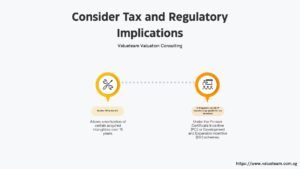
Layers of regulators and taxation bodies in different parts of the world have heightened scrutiny of intellectual property transfer across their borders, licensing arrangements and internal IP relocation. They also demand more strict records that validate the valuation of intellectual property assets especially where the valuation of intellectual property assets has a significant impact on taxable income.
The inconsistent assumptions of the valuations, unjustified growth projections, or arbitrary standards of royalty are now often questioned. Such regulatory climate increases the significance of the strict adherence to professional valuation principles.
8.2 Audit Implications and Risk Management
Intellectual property valuation is among the riskiest in financial reporting as handled by auditors. Numerous audit tests are needed because of the subjective nature of the future cash flow projections, discount rates, and the useful life assumptions used. Misstatements of materials are common where intellectual property rights value have been overstated.
Organizations whose valuation governance is well established, which is backed up by third party valuation specialists and constant monitoring are in a better position to survive audit and regulatory scrutiny.
9. The Future of Intellectual Property Asset Valuation
9.1 Data, Artificial Intelligence, and New Asset Classes
The new types of assets including artificial intelligence models, proprietary datasets, and platform ecosystems are reshaping intellectual property asset valuation. These properties tend to develop over time, and these old-fashioned methods of valuation rely on constant law protection.
More dynamic modelling of adoption curves and competitive risk are now supported by advanced analytics, machine learning and real time market intelligence. Nevertheless, valuation transparency regulatory expectations are brought up by this technological sophistication, too.
9.2 Sustainability, ESG, and Reputation-Based Intellectual Property
Reputation, trust, and ESG credentials increasingly possess monetizable intellectual property value meaning. The issuance of sustainability certifications and environmental technologies, as well as carbon-related intellectual property, is growing fast. Although existing accounting models continue to have problems formally registering much of these assets, their economic importance is undeniable.
Conclusion
Intangible assets have become the essence of the modern enterprise, and intellectual property asset valuation is among the most strategically important fields of corporate finance of the modern era. A clear understanding of the intellectual property value, the drivers of intellectual property rights value, and the practical execution of the valuation of intellectual property assets now determines transaction success, regulatory compliance, litigation outcomes, and long-term shareholder value.
Insights drawn from authoritative intellectual property asset valuation book chapters and every credible practical guide to successful intellectual property valuation and transactions confirm that intellectual property valuation is no longer a theoretical exercise—it is a transaction-critical, governance-defining, and strategy-shaping function. With the rapid increase in the pace of innovation and the increase of the intangible nature of assets as the dominant market valuation, the ability to become a specialist in intellectual property valuation will determine the next form of value creation in corporations.