Certified Patent and Technology Valuation
Valuation of Patents and Technology Assets
Introduction to Certified Patent and Technology Valuation
Technology and patents are a significant competitive advantage item of innovative business. These intangible resources, internal or acquired, have the potential of creating a high level of economic value with commercialization, licensing or strategic partnerships. Corporate transactions, financial reporting, and investments can only be made based on their fair value understanding.
This paper will discuss the main tools and issues in patent and technology asset valuation and how these organizations can come up with useful and defensible estimates of the value of technology and its prospects in the market.
Patent and Technology Valuation.
Patents are used as a legal protection tool as well as a financial tool in the current innovation-driven economy. They provide a monopoly on the right to explore inventions where the competitors cannot use the same technologies without permission. The operational efficiency and market leadership of a company are frequently based on technology assets in the form of proprietary algorithms and trade secrets, production processes.
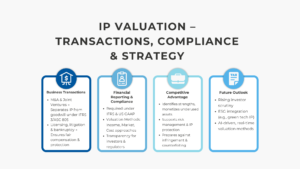
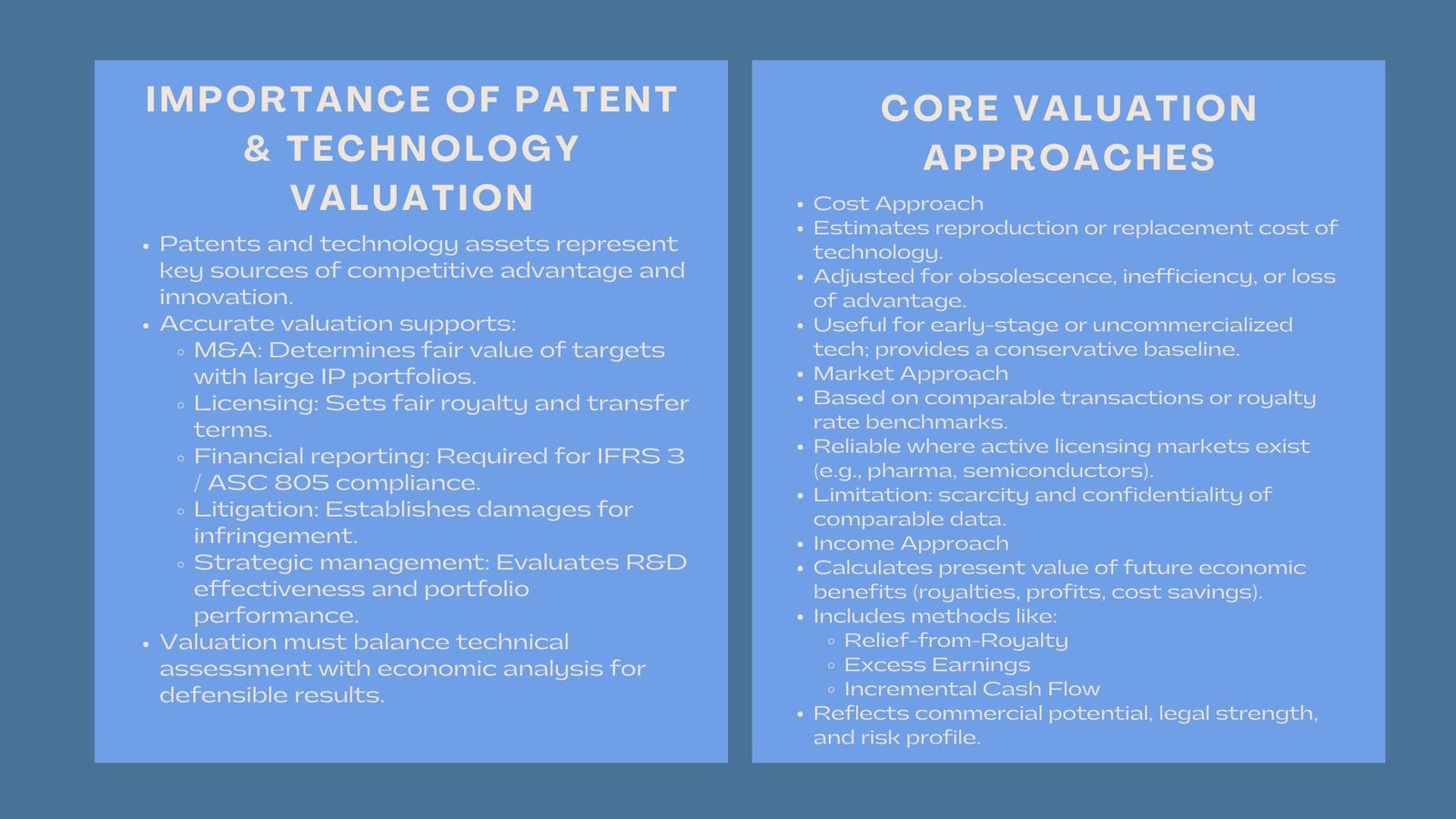
Proper valuation of these assets is important to a broad variety of purposes:
- Mergers and acquisitions (M&A): Fair purchase values of the target companies having large IP portfolios.
- Licensing and royalty negotiations: Determining fair play on transfer of technology
- Financial reporting: Adherence to accounting standard requirements on purchase price allocation IFRS 3 and ASC 805.
- Improving litigation and dispute resolution: Damages based on infringement or misappropriation.
- Strategic management: Evaluation of the effectiveness of R&D and portfolio investments.
In each instance, the valuation process should give a balance between technical evaluation and what should be analyzed economically so that the findings are consistent, transparent and defendable.
The most important methods of patent and technology valuation.
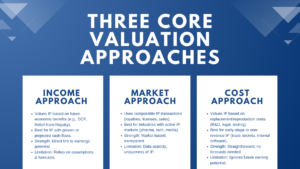
Intellectual property valuation is usually conducted in three main methods including the cost approach, the market approach and the income approach. The decision among them is determined based on the nature of the asset, the level of maturity, and access to data.
Cost Approach
The cost approach values the assets in terms of the cost needed to reproduce or substitute the technology asset with an item of similar value. This approach operates under the idea of substitution where a rational buyer would not be willing to pay more to an existing patent than it would be to make a similar one.
Valuers determine the reproduction cost (cost to replicate the same technology) or replacement cost (cost to reproduce an asset of the same functionality with current technology). Obsolescence, inefficiency, or lost economic advantage is then adjusted.
This method can be appropriate in early stage or uncommercialized technologies, with no information on income or the like market transactions. Although it is a conservative estimate, it can underestimate assets that have a good prospect in the market, or that have a strategic value.
Market Approach
The market approach is used to derive value by comparing the subject asset to other related technologies which have been sold or licensed in the market. This approach uses real transaction data, and thus it is a reliable measure of fair market value in cases where there is enough comparables.
Data can be obtained through licensing databases, industry reports and filings in court. Valuers take into account scope of patents, time remaining, industry and geographic reach in order to adjust the multiples of transactions or royalty rates.
Nevertheless, there are usually issues with the scarcity and secrecy of similar transactions. The method works best where there is an active licensing market such as in pharmaceuticals, semiconductors and telecommunications where the royalty benchmarks can be examined in detail.
A sophisticated application of this method is seen in patent valuation comparables and royalty rate benchmarking for technology transactions, which helps firms negotiate fair licensing fees and evaluate monetization potential.
Income Approach
The income approach places value on patents and technologies according to the present value of future economic gains which would be as a result of the use or possession of the patents and technologies. This approach is consistent with the views of the investors and is the most universally used in high-value IP appraisal.
There are a number of variants of this approach:
- Relief-from-royalty method: The estimation value is calculated as the amount of hypothetical royalties that a company would have saved under the ownership of the patent rather than under licensing.
- Excess earnings method: Separates the amount of income that can be directly identified with the technology, and then the returns on other assets are subtracted.
- Incremental cash flow technique: This is concerned with the extra revenue or cost reduction brought about by patented technology.
The major inputs of valuation are estimates of revenue, profit margins, growth rates, taxation, and the reasonable discount rate. The risk profile of commercialization of the technology and legal protection of the technology should be reflected in the discount rate chosen.
In real life, analysts tend to base their detailed forecasts on justifications using technical analysis, market research and opinion of experts to make the assumptions realistic. This approach is widely applied in technology asset income-based valuation modeling for innovation-driven companies, particularly where patents underpin recurring revenue streams or significant cost advantages.
Issues that affect Patent and Technology Valuation.
In addition to the selected methodology, there are a number of qualitative and quantitative variables on valuation outcomes:
- Legal protection: The power, the scope, and the life of the patent.
- Technological advantage: The level of how the asset performs better or costs less.
- Business viability: Market size, adoption, and barriers to entry.
- Development stage: In prototype, pilot or commercialization stage of the technology.
- Competitive landscape: Substitutes and the probability of infringement or obsolescence.
Jurisdictional differences in the strength of enforcement and regulatory environment are also taken into consideration by valuers because they may have a significant impact on risk and marketability.
Difficulties in Asset Valuation of Technology.
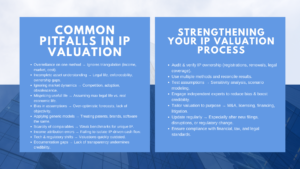
Technology valuation is a combination of both technical and financial experience. Some key challenges include:
- Little information: Analogous deals tend to be secret or nonexistent.
- Lack of predictability of future revenues: Technological change can be fast changing the market.
- Value attribution: Technologies are often associated with a greater system and it can be hard to identify their contribution towards total cash flow.
- Law and regulation risk: Value can be impacted in relation to patent litigation or impending approvals.
To surmount these obstacles, it is necessary to have a strong due diligence, documentation of assumptions and sensitive analysis to cover the variable results.
Best Practices of trustworthy Valuation.
In order to increase credibility and accuracy, organizations are recommended to use systematic valuation approaches and to follow the accepted standards, including the International Valuation Standards (IVS) or ISO 10668 when dealing with intangible assets. Best practices include:
- Carrying out adequate technical and legal investigations of every asset.
- Triangulating results through various methods of valuation.
- Compared to the industry benchmarking.
- Hiring multidisciplinary teams of financial analysts, engineers and legal professionals.
- Enhancing documentation to be audited or be regulated.
These will make sure that the conclusions on valuation are defendable, transparent and consistent with professional standards.
Conclusion
The art and science of valuation of patents and technology assets is diverse. It needs a profound knowledge of the technology behind it, its market potential and the financial principles of intangible assets valuation. Through the efficient use of the cost, market, and income approaches and taking into account the special qualities of all technologies, the companies will be able to obtain specific information concerning the true value of their innovations.
With innovation still being a central driver of business expansion, sound valuation procedures will also prove crucial in business decision-making, facilitating transactions and creating a balanced reflection of technological value in the balance sheet.