IP Valuation to Attract Investors and Funding
In the new era of the knowledge based economy, the most prized possessions that a company holds is often intangible. The patent on a drug created by a pharmaceutical company, the proprietary algorithm of a technology company, the trademark of a fashion company: these intangible assets may bring much of the overall value of a business, and in some cases, much more than the value of the physical property, equipment, or cash held by the business. To those in the finance, strategy, corporate development, or startup sector, understanding how IP valuation for investors works is no longer optional. It is a core competency that determines how businesses raise funds, enter into alliances, and position themselves to achieve sustainable development.
However, even with its significance, the intellectual property valuation is a rather unclear concept even among non-experts. Numerous founders and middle management folks are aware of the presence of patents or a strong brand in their company but have minimal understanding as to how to measure it in a manner that is valuable to a venture capitalist, a private equity firm or a strategic acquirer. This disconnect between owning the IP and monetizing it is among the most widespread causes why even better placed companies cannot get the funding they can rightly get to get or make offers that are highly underestimated of what they have created.
The article is a great and useful resource to understand the IP valuation, what it entails, how the most common intellectual property valuation methods operate, what investors are really seeking, and what practitioners can do to make IP presentable in fundraising situations. When you are getting ready to have your first investor meeting, or you are doing due diligence in the context of an M&A operation, the information in this article will allow you to engage with IP value with all the confidence and tact.
Why Intellectual Property Has Become Central to Company Valuation
The process of IP-based valuation has gained momentum in the last twenty years at a rapid pace. In its analysis, international consultancies have revealed that over 80 percent of the market value of large publicly listed firms in the technology, pharmaceuticals and consumer goods industries are now determined by the intangible assets of such companies. This change is symptomatic of an overall economic change – today competitive advantage is less about the possession of factories than it is about the possession of ideas, processes, platforms which can be hard to imitate. The question that is increasingly on the mind of an investor when he or she looks at a company is; what is the sustainable source of this companies edge and how stable it is shielded?
This is where company valuation for investment decisions intersects directly with IP strategy. . Having a portfolio of patents, trade secrets and proprietary technology organized well, a company is not only protecting its existing business but also building a sustainable moat, which warrants a value well above the current business worth the multiple. Think about a mid-sized German industrial automation company which came up with a number of machine-learning patents in the predictive maintenance. The due diligence team of the investors, when the company was seeking a growth equity investment, found out that the patent portfolio was not going out of patent infringement in 15 more years and did not have any direct prior art challenges. Such legal strength turned into one of the main excuses to high pre-money valuation than the industry peers usually have.
Even when concerning your junior and mid-level professionals, this dynamic is good to know, regardless of whether you are a leader or not. IP valuation is frequently requested in processes where finance analysts, product managers, legal associates, and business development professionals are requested to compile data, prepare materials, or assist in any other process related to IP valuation. Being conversant with the language, the rationale, and the constraints of these valuations places you in a better qualified and commerce conscious participant- and identifies you as an individual ready to assume a higher responsibility.
Table 1: Intellectual Property Valuation Methods — A Comparison
| Valuation Method | How It Works | Best Suited For |
| Cost Approach | Bases IP on the cost of historical or replacement of creating it. | Internal research and development, new patents, computer software programs. |
| Market Approach | Compare IP to other similar transactions or licensing agreements in the market. | Trademarks, brand names, licensed technology with similar items that are active. |
| Income Approach | Future cash flows of the IP are attributed to the project, and then discounted to present value. | Patent revenue-generating, software licenses, proprietary process. |
| Relief-from-Royalty | Calculates the amount of royalty saved by owning the IP as opposed to licensing. | Intellectual property that is branded, patents on technology with royalty standards established. |
| Real Options | Reacts to IP as a financial option – appreciates future strategic flexibility and possible benefits. | High-risk biotech patents, discovery R&D, platform technologies. |
Core Intellectual Property Valuation Methods Explained
No universal formula exists with respect to the valuation of IP. Rather, practitioners make a choice based on a few established approaches to the intellectual property valuation methods that are based on various assumptions regarding the cause of value. The most suitable methodology will be based on the character of the IP, the intention of the valuation, the availability of the market information, and the preference of the involved investor or counterpart. To appreciate the various disparities that exist between the two approaches, one would have to have a good understanding of the various approaches before making any meaningful contribution towards IP related talks on finances.
Income approach is generally regarded as the most commercial convincing tool especially for IP valuation for investors. Its principle is as follows: predicting the incremental revenue or cost savings of the IP during its useful life and discounting the future cash flows to a present value with a relevant discount rate. One standard example of the technique is in the pharmaceutical industry: when an American biotechnology firm tried to raise Series B on a new oncology compound, the financial advisors developed a discounted cash flow model that estimated that the maximum royalty payments on the patent were to be made in 12 years time. The model assumed probability-of-success corrections at each stage of clinical trial, and eventually resulted in a risk-adjusted net present value, which was the baseline of investor negotiating.
The relief-from-royalty approach is particularly worthy of being mentioned since it is both mathematically rigorous and mathematically intuitive to investors. The reasoning is easy to understand: in the case that you own the IP, you do not have to pay royalties in order to use it- and the amount of such avoided payments is a tangible element of the economy. Analysts can use the similarity in royalty rates between the licensing databases and apply the same rate to the estimated revenue to obtain a plausible IP value even when the attribution of direct cash flow may be difficult. Such an approach is considered to be especially widespread when intellectual property valuation providers are approached in order to assist with brand valuations, technology licensing deals, or cross-border transfer pricing.
Table 2: What Investors Look For in an IP Portfolio
| IP Attribute | Why Investors Care | Red Flags to Avoid |
| Legal Ownership | Establishes that the company has an exclusive right. | Controversial ownership, unregistered IP. |
| Scope & Enforceability | Generalized claims, well-written and broad, discourage competition. | Small-minded claims, lapsed rights. |
| Revenue Linkage | TV programming creates direct business revenue. | An IP that has no definite commercial use. |
| Competitive Moat | Hard to design IP enhances position in the market. | Replacement technology that is easily substitutable. |
| Transferability | Licensing or selling IP provides strategic optionality. | Only restrictions associated with key personnel. |
Five Steps to Prepare Your IP for Investor Scrutiny
To raise investment based on your IP, you need to do more than owning patents or trademarks. Investors do systematic due diligence and those companies that have organized their IP documents and have the ability to articulate value will always be at an advantage. The five steps listed below are the process that most seasoned advisors take through when preparing a company to undertake a funding round, acquisition, or strategic partnership. Following these steps will significantly strengthen your position in any company valuation for investment decisions process.
Process Flow 1: The IP Valuation Process — From Audit to Report
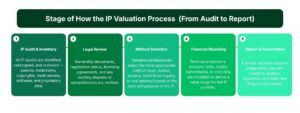
Process Flow 2: Preparing IP for Investor Presentation
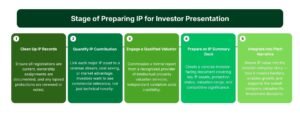
The two process flows are usually run in parallel and not in a sequential mode. As the specialists in valuation are executing their financial modelling, the legal department and the strategy department of the company should be working on the investor friendly narrative at the same time. The objective is to reach a stage in which the formal valuation report and the pitch materials are telling a consistent story one which starts with a clear description of the IP, which develops through its commercial relevance, and ends with a defensible and investor-ready range of values.
Real-World Cases: Lessons from IP Valuation in Practice
The history of IP-driven fundraising is replete with cases in point, of companies that exploited their IP brilliantly, and also, of the ones that miscarried as a result of not appreciating or communicating its worth. Among the most noticeable good cases is one in the pharmaceutical industry. One Canadian biotech company that was focusing on creating a new gene therapy delivery platform has hired an intellectual property valuation services specialist prior to taking investment to investors. The resulting report established that the company had three interlock patents on the delivery mechanism along with the therapeutic compound, which resulted in a portfolio that was much more defendable than single-patent assets. The valuation report made the headline request of USD 45 million in Series B funding by the company credible when the company was presented to institutional investors whereby it raised the requested funds in less than six months.
An opposing example points at the dangers of not valuing IP. The computer software startup was a UK-based company that developed an in-house natural language processing engine, which it offered to enterprise clients in the field of legal services. The technology was truly a groundbreaking one, and its inventors had not registered the important aspects of their IP, relying on the protection of the trade secrets and non-disclosure contracts. In the acquisition process, legal team of acquiring firm carried out due diligence, which revealed that some of the codebase was donated by a previous contractor whose agreement of assignment of IP was not comprehensive. The transaction took eight months and ended when acquiring the companies at a fee that was half the initial expectation of the founders. There would have been a proactive IP audit before the sale process that would have averted this result.
The morale of both instances is one and the same: IP valuation for investors is not just a financial practice, it is a risk management field of study. When companies invest effort to learn and write about their IP portfolio, they are in a better position to defend their valuation during negotiations, prevent expensive surprises in due diligence and develop the type of investor confidence that shortens the length of the deal. To those in or near the fields of corporate finance, legal, or strategy functions, aiding this type of proactive IP governance is one of the most useful investments you can make in the success of your capital-raising by your own organisation.
Common Challenges and How to Navigate Them
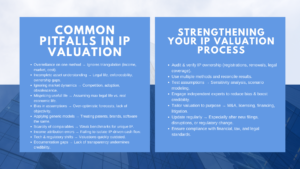
Although the importance of IP to investors is increasingly being acknowledged, there are day to day challenges that firms face when attempting to integrate IP into their investor story. The most endemic one is the subjectivity problem. As opposed to a purchase price and a schedule of depreciation of a piece of equipment, a patent or a trademark value is uncertain in nature and relies on assumptions on future market forces, competition, and the effectiveness of legal protection. The same patent portfolio may be analysed by two reputable valuation firms who may come to estimates that are less by two or more factors. This fluctuation may leave investors sceptical, especially the conservative investors who are used to more concrete asset classes.
The answer to this is never to eliminate the uncertainty because that is unattainable but to be open like it. Properly prepared companies will include IP valuations that include a well-disclosed set of assumptions, sensitivity analyses, which demonstrate how the value changes due to different situations, and benchmarking the valuation with the similar transactions. This methodology is analytically rigorous and establishes credibility. It should also be mentioned that the use of known providers of intellectual property valuation services also introduces a third-party credibility to the self-prepared estimates which is simply unfeasible. Investors will find it easier to base their thought on a valuation presented by an independent specialist even though they may modify it to fit their own risk assumptions.
The second issue is the lack of connection between technical and commercial departments in a company. R&D and engineering departments are better placed to understand the technical novelty of their IP but they are unable to express that financially or strategically to attract the attention of investors. On the other hand, finance groups can have knowledge of the valuation models but have a shallow knowledge of the technical issues to provide the detailed due diligence questions. It is necessary to bridge this gap, and this may be achieved by organizing cross-functional workshops, documentation, and investor preparation. The most convincing company valuation presentation to the investment decisions are the ones that present a unified set of views of the technical team and the finance team as to why the IP matters and why it is worth this much.
Conclusion: Making IP Valuation Work for Your Fundraising Goals
The process of intellectual property valuation is no longer limited to the world of expert advisors and big business. Since the intangible assets have started dominating the balance sheets of companies and in the decision-making of investors, knowing and being able to explain the value of IP have become a viable skill to the professionals in any industry and those with varying levels of seniority. Whether you are assisting with a Series A raise, getting ready to have a strategic partnership, or taking part in an M&A process, the concepts discussed in this article will give you a good ground to participate in IP-driven discussions with confidence.
The most important thing to note is IP valuation for investors is best achieved when it is proactive, structured, and commercial based. The ones that get funding on favourable terms are the companies which make regular IP audits, using qualified professionals as intellectual property valuation services, and creating a clear narrative showing how their IP has been used in generating revenue and competitive advantage. Others who lag too late on a deal or worse still, they realize there are gaps in IP in due diligence, will nearly always be able to negotiate in a weaker position.
To acquire the experience in the field, the steps to be followed are obvious to professionals. Begin by becoming familiar with the fundamentals of intellectual property valuation techniques, such as cost, market, income and relief-from-royalty valuation and when each is suitable. Get acquainted with the way the investment decisions of companies use IP as a part of the total enterprise value. Find the examples and case study in your sphere. And where the time comes, become part of IP governance in your organisation: be it marking an unregistered process, contributing to a valuation exercise or assisting in the preparation of an IP summary to be presented to an investor. These are the investments that create a reputation, expertise and finally lead to doors that are more senior in strategy, finance and corporate development.