Learn How To Value Intellectual Property
Advanced Insights into the Valuation of Intellectual Property: A Review of Approaches and Methods
Introduction to Learn How To Value Intellectual Property
With the world economies moving towards innovation driven growth, intellectual property (IP) has turned out to be one of the best strategic resources a firm can possess. The intellectual property valuation and review of approaches and methods is thus a key to competitiveness, investment decision, and long-term business strategy. In contemporary business, the intellectual property value of a business can have high value compared to the physical possessions of that business, particularly in knowledge-based enterprise like technology, biotechnology, creative industry, and research. With the growing dependence of institutions on proprietary knowledge, patents, copyrights and trademarks, accuracy in determining IP value has become a necessity.
This paper discusses the changing value chain of intellectual property, analyzes the practical considerations that form the basis of IP appraisal, and identifies the structured guidance like the intellectual property valuation manual to academic institutions, which provides a specialised method of universities, researchers, and innovation ecosystems. By examining techniques, practice, and practical experiences, the following discussion will intend to offer a precise and broad insight into the functionality of intellectual property valuation in the real world context.
Understanding the Strategic Importance of IP Valuation
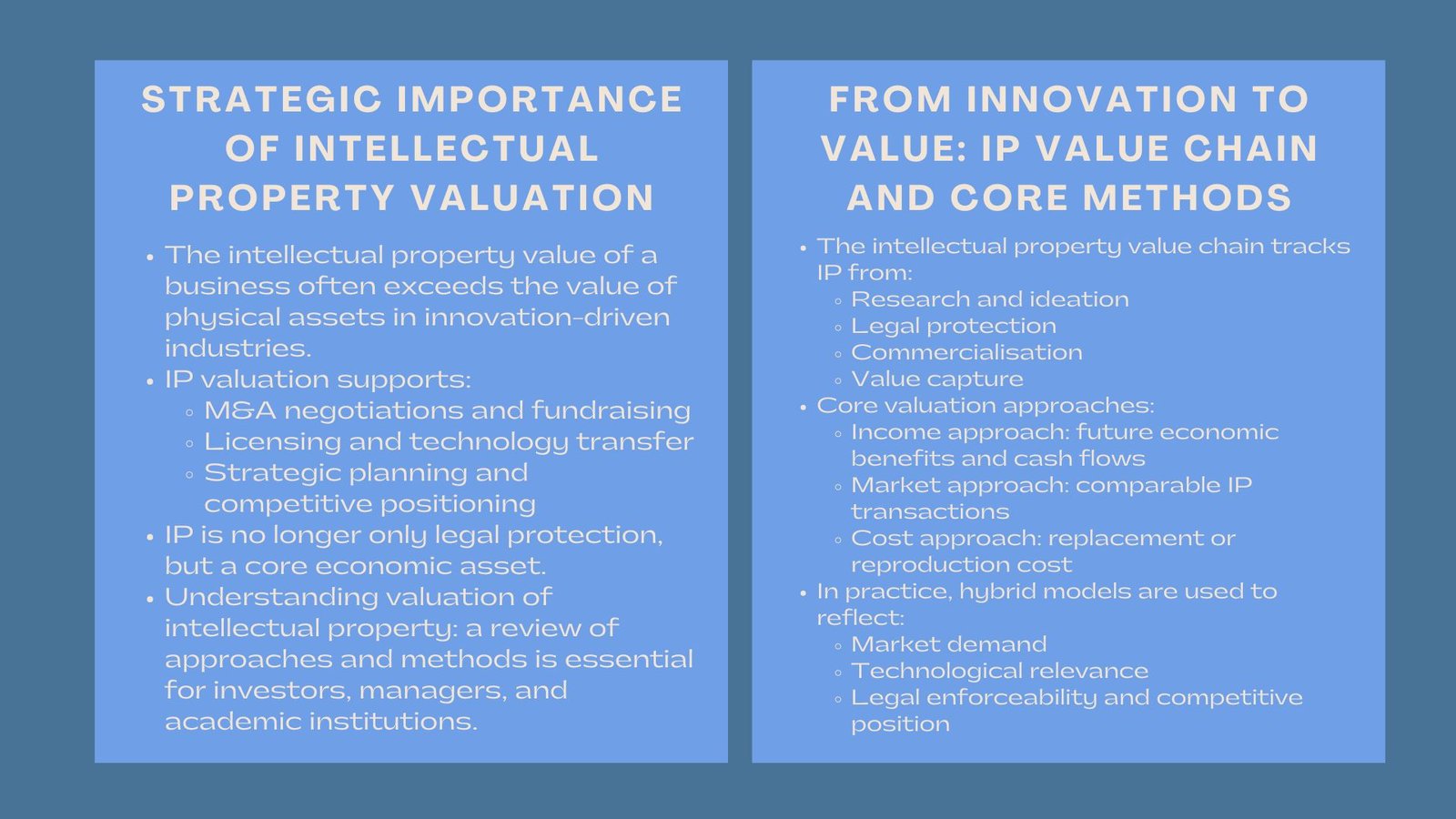
The intellectual property has become a significant economic asset and not a legal protection mechanism. Intellectual property value of a business influences mergers and acquisitions, licensing transactions, fundraising, transfer of technology and strategic relationships. It is common to find companies which have good IP portfolios doing better than those with limited portfolios since their innovation assets have an entry barrier and allow high prices.
The intellectual property value chain assists in the understanding of how IP creates wealth, starting with ideation and development to legal protection, commercialisation and finally value capture. Structured appraisals are becoming vital in determining the relationship between patents or proprietary technologies and financial results to investors and stakeholders. Consequently, intellectual property valuation has emerged as an essential subject of knowledge in the realm of finance, law, and academic centers of institutions that handle research-oriented resources.
Conceptual Foundations: The Intellectual Property Value Chain
The intellectual property value chain is a trail of the entire lifetime of innovation, creation to market impact. Potential value is manifested in research activities, inventions, disclosures, and prototype development at the initial stages, when commercialisation is yet to take place. The more technologies are polished, secured and incorporated into commercial products, the more the economic significance they are given.
The knowledge of every step in this chain can enable organisations to know the value of IP created, area of its loss and where appraisal is the most demanded. The intellectual property valuation manual for academic institutions reinforces this point by providing guidelines for universities, research centres, and technology transfer offices in managing patents and research-derived intangible assets. Such frameworks assist institutions in justifying licensing rates, broker commercial deals, and providing funds to innovations that rise within the academic settings.
Key Approaches in the Valuation of Intellectual Property
An in-depth knowledge of the valuation of intellectual property review of the methods and approaches normally points at three main valuation methods where they include the market approach, income approach, and the cost approach. Although both approaches have weaknesses and strengths, they are all combined to give a structured collection of tools which the analysts and institutions employ to come up with fair and defensible IP values.
The market approach determines comparable transactions in intellectual property, yet such information may be typically scanty since IP deals are not necessarily publicly announced. The income method is used to compute the future economic benefits which are attributable to the IP and thus it is especially important in the case of a project having a high commercial potential. The cost method gauges the amount of money that can be invested in order to recreate or replace the intellectual property and provides a low but realistic viewpoint of valuation when there is no certainty about the revenue.
The intellectual property value of a business in any case should be studied in the context of its competitive environment taking into account the brand strength, technological capability, legal enforceability and the market demand. All of these factors make the IP portfolio relevant in the real world.
Academic and Institutional Perspectives on IP Valuation
The intellectual property valuation manual on academic institutions offers an effective guideline to the academics, administrators and the researchers in charge of handling the intellectual property owned by the university. Universities tend to have high-value patents and research outcomes, but they have separate issues in valuation due to the fact that many technologies are at an early stage of development, have no market history, or are contingent on uncertain adoption.
The manual stresses on the role of open methods, uniform documentation, and due diligence. It further emphasises the necessity to know the value chain of intellectual property and in the process acknowledges the fact that academic innovations might need further steps to be commercialized; like proof-of-concept studies, pilot testing and possibly industry collaboration. Valuation process should consequently consider the development risk, regulatory routeway and readiness to commercial sake.
Applications of IP Valuation in Business and Finance
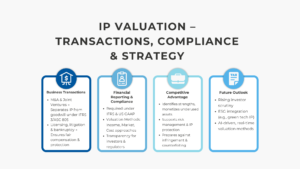
Intellectual property value of business is not only applicable to the financial reporting but to the strategy of decision-making, the raising of funds, legal litigation, licensing, and competitive positioning. In case of mergers and other acquisitions, companies depend on IP valuation where negotiation results depend on the fair value of intangible assets. New companies often rely on IP valuation to secure investor interest as well as as a basis to appreciate equity investment, whereas established companies look to it to aid brand protection, royalty benchmarking, and long-term strategic planning.
The intellectual property valuation survey of methods and practices shows that in practice, most practice combines hybrid models, a combination of the assumptions of income effect with cost and market perspective. The result of this combined approach is a more realistic and defensible valuation, particularly in instances where intangible assets play a major role in the long term performance.
Challenges in the Modern Intellectual Property Landscape
The issue of IP value involves dealers with a number of practical issues, including data constraints and legal ambiguities. The intellectual property value chain is dynamic; that is, it can change the value assumptions very quickly in response to market conditions, regulatory changes, and technological disruptions. The emergence of AI, biotechnology and online platforms has built complicated intangible ecosystems that are not necessarily appropriated by conventional valuation frameworks.
Academic researchers have had difficulties in estimating market adoption, commercial readiness and licensing potential. To businesses, a challenge is that it is not always easy to predict the level of revenue that can be attributed to intangible assets. Despite the systematic advice of the intellectual property valuation manual to the practitioners of academic institutions, the uncertainties regarding enforcement risk, competitive forces and international protection remain.
Future Developments in Intellectual Property Valuation
The changing face of innovation is necessitating the need to have more sophisticated tools and methodologies. To refine estimates using data analytics, scenario modelling, and risk-adjusted valuation is becoming more commonly used by analysts. Along with the growth of intangible assets as the main part of corporate value, the valuation of intellectual property will get a revision of practices and techniques to introduce novel schemes that incorporate the technological complexity and international market trends.
Institutions and businesses are also supposed to improve their intellectual property value chain and this will ensure that the internal strategies are aligned to the international best practices. The application of broad inclusive practices like the intellectual property valuation manual on academic institutions will be further vital to provide uniformity, accountability and viable practices.
Conclusion
The key to value creation, competitive advantage and long-term growth in industries has moved to intellectual property. With the pace of innovation, one should be aware of the importance of valuation of intellectual property by conducting a review of strategies and methods to help organisations consolidate their strategic position. The intellectual property value of a business must be assessed within a structured framework that recognises legal protection, market potential, technological relevance, and commercial readiness.
The intellectual property value chain provides a clear map of how IP progresses from invention to monetisation, allowing analysts and institutions to capture its real economic impact. With the support of structured guidance such as the intellectual property valuation manual for academic institutions, organisations can enhance accuracy, transparency, and credibility in their valuation practices, ensuring that intellectual property contributes to sustainable growth and strategic decision-making.