Professional WIPO Intellectual Property Valuation
Intellectual Property Valuation Basics for Technology Transfer Professionals: WIPO Frameworks and Brand Rights Integration
Guide to Professional WIPO Intellectual Property Valuation
The intellectual property (IP) has turned into one of the most important sources of the enterprise value, the innovation competitiveness, and the commercial differentiation in the modern knowledge-based economy. More and more universities, research institutions, startups and multinational corporations are using structured valuation schemes to monetise patents, software, trademarks and brands. To technology transfer professionals, the basic knowledge of the intellectual property valuation basics for technology transfer professionals is no longer a matter of choice, but the foundation of core competencies that directly impacts the licensing negotiations, spin-off formations, and cross-border collaboration.
This article is a practical and detailed discussion of the IP valuation principles, with a strong focus on internationally recognised methodologies such as wipo intellectual property valuation, while also integrating the commercial importance of brand valuation and intellectual property rights. The discussion is tailored to professionals operating at the intersection of innovation, finance, and legal governance, where valuation accuracy determines long-term success.
1. The Strategic Role of Intellectual Property Valuation in Technology Transfer
The activities of technology transfer lie at the intersection of the research, commercialization and market execution. It is at this juncture that intellectual property valuation principles in technology transfer practitioners develop the background to decision-making and proper stakeholder alignment.
1.1 Why Valuation Matters in Technology Transfer
Valuation in the case of technology transfer offices is not about the process of giving a figure to an asset. It is concerned with monetizing scientific innovation to be conveyed to investors, industry partners, and policymakers. Proper valuation also assists in setting the licensing fees, equity distribution during a spin-off and also prioritisation of patent portfolio to be commercialized.
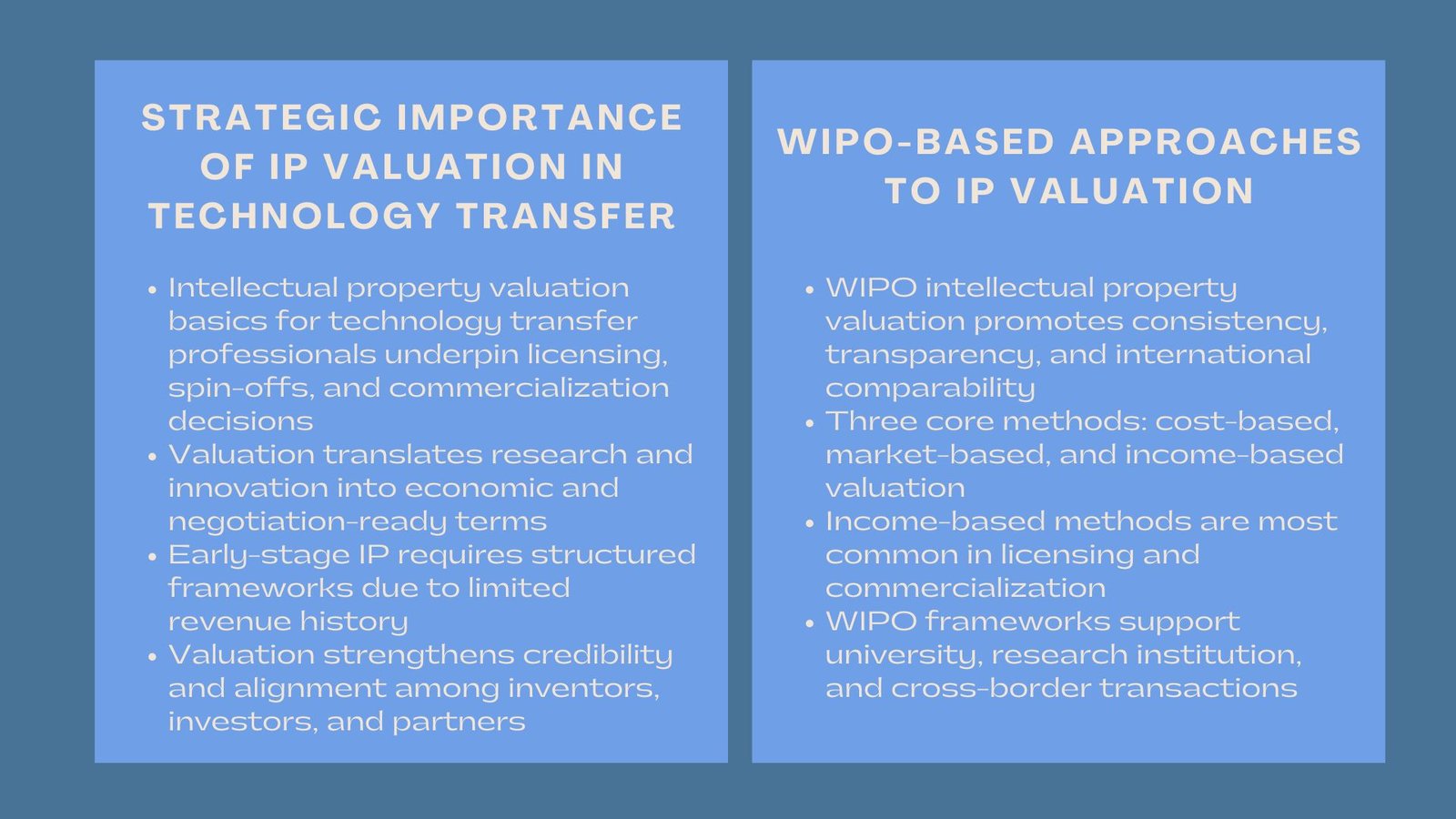
Practically, technology transfer professionals are frequently concerned with the early-stage IP with limited historical revenue information. This complicates the valuation especially and highlights the value of internationally based models like the wipo intellectual property valuation which offer a systematic guideline which fits well in the innovation-driven economy.
1.2 Valuation as a Negotiation Tool
Valuation could be used as an analytical and strategic tool in licensing negotiation. A supported valuation increases credibility, diminishes asymmetry of information and allows technology transfer specialists to justify the royalty rates and milestone payments. Intellectual property valuation fundamentals are an understanding of the basics of technology transfer professionals to make sure that there is economic reality behind the negotiation and not speculation.
2. Core Principles of Intellectual Property Valuation
Before applying advanced models, technology transfer professionals must master the conceptual foundations of IP valuation. These principles underpin all recognised valuation approaches and are central to intellectual property valuation basics for technology transfer professionals.
2.1 Identifiability, Control, and Economic Benefit
An intellectual property asset should be identifiable, legally enforceable as well as able to yield future economic gains. These are the criteria that are necessary when deciding on whether or not an asset should be valued as a stand alone IP right or as a subset of a larger business ecosystem.
As an example, a patented biomedical process, which a few pharmaceutical companies are licensed to use, is easily identifiable and controllable, and can thus be valued in terms of income and should be considered under income-based valuation, which is in line with wipo intellectual property valuation principles.
2.2 Market Context and Commercial Readiness
The results of the valuation are very reliant on the commercial maturity of the technology. The uncertainty and risk of the research outputs are higher in the early stage, and it should be reflected in discount rates or probability-weighted situations. Technology transfer professionals who understand intellectual property valuation basics for technology transfer professionals can better align valuation assumptions with technology readiness levels and market adoption dynamics.
3. WIPO Intellectual Property Valuation Frameworks
The World Intellectual Property Organization has come up with internationally recognised resources which facilitate the implementation of consistent and transparent valuation practices. The Wipo intellectual property valuation systems are also very useful in international technology transfer and international licensing.
3.1 Overview of WIPO Valuation Approaches
WIPO has singled out three major valuation methods, namely cost-based, market-based, and income-based methods. All methods have their applications based on the availability of data, type of asset and condition of transaction. The income based method is frequently most applicable to technology transfer professionals, who associate valuation with future cash flows that are likely to be earned by them due to licensing or commercialization.
Applying wipo intellectual property valuation guidance, would mean that assumptions can be justified and consistent with international best practice, especially when obliged to work with multinational partners or a governmental funding organization.
3.2 Application in University and Research Institution Settings
The wipo intellectual property valuation methodologies are often used in universities to rationalise licensing conditions and equity interest in spin-off enterprises. These structures assist in the strike of a balance between academic goals and commercial interests so that research funded by the state of the art should produce quantifiable economic value.
By incorporating these standards into the internal processes technology transfer offices make the process more transparent and eliminate conflicts in the negotiation process.
4. Brand Valuation and Intellectual Property Rights in Technology Transfer
Although patents and software have dominated the discourse of technology transfer, the importance of brands and trademarks in technology transfer has become well known. The concept of brand valuation and intellectual property rights will allow the valuation to be more inclusive of non-technical assets.
4.1 Brands as Strategic Intangible Assets
The brands in technology based markets are indicators of quality, trust, and differentiation. In the case of spin-offs that are spin-offs of research institutions, brand value is critical in the perceptions of the investors as well as the success in entering the market. A broader perspective of enterprise value can be effected by valuing an enterprise by integrating brand valuation and intellectual property rights in valuation analysis.
To take an example, a university spin-off of AI software, could gain significant value, not just in the value of its proprietary algorithms, but also in being associated to a recognised academic institution, which in turn increases brand credibility.
4.2 Legal Protection and Economic Value
It is impossible to separate brand valuation and intellectual property rights. Brand value is enforced and maintained through trademarks, trade names and other legal provisions. Technology transfer professionals involving brand valuation and intellectual property rights in their analyses are in a better position to define comprehensive licensing agreements and joint ventures.
5. Valuation Methods Applied in Technology Transfer Transactions
Contextualised judgement and methodological discipline is necessary when applying the theory of valuation to real-life transactions. The basics of intellectual property valuation basics for technology transfer professionals focus on the choice of the methods that represent the characteristics of assets and the purpose of the transaction.
5.1 Income-Based Valuation in Licensing Deals
Technology licensing Income-based valuation, commonly realized by the discounted cash flow models, is commonplace. Central inputs are expected royalties, penetration rates in the market, and life assumptions of the assets to use. The congruence of these inputs with wipo intellectual property valuation standards increases auditability.
5.2 Market-Based Benchmarks and Comparability
Market-based valuation is based on similar transactions, similar licensing transactions or royalty-rate databases. Though information might not be available, particularly in developing technologies, market standards can be used as good guidelines that facilitate negotiation plans and affirm the principles of intellectual property valuation in the eyes of the technology transfer experts.
6. Risk Assessment and Uncertainty Management
IP valuation is risky, and more so during the early stages of technology transfer. Valuation cannot be correctly effected without systematic identification and quantification of uncertainty.
6.1 Technical, Market, and Legal Risks
The risk associated with the transfer of technology should be examined by technology transfer professionals in the domain of technical feasibility, regulatory approvals, competitive reaction, and the enforced IP. They are direct risks associated with valuation, and need to be clearly inputted in models, via the analysis of scenarios, or risk-adjusted discount rates.
Wipo intellectual property valuation frameworks lead to systematic risk evaluation, which enhances coherence in transactions.
6.2 Portfolio-Level Considerations
Valuation, in most of the instances, is applicable to portfolios, and not to individual assets. Portfolio valuation also acknowledges the benefits of diversification and strategic synergy especially after taking into account brand valuation and intellectual property rights among others in addition to patents and software.
7. Integrating Valuation into Technology Transfer Strategy
Valuation cannot be done as a one-off exercise but rather part and parcel of technology transfer strategy. Understanding the fundamentals of valuation of intellectual property in technology transfer professionals allows one to handle the portfolio proactively and make well-informed decisions.
7.1 Supporting Policy and Funding Decisions
Evidence of the economic impact of research funded by the public-sector is becoming a growing requirement among the stakeholders. A sound method of valuation congruent with wipo intellectual property valuation models contributes to accountability and increases access to funding in the future.
7.2 Enhancing Commercial Outcomes
With the inclusion of valuation considerations into commercialization planning, the technology transfer professional will be able to prioritize high-potential assets, can flex terms, and can create long-term value.
8. Conclusion: Building Valuation Capability for Sustainable Innovation
With intangible resources taking over the role of enterprise value, intellectual property valuation has not been an esoteric concern anymore, but a strategic capability. An effective understanding of the fundamentals of the intellectual property valuation to the technology transfer professionals will enable the practitioners to convert innovation into economic value outputs.
Technology transfer professionals can increase credibility, enhance the results of negotiations and help sustainable innovation ecosystems by using internationally recognised frameworks like wipo intellectual property valuation and integrating brand valuation and intellectual property rights into overall analyses. With ever-growing technology transfer all over the world, valuation expertise will be one of the characteristics of a successful knowledge commercialization.