Trusted IP Valuation Firm Selection Guide
How to Choose the Right IP Valuation Expert or Firm
Introduction to Trusted IP Valuation Firm Selection Guide
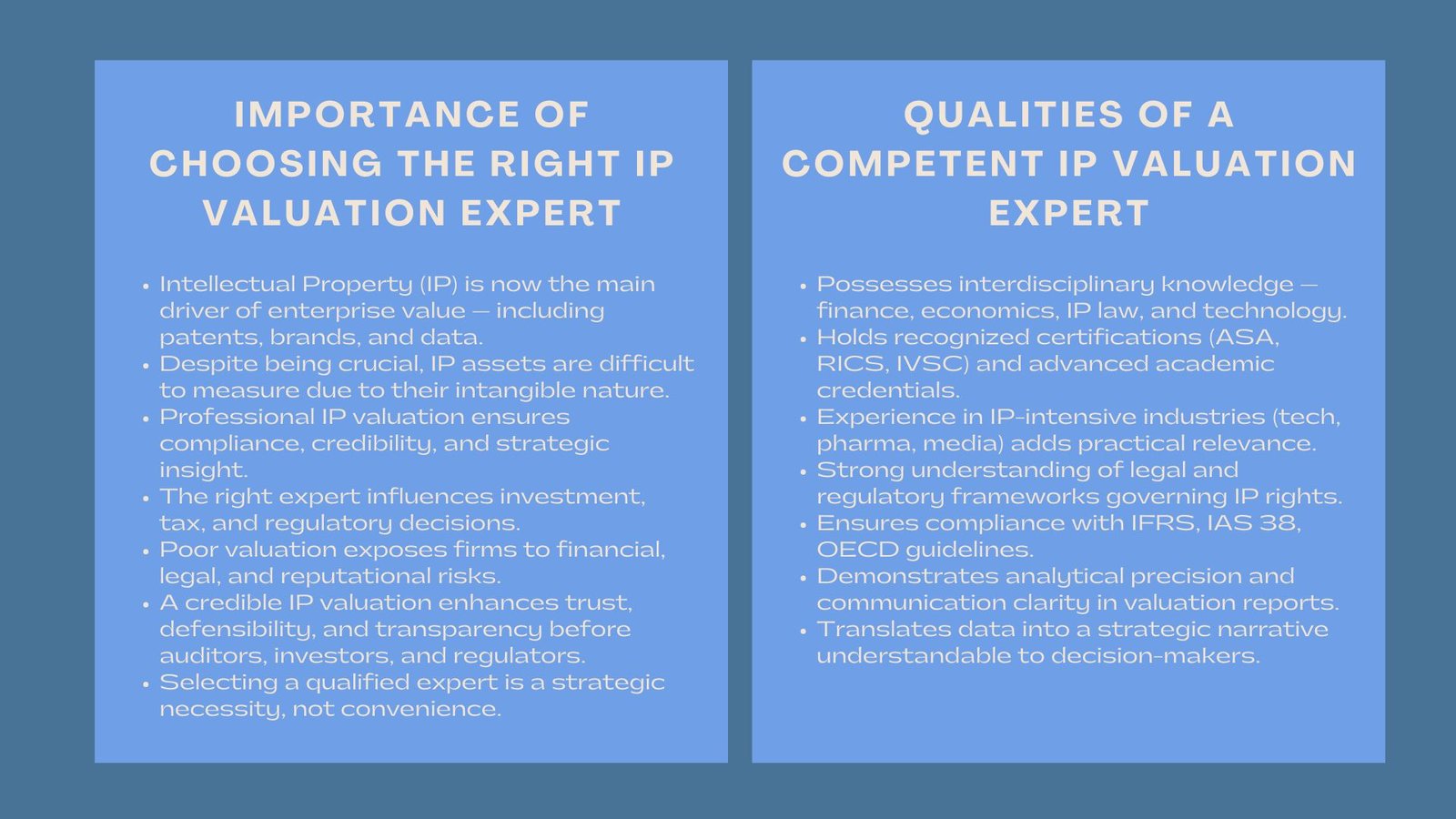
In the modern knowledge-based economy, intellectual property (IP) has emerged as a central driver of enterprise value. From proprietary technology and software to brands, patents, and customer data, intangible assets often account for the majority of a company’s worth. Yet despite their strategic importance, these assets are among the most difficult to measure and manage. This is where professional IP valuation becomes indispensable.
Selecting the right IP valuation expert or firm is not a matter of convenience—it is a matter of strategic necessity. A credible valuation can determine tax outcomes, influence investment decisions, and withstand regulatory scrutiny, while a poorly executed valuation may expose the organization to significant legal, financial, and reputational risks.
This article explores how to identify, evaluate, and select the right IP valuation professional or advisory firm. It highlights the qualities that define expertise, explains the key evaluation criteria, and discusses how to choose the right IP valuation firm in different business contexts—ranging from mergers and acquisitions to litigation and transfer pricing—shape the requirements for a qualified valuation partner.
The Importance of Expertise in IP Valuation
The Complexity of Intangible Asset Valuation
Unlike tangible property, IP does not have a clear physical form or easily observable market value. Its worth depends on a combination of legal enforceability, commercial potential, and technological viability. Moreover, the valuation methodologies—whether income-based, market-based, or cost-based—require specialized understanding of accounting, finance, intellectual property law, and economics.
An expert in IP valuation must therefore possess interdisciplinary competence. They must understand not only how to model discounted cash flows or determine royalty rates but also how to interpret licensing contracts, patent claims, or market comparables. This complexity makes it crucial for companies to engage professionals who specialize in the valuation of intangible assets rather than general business appraisers.
The Consequences of Inaccurate or Unreliable Valuation
An unreliable IP valuation can have severe consequences. Inaccurate figures can distort financial statements, lead to disputes with tax authorities, or misinform strategic decisions such as mergers or licensing deals. In litigation contexts, a valuation that lacks methodological rigor can undermine an entire case. Conversely, a credible, well-supported valuation provides defensibility, transparency, and trust—both within the organization and before external stakeholders such as auditors, investors, or regulators.
The right expert not only ensures compliance with relevant accounting and tax standards (such as IFRS 13, IAS 38, or OECD Transfer Pricing Guidelines) but also enhances strategic decision-making by revealing how intangible assets contribute to value creation.
Core Qualifications of a Competent IP Valuation Expert
Professional Accreditation and Technical Knowledge
One of the first indicators of a competent IP valuation professional is recognized accreditation or certification. Experts who hold credentials from organizations such as the ASA (American Society of Appraisers), RICS (Royal Institution of Chartered Surveyors), or IVSC (International Valuation Standards Council) are typically trained in standardized methodologies and ethical guidelines. Many also possess advanced degrees in finance, economics, or law, providing them with the technical foundation needed to handle complex assignments.
Beyond academic and professional credentials, practical experience in IP-heavy industries—such as pharmaceuticals, technology, and media—can be equally important. Familiarity with sector-specific valuation drivers allows experts to identify relevant comparables, assess competitive positioning, and anticipate market risks.
Experience with Legal and Regulatory Frameworks
IP valuation does not exist in isolation; it must align with the legal framework governing intangible assets. The expert must understand how patents are protected, how trademarks are enforced, and how licensing or transfer agreements are structured under relevant jurisdictions.
Moreover, regulatory compliance plays a critical role. Whether the valuation is conducted for financial reporting, taxation, or dispute resolution, it must meet the disclosure and documentation requirements set by governing authorities. An expert who can navigate both the financial and legal dimensions of IP ensures that the valuation withstands audit or legal scrutiny.
Analytical and Communication Skills
While technical ability is essential, the best valuation experts combine analytical precision with clear communication. Their role extends beyond number-crunching; they must interpret data, articulate assumptions, and explain complex valuation outcomes in ways that decision-makers can understand.
A strong valuation report not only presents calculations but also tells a coherent story about the asset’s role in the company’s value chain, its market potential, and associated risks. This combination of analytical depth and communicative clarity distinguishes professionals capable of transforming financial data into strategic insight.
Evaluating the Reputation and Reliability of Valuation Firms
Track Record and Industry Recognition
Reputation serves as a proxy for credibility. A valuation firm’s past engagements—particularly with reputable corporations, investors, or law firms—reflect its competence and trustworthiness. Companies should review case studies, client testimonials, and published reports to gauge the firm’s consistency and reliability.
Firms that have handled valuations for IPOs, mergers, litigation, or transfer pricing documentation typically possess the rigor and institutional knowledge necessary to manage complex IP assessments. Industry recognition, such as inclusion in professional associations or citation in regulatory proceedings, further reinforces credibility.
Independence and Objectivity
Independence is a cornerstone of any credible valuation. The firm or expert must maintain objectivity, free from conflicts of interest or bias toward the commissioning party’s financial objectives. Independence ensures that the valuation reflects true economic substance rather than managerial preference.
Professional ethics require that valuation experts disclose potential conflicts, avoid advocacy roles, and adhere to international valuation standards. Engaging an independent firm not only enhances transparency but also strengthens the valuation’s defensibility before auditors, regulators, or courts.
Methodological Rigor and Transparency
A competent valuation firm demonstrates methodological rigor by applying recognized frameworks and explaining every step of its analysis. Transparency in assumptions, data sources, and adjustments allows stakeholders to understand and evaluate the reasoning behind the numbers.
The use of well-documented models, sensitivity analyses, and scenario testing enhances confidence in the valuation’s reliability. In contrast, opaque or overly simplified approaches can raise questions about validity and objectivity. A high-quality firm welcomes technical scrutiny and provides clear justification for its conclusions.
Matching the Expert to the Business Context
Valuation for Mergers and Acquisitions
In M&A transactions, IP often represents a significant portion of deal value. The chosen expert must be capable of conducting valuations that satisfy both buyer and seller, aligning with purchase price allocation (PPA) standards under IFRS 3. The valuation must capture synergies, competitive advantages, and post-acquisition integration potential.
A specialist with experience in transaction modeling and negotiation dynamics can help identify which IP assets truly drive the acquisition’s premium. Their analysis supports not only financial reporting but also strategic decision-making during the due diligence process.
Valuation for Tax and Transfer Pricing
When IP is transferred between related entities or jurisdictions, the valuation must meet tax authority expectations and OECD’s arm’s-length principles. Here, the expert must possess deep understanding of international transfer pricing rules, local tax laws, and documentation requirements.
A firm that regularly prepares IP valuations for tax planning will be familiar with developing defensible pricing models, such as the Relief-from-Royalty or Profit Split Method. Their work ensures that intercompany transactions are both compliant and strategically efficient.
Valuation for Financial Reporting and Audit Support
For financial reporting purposes, valuations must comply with accounting standards such as IFRS 13 or ASC 820. The expert must understand how fair value is measured and disclosed, how impairments under IAS 36 are tested, and how amortization policies affect financial statements.
Additionally, collaboration with auditors is essential. A valuation firm that communicates effectively with auditors and provides well-documented assumptions can significantly reduce audit delays and mitigate disputes over asset recognition.
Valuation for Litigation and Dispute Resolution
In intellectual property litigation—such as infringement, breach of contract, or shareholder disputes—the valuation expert often serves as an expert witness. The ability to defend valuation methodologies under cross-examination is as critical as technical accuracy.
Experience in forensic analysis, damage quantification, and testimony preparation distinguishes valuation professionals capable of operating in legal environments. Their reports must be not only precise but also persuasive, aligning economic reasoning with legal arguments.
Technological Capabilities and Modern Tools
Use of Data Analytics and Automation
As IP valuation becomes increasingly data-driven, firms equipped with advanced analytical tools gain a competitive edge. Automation and artificial intelligence can enhance valuation accuracy by processing large datasets, identifying comparable transactions, and running predictive models.
For example, advanced modeling software allows sensitivity testing on royalty rates or cash flow projections in real time, reducing human error and improving transparency. A firm that invests in technology demonstrates both innovation and commitment to methodological integrity.
Integration with Digital IP Management Systems
Leading valuation firms are now integrating their processes with IP management platforms that track patent portfolios, licensing agreements, and market performance. This integration allows real-time monitoring of asset performance and facilitates more dynamic valuation updates.
Such systems improve efficiency and ensure consistency between valuation outcomes and ongoing IP strategy, making them invaluable for multinational corporations managing complex portfolios.
Assessing Cost, Scope, and Deliverables
Balancing Quality and Cost
While cost is an important consideration, selecting a valuation expert solely on price can be misleading. A lower fee may indicate reduced analytical depth, insufficient documentation, or lack of industry expertise. The focus should instead be on value for money—the balance between methodological rigor, credibility, and practicality.
A transparent engagement letter outlining scope, assumptions, deliverables, and timeline is essential. Clear communication about project milestones prevents misunderstandings and ensures that both parties align on expectations.
Deliverables and Reporting Standards
A comprehensive valuation report should provide detailed documentation of methods, assumptions, sensitivity analyses, and final conclusions. It must comply with applicable valuation and accounting standards and be presented in a format acceptable to auditors, tax authorities, or courts.
High-quality firms deliver reports that are not only technically sound but also visually structured and narrative-driven, making them understandable to non-specialist stakeholders. The ability to present complex financial reasoning in accessible language is a hallmark of professional excellence.
Long-Term Relationship and Strategic Alignment
Selecting an IP valuation firm is not a one-off decision; it often marks the beginning of a long-term advisory relationship. Businesses with recurring valuation needs—such as annual impairment testing, tax planning, or transactional advisory—benefit from engaging partners who understand their industry, strategy, and risk profile over time.
A long-term relationship fosters institutional knowledge, allowing the firm to provide not just valuations but also insights into market trends, regulatory developments, and strategic opportunities. The right partner becomes an extension of the company’s internal finance and legal teams, contributing to sustained value creation and compliance.
Conclusion
Choosing the right IP valuation expert or firm is both an analytical and strategic decision. It requires balancing technical proficiency, industry experience, independence, and communication skills. The ideal expert is not just a technician but a trusted advisor—someone who can translate complex valuation models into actionable insights and defend them under regulatory or legal scrutiny.
In a business landscape where intangible assets define competitive advantage, the credibility of a company’s IP valuation can influence everything from investor confidence to tax outcomes and litigation success. By engaging professionals who combine methodological intellectual property valuation expertise for IFRS and tax compliance rigor with strategic understanding, organizations ensure that their intangible assets are not only accurately measured but effectively leveraged for long-term growth and compliance.
Ultimately, the right IP valuation partner provides more than a number—they provide a foundation of trust, transparency, and strategic clarity in an economy where intellectual capital has become the true measure of enterprise value.