What Is Digital Asset Valuation in the AI Era?
As with every technological advancement, the definition of value for valuation professionals is changing. With each great advancement in technology, the way valuation professionals determine value has had to evolve. Today, Digital asset valuation is no longer limited to websites and domain names, software licenses, but also training data, model weights, algorithms, and proprietary AI pipelines that are seldom traded in any market. As more and more deals depend on assets that are not easily researched in a market database, digital intellectual property valuation is becoming as relevant to entry-level and mid-level professionals looking to enter an advisory career in accounting, finance or technology as traditional financial statement analysis. In this article, you’ll get a basic understanding of what makes digital assets so difficult to value in the era of AI, learn practical tips and real-life examples, and understand how AI intellectual property valuation services are evolving to support a new class of assets that just a few years ago didn’t exist in this capacity.
What Is Digital Asset Valuation and Why Does the AI Era Change It?
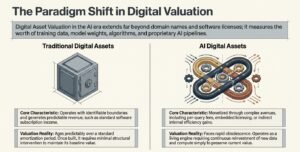
Digital asset valuation is the valuation of intangible assets that rely on technology, such as software, digital content, domain names, cryptocurrency holdings and more recently, AI systems. Up until now, the discipline was primarily concerned with assets that had more concrete income sources, like a mobile application that brings in subscription revenues or a database that is licensed to third parties. The core valuation methods – income, market and cost – were taken from the field of valuing traditional intangible assets, and applied with some minor modifications to reflect the nature of the digital asset for many years this toolkit was adequate as the majority of digital assets remained relatively predictable and behaved like products. The asset, however, has in fact changed in the AI era, because it is a trained machine learning model which has value only if it is trained on high-quality and legal data, has a high amount of compute power devoted to its training, performs well compared to similar models in development or training, and is not quickly surpassed by newer models. The model of monetisation of an AI asset is also different from the model of a conventional software license: some models involve fees per query, some involve a built-in software license within a larger product, and some involve indirect value creation – improving the underlying efficiency of large enterprises – which is making the first step of finding an appropriate valuation framework difficult.
This change is important because the AI systems exhibit properties of many of the old asset categories in one. They are similar to software because they can be licensed or incorporated into products; they are similar to data assets because their value is dependent on the data that can be used to develop them; and they are similar to research & development assets because there is an ongoing investment needed to keep them competitive, thus positioning them as a convergence of at least three traditional asset valuation approaches most professionals have been taught to treat separately. State-of-the-art models 18 months ago are now commonplace capabilities, and that presents an obsolescence threat that is not as prevalent in traditional software. In practice, the older intangible asset accounting frameworks remain relevant, but all of the assumptions made in those frameworks – including those relating to useful life, comparable market data, etc. – must be reconsidered in the context of an AI, not automatically assumed. Another mental model that is helpful for junior professionals is to visualise an AI system not much different from industrial equipment, a living asset that needs constant investments to maintain its operating level.
How Does Digital Intellectual Property Valuation Differ From Traditional IP Valuation?
In the traditional world of IP valuation, the valuation may involve patents, trademarks, and copyrights that are legally protected and have been extensively licensed in the past, where valuation professionals could find comparables in the market. In the era of AI, valuing IP is far more complex, especially since the legal framework for certain AI assets remains unsettled, with courts and regulators globally grappling with complex questions about ownership and its rapidly evolving technical landscape sometimes outpacing legal solutions. The defensibility of any valuation placed on the asset depends on questions that have been raised, such as training data is properly licensed, whether a model’s outputs infringe upon existing works protected by copyright, and whether a trained model can be protected as a trade secret or existing copyrighted work. A valuation professional cannot simply assume clean legal title as they can with a registered patent, and legal due diligence is now a much greater component of the valuation process for the earlier generations of digital assets. Some jurisdictions are still in the process of determining if specific uses of copyrighted material for purposes of training artificial intelligence are protected by the doctrine of “fair use” or if explicit licensing is necessary, with a valuation that would need to be repeated after the term of the transaction at which that jurisdiction reaches a conclusion.
The second is how the value of the AI development stack is distributed. In conventional IP valuation analysis, the typical unit of analysis is one patent or a trademark. In the context of an AI system, there are several different aspects to consider: value is inherent in the training data, in the architecture of the model, in the process of fine-tuning the model, in the underlying infrastructure, and potentially proprietary testing and improvement methodologies over time. This complicates the process of valuing digital intellectual property for AI assets, as this is often done by breaking the IP asset into its constituent parts and valuing each part individually, rather than considering the AI system as a single intellectual property asset as a valuation professional may do with a single trademark or patent family. Another advantage of this component based approach is that it allows a company to focus on the component that is actually creating the most value for them, which is typically the proprietary dataset, not the specifics of the architecture, as many are now available for general use, but well-labelled, unique datasets are still relatively sparse and more difficult to replicate.
What Are Five Key Steps in the AI Intellectual Property Valuation Services Process?
Experts providing or commissioning AI intellectual property valuation services typically go through a sequence of steps, as there is greater legal and technical uncertainty involved with valuing AI assets than most other types of intangible assets a valuation team will be asked to value. The five steps outlined below are some of the steps that many valuation teams take to systematically move from the legal confirmation to a number that can be justified. The five steps below illustrate some of the steps taken by many valuation teams to systematically progress from the legal confirmation to the defensible number rather than jumping straight to an output from a model.
First, understand the legal rights to the training data and the rights associated with the outputs of those models, as copyright or licensing disputes can significantly diminish the defensible value of an AI asset, and not just because of its technical merits. Second, make sure to record the technical details and performance benchmarks of the model and compare it to other models of similar sophistication, because performance relative to other models may be a more important value driver than sophistication of architecture alone. Third, determine its dependence on a specific team, vendor, or compute provider, since if a compute provider is acquired by another company, one or more AI models built using the tacit knowledge of a small technical team can lose a lot of value. Fourth, evaluate useful life appropriately, taking into account that AI models may experience faster depreciation compared to many traditional software, because of the constant improvements of other AI models and infrastructure that are already available. Fifth, choose a valuation approach or set of approaches that is suitable for the maturity of the asset: an income approach is suitable for mature AI systems that generate revenue; a cost approach and/or a market approach are suitable for earlier-stage assets where forecasting future cash flows would be highly speculative. One of the most frequent errors in a well-drafted valuation is to miss any one of these steps, especially the legal confirmation step. These five steps have become embedded in the engagement checklists of many valuation firms, rather than suggestions for best practice, as the minimum standard for any valuation engagement involving AI assets.
How Do Valuation Methods and Real Cases Show Digital Asset Valuation at Work?
The four general valuation methodologies have different assumptions and implications when valuing AI assets as opposed to traditional intangible assets and often can make the difference in the most important decision facing an AI valuation. The table below provides a summary of the way each method is applied in practice and the areas in which it is most likely to give rise to problems when valuing AI-related digital assets and should serve as an initial checklist prior to any formal engagement. Many valuation teams also have a running tally of what the final methodology will be for each of their engagements, as patterns can emerge by asset type and industry that can facilitate scoping conversations on upcoming engagements. A junior analyst who can explain not only the mechanics of each method but also why a senior analyst might reject it for a particular asset will move much quicker than one who knows only the mechanics.
Table 1: Digital Asset Valuation Methods in the AI Era
| Valuation Method | Best Suited For | Key Limitation |
|---|---|---|
| Income approach | AI models with clear, forecastable revenue streams | Relies heavily on uncertain future cash flow projections |
| Market approach | Assets with comparable licensing or transaction data | Few truly comparable AI transactions exist publicly |
| Cost approach | Early-stage models or proprietary training pipelines | Development cost rarely reflects true market value |
| Data-driven relief-from-royalty | Licensed datasets and trained model weights | Royalty benchmarks for AI assets remain immature |
For instance, imagine a medium-sized software business that bought a smaller startup in AI, mainly because of a computer vision model trained on custom manufacturing defect images from its own data gathered over the years. The acquiring company’s advisors found when valuing the company that some of the training data was licensed from a third party, but that the licensing agreement prohibits commercial resale, a fact that was not initially revealed in the initial negotiations. This discovery was made only after the valuation team asked for the data provenance record, a component of normal due diligence, which is now considered a necessary piece of documentation in any acquisition of AI, but was not always part of smaller technology transactions until quite recently. This meant that the valuation team had to discount the value of the model that it estimated, as they would have to retrain a part of the model with properly licensed data, which is normally not a consideration when valuing a physical asset or a registered patent. Ultimately, the final purchase agreement contained a resolution clause which would allow both sides to modify the price if the issue was resolved, rather than both parties walking away from a deal that would have been otherwise considered strategic to them.
Another example is an AI-powered media company that used AI IP valuation services to value a proprietary recommendation algorithm prior to planning a divestment. The valuation team started using an income approach, based on the value of the algorithm to user engagement and advertising revenue, but as part of due diligence, it came to light that a competitor had released an open source version with comparable performance at a much lower cost, causing a change in buyer sentiment, which resulted in re-negotiations of the asking price during the sale. This meant that the valuation team had to drastically reduce the assumed useful life of the asset and therefore the overall valuation, a reminder that competitive obsolescence risk is much greater in AI than in most other technology sectors – and should be incorporated into all assumptions for Digital Asset Valuation, not as an afterthought. The final agreed valuation also contained a shorter amortisation period than the draft report, in line with the increased rate of obsolescence of the underlying technology.
What Are the Benefits and Challenges of AI Intellectual Property Valuation Services?
Companies dealing with mergers, licensing, fundraising, and financial reporting needs will find these robust AI IP valuation services extremely valuable in implementing real strategy. By having a defensible valuation, management, investors, and acquirers can all have a valid basis for negotiations, avoiding the potential of disputes later on in a transaction once the performance or legal rights to an AI asset are better defined. Such valuations also contribute to improved internal decision-making – whether it is to continue with an in-house model, license a third-party version, or outright buy the competition, the clear-eyed view on the relative valuations drives better business decisions – not just based on technical interest. This is a set of skills that are unique to the finance industry and are becoming ever more valuable in investment banking, corporate development, and consulting, as finance professionals are exposed to such engagements. Companies that develop this skill will also enjoy a subtle recruiting edge as candidates will become more demanding in evaluating offers across similar advisory services, where experience with AI valuation is becoming a differentiator.
But the problems are large and still growing. Valuation professionals also must rely more on judgment than in the valuation of more traditional asset classes, as there are not many reliable market comparables since most transactions involving AI assets are private and generally do not include the same level of detail in the pricing of the assets. Rapid technology changes also make useful life assumptions difficult as today’s “state-of-the-art” technology might be obsolete within one year or two because other models get better. The valuation of training data and the ownership of that data are also uncertain, and as regulations evolve in various jurisdictions, a valuation that is “defensible” today may have to be reconsidered as the legal landscape becomes clearer. Another one that many smaller AI firms don’t often consider is talent risk, which can be a significant issue in the short term if major researchers leave after an acquisition, though it is more difficult to calculate than just a technology or data risk, but just as real. The practical solution for professionals entering this field is to make assumptions explicit and share them with the legal and technical team more often and more frequently than the usual timeframe for valuing traditional intangibles and to work closely with legal and technical professionals during the valuation process, rather than view it as a strictly financial undertaking. Another quick way for a young professional to learn to make good decisions in a profession where data is still relatively limited is to take a moment to reflect on previous evaluations and past experiences instead of going straight to the next one.
Conclusion
The digital asset valuation in the AI age requires a combination of traditional valuation expertise and a profound understanding of AI system construction, training and security. The bottom line for those developing a career in this field: If you consider each of your AI assets to be a combination of data, technical performance, legal standing, and human expertise, you must evaluate each one separately and then add them all together to arrive at a single number. By taking the time to understand the basics of digital intellectual property valuation, keeping up to date on the advancements of AI-based intellectual property valuation services, and cultivating strong professional relationships with legal and technical experts, early-career professionals can prepare themselves to tackle one of the most important and rapidly expanding valuation challenges of the financial sector. In a world where AI is being adopted in virtually every industry, the skill of credibly valuing AI systems will grow in importance to distinguish those who can simply use AI tools from those who can be trusted with the task of valuing them defensibly.