Why Trademark Valuation Matters for Business Owners?
As a business owner, you know that your company’s name, logo, and other distinguishing features can be one of your greatest assets – but one that you may not pay attention to. Business trademark valuation provides the owner of a brand with a defensible, fact-based valuation for the value of a trademark, which can be used for a variety of purposes, including for sale, for a trademark license agreement, for a loan application, or in court. Trademark valuation benefits are fundamental as stepping-stones to understanding the linkage between legal rights and financial statements, and between marketing choices and measurable returns, for professionals who are developing a career in valuation, finance, and/or brand strategy. The article walks through the concept of trademark valuation, how the trademark valuation service is usually engaged, the five steps most trademark valuation practitioners follow, and some of the challenges encountered in the process, providing practical tips for anyone advising and guiding a business owner to protect and monetize his or her brand.
What Is Trademark Valuation and Why Does It Matter for Business Owners?
Valuation of a trademark, defined as a registered mark or an unregistered mark, is an estimation of its monetary value, considering its potential economic value for the rest of its useful life. Registration is different from trademark, which gives legal ownership and the power to stop others from using a similar mark; valuation is a figure that can be placed on a balance sheet, put into a negotiation, or presented to a court. This distinction is important as many business owners believe that registering a mark helps them value the mark, whereas in reality it only registers the asset and not its value. Valuation of trademarks for business is a synthesis of three fields – intellectual property law, corporate finance and brand strategy – and practitioners often have to rely on expertise from each of these areas, from understanding how to read a trademark register and how to negotiate licensing agreements to understanding how to build discounted cash flow models and how to analyze research on brand recognition.
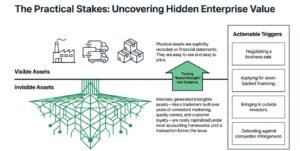
Business owners should take pride in the fact that they can expect to see a considerable difference between the thatched roof and the tiled one. A trademark developed over many years of consistent marketing, customer loyalty and quality control can constitute a significant portion of enterprise value not explicitly shown on the financial statements – most accounting frameworks do not require the capitalization of internally created intangible assets until a transaction is made that forces the accounting to take place. A documented, methodologically sound valuation is not a statement of “brand strength”, but a number that an owner can use to change the discussion when he is negotiating a sale, applying for asset-backed financing, adding an investor to the company or defending against a competitor’s application of a similar mark. For small and medium size businesses, this has a greater impact, as they tend to neglect how much of the purchase price a buyer will add to the brand as opposed to other tangible or inventory factors. For the junior professionals starting out in valuation or corporate finance, this is typically the first time they have gotten hands-on experience with this simple fact: Intangible value is real value even if it’s harder to see than a factory or a fleet of vehicles.
How Does Business Trademark Valuation Work in Practice?
In reality, business trademark valuation combines three popular methods each applicable to different situations and data availability. The cost approach is used when there is limited market and income data, and is typically applied to younger brands, where it is the cost of recreating the mark from the ground up, which involves the design, the registration, and the total marketing investment required to establish the same level of brand awareness with the targeted customer base. The market approach involves comparing similar transactions or licensing agreements in a similar category within the same industry; although it is difficult to find truly comparable information, in many cases, the terms of most licensing agreements are confidential between the parties. The income approach is normally the most defensible approach and is often used for established brands with a proven earnings history, where the future economic benefits the mark can be expected to generate are estimated and discounted to present value with an appropriate discount rate. Typically, more than one of these methods will be used together by most experienced valuers and not one at a time.
The most popular method in the income approach is the relief-from-royalty method, which is the way a trademark valuation service will use in this approach. It assumes a royalty that would otherwise have to be paid to a third party to license an equivalent mark, applies this royalty rate to forecasted revenue that can be attributed to the branded product or service, and discounts the stream of royalties to present value with a discount rate that reflects business risk and the risk involved in the mark itself. Determining a royalty rate usually entails a combination of looking at licensing rates in the industry, the market place where the mark is used and the competition and the length of the useful life of the mark (all of which requires professional judgment as much as it does data). It’s also important for the analysts to carefully project revenue and distinguish between the revenue that can be attributed to the trademark and revenue generated by other factors, such as pricing, distribution agreements, and unrelated product features, which are more common errors to make in a rushed valuation.
Five Steps in a Business Trademark Valuation Engagement
Most internal and external Trademark valuation engagements are essentially the same in terms of the process they go through—scoping, finalizing a written report. The five steps outlined below outline the process of a typical business trademark valuation project, from its inception to the completion of a defensible conclusion.
Table 1: Steps in a Business Trademark Valuation Engagement – Why Trademark Valuation Matters for Business Owners?
| Step | What Happens |
|---|---|
| 1. Define the Purpose | Understand the purpose for the valuation—whether it is for sale, financing, litigation or financial reporting—because it will affect the standard of value and valuation methodology. |
| 2. Gather Legal and Financial Data | Obtain trademark registration documents, licensing information, revenue by product line, and marketing expenditures specifically attributed to the trademark. |
| 3. Assess Legal and Market Strength | Evaluate the scope of registration, enforcement record, geographical extent and competition to ascertain the potential longevity of the mark’s value. |
| 4. Select and Apply a Valuation Method | Select the cost approach, market approach, income approach or a combination of these, depending on the data available and the purpose of the engagement. |
| 5. Document and Report Findings | Create a prepared document containing assumptions, calculations, and supporting evidence that will pass the audit, purchase, tax, and/or court test. |
What Are the Key Trademark Valuation Benefits for Growing Companies?
The most cited advantages of trademark valuations are related to decision making leverage. A documented valuation is a significant consideration for a seller’s negotiating strength and is useful for a buyer’s justification of the purchase price allocated to tangible assets, goodwill, and identifiable intangibles (including the trademark), if applicable accounting standards require it for representation in the valuation. In finance, lenders are now more willing to accept intangible assets as collateral, provided that the asset has a credible independent valuation, thus creating opportunities for asset-light and service-based businesses who have little or no tangible assets to offer as collateral. No matter if the company is licensing the mark to a franchisee or the company is negotiating to use the mark of another company, an independent valuation provides both parties with a common, defendable basis for royalty negotiations—not an instinctual setting or a precedent from another line of business.
For a mid-sized specialty foods company that had over a decade of regional brand-building behind it, the brand was a significant intangible asset that had been created internally over this timeframe and which had not been recorded on the books, consider how valuable it would be if it were acquired. Early on, when the founders started talking about selling the firm, the trademark itself was valued at a significant portion of the company’s enterprise value, in this instance, based on the price premium retailers were willing to pay for a place on their shelf for a product with the same production costs under the brand name as they would for a private-label version. The discovery had a major impact on the purchase price arrangement, as the acquiring company agreed to a higher purchase price overall and agreed to pay some of this purchase price as a continuing royalty based on the use of the brand in new product lines. One of the most obvious benefits of valuing a trademark in a real transaction is that it transformed an asset that was intangible and hitherto unrecorded into specific deal terms that could be referred to and defended by both parties.
Table 2: Trademark Valuation Benefits by Business Scenario – Why Trademark Valuation Matters for Business Owners?
| Scenario | Benefit |
|---|---|
| Mergers & Acquisitions | Supports purchase price allocation and strengthens negotiating position on deal value. |
| Financing & Lending | Gives lenders a documented basis to accept the trademark as partial collateral. |
| Licensing & Franchising | Establishes a defensible royalty benchmark for both parties. |
| Litigation & Disputes | Quantifies damages in infringement or dilution claims. |
| Financial Reporting | Supports intangible asset recognition during impairment testing or purchase price allocation. |
When Should a Company Engage a Trademark Valuation Service?
There are a number of factors that tend to motivate a company owner to seek out a trademark valuation service. Purchase price allocation typically represents the most common situation when mergers and acquisitions occur, as it involves identifying and separately valuing and disclosing identifiable intangible assets that are part of the acquired assets, such as trademarks. One of the more practical benefits of trademark valuation prior to licensing negotiations is the ability to conduct an independent royalty benchmark, whether it’s a company negotiating for the use of another mark or negotiating to license their own mark. There are many situations that require a formal valuation, each with its own standard of value and its own expectations of reporting, which a generalist accountant might not be able to apply. Some owners order valuations even when not a part of the transaction that generated it, because at some time they will have to fairly value their business assets—intangible assets in particular—to when they transfer ownership to a family member or to a management team.
Proper handling of a trademark valuation service can actually provide more than just a value. A credible engagement results in a written report documenting the purpose of the valuation, the standard of value applied, the data reviewed, the method used, and the reasons for all of the major assumptions and supporting data used to reach each conclusion, and then allowing the conclusions to stand up to scrutiny by auditors, counterparties, tax authorities, or a court years after the valuation report is issued. Valuers need to be familiar with financial modeling techniques, as well as the substance of trademark law, because the strength of a trademark and the breadth and history of its registrations and enforcement can impact the numbers that follow; a trademark that lacks any strong legal protection or history of disputes will not be worth the same as the same trademark with well-maintained, well-enforced rights. In the early years of a valuer’s career, asking a potential valuer how he/she would value a particular edge case in the business is a quick method to assess his/her competence or skills rather than going through a generic proposal.
What Challenges Arise During the Trademark Valuation Process?
One of the most longstanding problems in the valuation of trademark assets is separating the flow of cash generated by the trademark from cash flow generated by other intangibles like customer relationships, proprietary technology, or general goodwill, especially in a bundled acquisition where they are acquired as a part of the overall transaction. Comparable licensing transactions are also hard to find because the terms of a licence agreement are generally kept confidential, as well as because the range of industry benchmarks can be broad and is frequently dependent on factors such as exclusivity, territory, contract length and strength of the licensor’s other marks, meaning that valuers must use their professional judgment, as well as limited public data, to identify comparable transactions. A new analyst to this area will often use a generic royalty rate for the industry without taking into account the specific competitive position of the mark, and in so doing will either overstate or understate the resulting number, and consequently the credibility of the report.
The second set of challenges are those concerning assumptions underlying the income approach: choosing an appropriate discount rate that is fair to the risk of the mark and the underlying business; making reasonable assumptions regarding the forecast of income over a useful life; and adjusting for currency or market risk for a brand operating in multiple countries with varying growth prospects. The best trademarks are valued by two or more qualified trademark valuers who come up with two different, both defensible, valuations—these judgment calls can make a difference—and the most solid trademark valuation comes from the valuer who can provide transparent documentation of the assumptions of his valuation, not a simple number without context or workpapers. It is important to note that a brand value is not a one-off exercise as brand strength, competitive positioning and market conditions are constantly evolving, and what was calculated 5 years ago may not reflect the business today. One of the easiest things to pick up from companies that have been through the process multiple times is that they need to build in a regular review cycle.
Conclusion: Why Trademark Valuation Matters for Business Owners?
Trademark valuation is important to business owners because it provides a defensible, negotiable and actionable value for their brand’s reputation, not just a “goodwill. The lesson for the junior and mid-level valuation professional is that business trademark valuation is a regular, not a singular activity, and when a transaction, like a sale, financing, licensing negotiation, or dispute seems iminent, there is a “best time” to utilize a qualified trademark valuation service, and the data, such as licensing agreements, marketing expenditures and registration records, should be organized well before a valuation is actually required. When you do this over and over, you’ll reap the full benefits of what is often an intangible asset to your business, being able to value your trademark and unlock more of the potential benefits, including better deal terms, improved financing opportunities, and informed decisions on how to invest in your business’s brand.