How Customer Dependence Affects Technology IP Value
How Customer Dependence Affects Technology IP Value
The risk that is associated with a technology company’s revenue is not as evident as the numbers indicate, when the revenue is coming in from a small number of customers. The issue of dependency on customers and its effect on the value of IP related to technology is one that valuation professionals ask themselves on a regular basis, and it has an impact on both the cash flows that the asset is expected to produce, and on the discount rate that should be applied to such cash flows. The customer dependency effect on IP comes from discounted cash flow models, discussions regarding royalty rates, and through the valuation of technology assets in due diligence by acquirers. This article briefly addresses how a customer concentration may impact a technology’s value, how a technology’s value is driven by customer reliance on IP, and offers tangible examples of customer reliance on IP impacting valuation in the marketplace, and concludes with practical tips for junior and mid-level professionals to implement on their own. The goal of the objective across is to move from a general sense of “concentration is suspect” to a repeatable and defensible approach to measuring the impact of the risk on a valuation conclusion.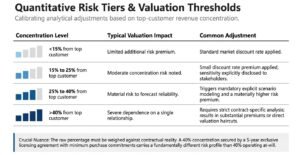
What Is Technology IP Customer Dependence and How Customer Dependence Affects Technology IP Value?
Technology IP customer dependence is when the majority of the revenue from a technology IP, which could be a software, patented process or proprietary algorithm, is derived from a single customer or group of closely-related customers. It is important for valuation since most technology IP is valued by the income approach – typically a discounted cash flow model or a multi-period excess earnings model, which both involve projecting future income streams an asset can generate. If it’s based on the good faith of one customer, then the predictive power of the whole model evaporates and the key question comes to the fore: What is the value of the technology IP if the customers can’t be relied upon? A valuer will typically first develop a revenue profile by customer for at least the past 3 years to hide a trend in one good year. Depending on the sophistication of the modeling that ensues, this mapping exercise is the key to all subsequent steps in the technology IP customer dependence assessment: if the technology owner doesn’t know where the money is going, then the rest of the modeling in the valuation process can fail. This effect is transmitted in two ways: cash flow forecast effect and the effect of the cash flow forecast on the discount rate. There’s a contractually agreed-upon and/or anticipated purchasing pattern, or there is a realistic possibility that the dependent customer will no longer make purchases, and in each of these scenarios, the revenue forecast will vary significantly. At the other end of things, a discount rate will be a premium to the base rate obtained from market data if the revenue is concentrated in a particular company as a risk factor. It is important to note that this premium is not a standard industry figure, but rather is a figure that two valuers might reasonably determine for the same property, based on their reasoning and evidence as they consider the facts of the dependent relationship, rather than the application of a “rule of thumb. The two changes make two similarly sized tech companies with the same revenue from the current year, worth vastly different amounts when technology IP customer dependence is added to the model—a type of judgment call that’s something junior analysts have to learn. Technology valuation firms with “repeatable” technology IP customer dependence valuation process have a higher likelihood of uniformity of results across valuation engagements on technology IP because they have a consistent language and similar thresholds for each engagement rather than utilizing a different set of criteria when a new technology asset is added to the desk.How Does Customer Concentration Impact on Technology Valuations in Practice?
The impact of the customer concentration on the valuations of the technologies is typically measured first based on two simple concentration ratios: Concentration ratio of the largest customer and Concentration ratio of the top 3 and 5 customers. Twenty to twenty-five percent from any one customer is typically a large risk flag and anything greater than forty percent is a big risk that must be modeled expressly—not half the risk premium. Exclusive 5 year contract with minimum purchase requirements and a customer where your contract is month-to-month and you don’t have to buy anything are very different exposures. A junior valuation professional asked the right questions when interviewing management – specifically what is the contractual reality of a concentration figure, because the percentage is not necessarily relevant to the appraisal of the actual dependency of the technology IP customer. Measuring the concentration impact on technology assets is not just about revenues, either: a large customer with high volume discounts could have a lower impact on the enterprise value than their revenue contribution. More often, the analysts will create a scenario model that shows what value the asset has in a “base case,” a “case where the number of the customer using the asset is reduced by a certain percentage,” and a “worst case” where the customer using the asset goes elsewhere.The analysts will usually develop a model, a scenario, that shows the value of the asset in a “base case” as well as a “case where the number of the customer using the asset is reduced by a certain percentage” and a “worst case” where the customer using the asset goes elsewhere, thus providing a range of values for the decision makers. In this manner, boards, acquirers and lenders will have a deeper understanding of the downside risk than they would from a single blended forecast, and it is increasingly becoming a prerequisite in technology transaction due diligence, particularly when the target is being acquired on the basis of its intellectual property, rather than its operating business. The consequence will be that, without doing so, the buyers will renegotiate purchase price after closing, when they realize there is risk of concentration, which will make the transaction a much bigger disruption for the seller and costlier for the buyer than it will be if concentration risk was identified and mitigated during the initial diligence phase.Table 1: Customer Concentration Impact on Technology IP: Risk Tiers
| Concentration Level | Typical Valuation Impact | Common Adjustment |
|---|---|---|
| Below 15% from top customer | Limited additional risk premium | Standard market discount rate applied |
| 15% to 25% from top customer | Moderate concentration risk noted | Small discount rate premium, sensitivity disclosed |
| 25% to 40% from top customer | Material risk to forecast reliability | Explicit scenario modeling and higher premium |
| Above 40% from top customer | Severe dependence on single relationship | Contract-specific analysis, substantial premium or haircut |
What Does Customer Dependency Impact on IP Look Like Across Different Deal Types?
If the valuation is to be done for a specific purpose, the dependency of the customer’s valuation of the IP will manifest itself in different ways. The dependence is mainly reflected in the discount rate in financial reporting, such as for impairment testing of capitalized development costs or acquired technology, and also in less-optimistic assumptions of useful life, as the auditors do not want to be overly optimistic on the churn of the customers. Identifiable dependency is often manifested in the reduction of the purchase price, e.g., if the core technology is priced by the acquirer, or as a change of the risk profile towards the seller, e.g., if earn-outs are used that are to be settled with the seller if the current customer does not renew the contract within a specific time frame after closing. If the licensor has a heavy dependence on a specific licensee, he may want to emphasise to the licensor in the rate negotiation that he is so dependent on the licensee that their loss will have a significant impact on the IP value reported by the licensor. So, some of the licensors negotiate longer contracts and minimum royalty floors expressly to mitigate the impact of valuation during an next round of financing or during sale. Also, it’s important to understand that reliance on customer tech value is not forever. A tech firm with two or three enterprise customers every year, and the anchor customer’s contribution to the top line slowly underperforming is different than a tech firm that has been underperforming over the past few years. Rather than just adding up one point in time, increasingly valuers are thinking about the trend of concentration, because a company whose concentration is clearly trending upwards will likely be in good shape and may be able to justify having a lower risk premium than the concentration percentage. Commercialisation is usually the best indicator of how the value of customers’ technology will change over the next 2-3 years, yet it is a detail that is picked up early in the career of a junior professional and is often not taught.What Five Steps Help Assess How Customer Dependence Affects Technology IP Value?
- Plot the revenue against customers with respect to time. When coming to a conclusion on concentration, it is important to start with a minimum of three years of revenue by customer schedule; one year may be a good year, the following year may be a bad year, and the third year may be good.
- Review contractual protection. Examine whether the dependent is tied to a multi-year contract with little or no obligations or ties or whether the dependent relationship is informal and at-will.
- Model multiple scenarios. Provide a base scenario, a downside scenario and a stop-loss scenario instead of a single blended scenario, which allows decision makers to see a range of scenarios.
- Make desired adjustment to the discount rate. Do not use a “one fits all” risk premium for all engagements, but rather a specific add-on based on the specific concentration level and the specific terms of the contract in the particular engagement.
- Don’t follow the snapshot, follow the trend. Simply work out the change in concentration over time – this will make a huge difference to the size of the risk premium.
What Real-World Examples Show About Customer Reliance Affecting IP Value?
Consider Voss River Analytics, a medium-sized data platform business with a predictive maintenance solution for a single, large logistics company, which provided approximately 60 percent of its revenue. The company has attempted to find investment elsewhere, and applied the idea of customer reliance to the value of the core technology, coming to the conclusion that while the core technology was an innovative one, it was not a technology that the company could value alone – as much of the company’s history was built around one customer relationship and no long term contractual lock in. Instead, the valuers present another story: The volume of the logistics customer will decline by half over the next two years—a less optimistic but more plausible story that results in a valuation for the technology that is nearly a third lower than a linear extrapolation of past growth. The company finally used this find to deflate its sales diversification strategy and re-enter the market 18 months later for a second round funding. Those who read the revised numbers later said they felt much more sure about the company’s second round projections than if it would have been a more rosy (unadjusted) forecast. There was also an anecdote about a company called Halden Robotics, that had developed an industrial sensor that was licensed almost exclusively to one supplier to the car industry for nearly 10 years. As an opportunity for a bigger industrial company to acquire Halden, the value of the dependent customer technology was found to be substantial, as approximately seventy percent of its licensing revenues came from the one automotive relationship, under a contract which was scheduled to expire within eighteen months of the proposed closing date. The acquirer, however, did not walk away, but instead structured it to have a contingent cash payment, if the impact of customer dependency on the IP would be similar to the terms of the existing license; and made the customer dependency impact on IP a tie to the consideration received by the acquirer’s shareholders. Both examples involve concentrated technology IP, but the benefits of that IP are highly dependent on the particular dependent relationship created, and how open the future access is to the benefits of that IP. In both situations, the parties that first encountered the underlying customer reliance that impacted IP value didn’t leave it as a last minute due diligence surprise but instead negotiated terms which both parties considered fair in light of the actual risk faced.What Challenges and Lessons Come With Dependent Customer Technology Value?
The most longstanding problem with dependent customer technology value is the ability to get reliable forward looking information about the dependent relationship itself, particularly where the relationship is fragile, and where the management isn’t keen on revealing the fragility of the relationship because it is of commercial value during a fundraising or sale process. However, during a live transaction a valuers must provide evidence to back up management’s optimism; this may include a record of contract renewals, letters to customers about the pricing negotiations and, if possible, direct communication with the customer’s procurement team. If there is no direct contact with the customer, smart valuers look for other clues that would suggest how well the customer and supplier relationship is doing: size of customer purchases in the last few quarters, any recent renegotiations of payment terms, or anything the customer says about their supplier consolidation efforts in the public press. Another challenge is that the value of concentration risk may overlap with the actual technical merit of the technology, meaning that a wrong answer could be given if a concentration flag is ignored because of the value of the underlying technology and/or if the value of the underlying technology is ignored because of the concentration flag. One of the more difficult judgements which technology IP valuation practitioners have to make regularly is determining the value of the customer’s dependent technology. This skill becomes more developed over multiple engagements, during which the first, less rigorous, evaluation of the value of dependent customer technology is either much greater or much less than hoped. The most apparent lesson to be learned by those who have been doing it for a while is that they must explain the risk and quantify it, not bury it in one discount rate figure that the reader must figure out. The scenario range, as well as the facts to be considered in determining customer dependency impact on IP conclusion identifies a basis for boards, auditors and acquirers to make their own IP conclusion and reduces the risk of any disputes following acquisition. They also learn that they can’t only wait for the finance department of a company to tell them, but by getting into direct contact with the sales and account management departments, they will often find indications of a dependent relationship that won’t be found in any regular financial data room. Lastly, the same concentration assumptions are re-evaluated at every valuation date, as opposed to continuing with a previous assumption without it being reevaluated as the business evolves over time. Table 2: Common Challenges From Customer Dependency Impact on IP and Practical Mitigations| Challenge | Practical Mitigation |
|---|---|
| Management understates relationship risk | Corroborate with contract history and independent evidence |
| Concentration masked by strong current revenue | Build a multi-year revenue-by-customer trend line |
| Single blended forecast hides downside risk | Present base, decline, and termination scenarios |
| Discount rate premium applied inconsistently | Tie the premium explicitly to concentration level and contract terms |
| Conclusion not revisited over time | Reassess concentration and trajectory at each valuation date |