Strategic IP Valuation for Licensing and Franchising
IP Valuation for Licensing, Franchising, and Royalty Agreements
Introduction to Strategic IP Valuation for Licensing and Franchising
Intellectual property (IP) is currently an influential instrument of value creation and business growth in the modern global economy. Corporations no longer base their business on tangible products or services, but instead, they are using their intellectual assets, patents, trademarks, software, and proprietary know-how to create brand ecosystems, attract investors and generate recurring revenue. Licensing, franchising and royalty are some of the best means of monetizing these intangible assets. IP valuation has a very significant role in identifying fair compensation, structuring agreements and adhering to accounting and tax standards in these models. In the case of licensing patented technology, franchising of a retail brand or even negotiating a music royalty, it is important that both the licensors and the licensees know how to quantify the economic value of IP.The Intellectual Property Strategic Significance of IP Valuation in Business Contracts.
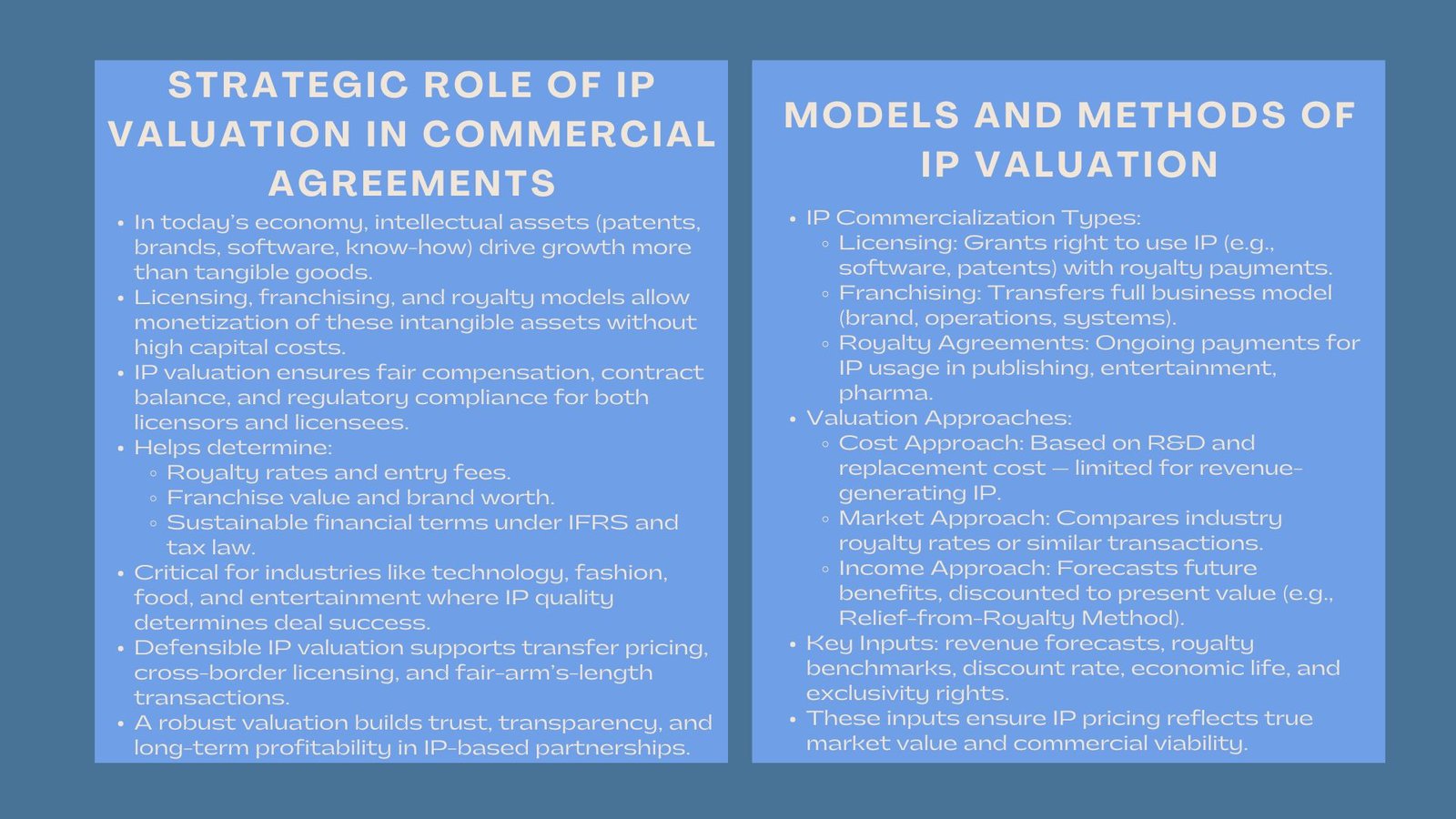
Licensing and franchising not only help companies to grow without excessive capital outlay, it also gives others an opportunity to access established intellectual property. These deals are typical in industries – in technology, fashion, food service, entertainment and are dependent on the quality of the IP at hand. Valuation offers the basis upon which royalty rates, entry fees and terms of contracts are set. It makes sure that the deal is a fair trade between the parties, with the risk and the reward of using IP being even. To licensors, a strong valuation ensures that the licensor is not undervalued; to the licensee, it ensures that they do not pay a high price when the returns of the rights are unlikely to be realised. Precise IP valuation also assists companies in accounting, taxing as well as transfer pricing. The regulatory authorities tend to examine the transactions of the cross-border licensing to affirm the arm-length pricing and as a result, defensible valuations are a compliance criterion and not a ritualism.Knowledge of the IP Monetization Models.
The three types of IP commercialization, which include licensing, franchising and royalty agreements, are associated with different structures and valuation.Licensing
Licensing entails transfer of rights to use an IP property by another party, within a given market or during certain times. This can be in the form of software licenses, music rights, and transfers of technology. The licensor retains ownership and gets royalties on a sales, use or fixed basis. What IP valuation in such cases would be is not only the initial license price, but also the continued royalty rates that reflect the IP contribution to revenues of the licensee.Franchising
Franchising extends beyond the IP usage, and entails transfer of an entire business model. It consists of trademarks, brand identity, operating systems and proprietary processes. The franchisee will have the advantage of a ready brand and a working business structure whereas franchisor will enjoy unending revenue through franchise charges and royalties. Franchising ought to be valued as both tangible and intangible, including brand name, loyalty of customers and consistency of operating standards.Royalty Agreements
Royalties are used to stipulate payments to be paid to the owner of an IP asset regarding the further use of the asset. These agreements occur in the entertainment, publishing and pharmaceutical industries. Royalty valuation is concerned with the projection of future cash flows of the IP and the conversion into present value by applying an appropriate discount rate. The result of this is whether the royalty rates will prove to be commercially viable and sustainable in the long run.Widespread Methods of IP Valuation.
Commercial agreements generally use IP valuation using one of three approaches that have been determined market, cost, and income. The selected approach will rely on the availability of data, the nature of the transaction, and the nature of assets.Cost Approach
The cost method calculates the value of IP using the cost one must pay to recreate or to substitute. This is in terms of research, development and testing, which has been adjusted to obsolescence and inefficiency. Although this method is simple, the earning potential of the IP is not always well reflected, and as such, it is not preferred when dealing with revenue-generating assets such as trademarks or franchises.Market Approach
The market approach is used to establish a value based on similar IP licensing or sales. To come up with indicative market rates, analysts will evaluate royalty levels, licensing transactions and industry transactions. The approach is particularly applicable to those industries, where the information about deals is transparent or there are formed royalty standards. Many practitioners apply market-based IP valuation analysis for franchise royalty benchmarking to align their findings with industry averages and ensure fair and competitive pricing in contractual negotiations.Income Approach
The income approach measures value based on the future economic benefits attributable to the IP. It involves forecasting cash flows — typically in the form of royalties or cost savings — and discounting them to present value. Among its variations, the relief-from-royalty method is the most widely used for licensing and franchising scenarios. It calculates the hypothetical royalties a company would pay to use the IP if it did not own it. Valuation experts often employ income-based royalty rate determination for IP licensing and franchising agreements to ensure that the rates accurately reflect the IP’s profit-generating capacity and align with both business strategy and compliance standards.Important Data and Considerations of inputs.
Strong IP valuation is based on sound data and sound assumptions. It is not only that analysts have to know the asset itself, but also its market position, the driving forces behind its revenue, and its lifecycle.- Revenue estimates: The key value driver, which is the anticipated performance of the product or service within the scope of the licensing or franchise arrangement.
- Royalty rates: Benchmarked based on industry data or similar transactions to make sure that it is in line with the market norms.
- Economic life: The term economic life indicates the duration that the IP will remain economically useful, and this could be less than the period of its legal protection.
- Discount rate: It is a factor that includes the risk of the business, and the volatility of the industry, as well as the cost of capital incurred by the licensee.
- Territory and exclusivity: The more rights are awarded, the bigger and more exclusive they are, the greater the IP value is likely to be.
Difficulties in IP Valuation to License and Franchise.
Although it is essential, the IP valuation of commercial deals is a complicated task in nature. Data on the market might be insufficient, especially a niche market or a new technology. The terms of contracts, territories, and royalty arrangements appear to have differences and consequently, true comparables are hard to discover. Additionally, the forecasting of revenue streams in the future needs not only quantitative model to be performed, but also profound knowledge of the market trends and brand development. The other most frequent difficulty is the separation of the value of interrelated assets. In franchising, as an example, a trademark can be confounded with proprietary training systems or a relationship with the customers. The valuation professionals have to separate the contribution of each component and still make it logical and supportable as a whole.Implications of Regulatory and Accounting.
The IP valuation is also important in financial reporting and tax. In connection with transfer pricing rules, transactions between related parties, including licensing agreements, within a multinational setup are to be undertaken at arm-length. supportable valuations with officialized procedures can assist companies to meet documentation requirements and evade penalties. In financial reporting, both IFRS and US GAAP give a guide on the impact of licensing and royalty agreements on the revenue recognition, amortization and impairment testing. Distortion of earnings and audit problems can be triggered by misstating IP values or royalty rates. Thus, to achieve both commercial and regulatory standards, companies usually involve independent valuation professionals who conduct objective and transparent valuations.The IP Valuation and IP Strategy in IP negotiation.
In addition to compliance, IP valuation increases bargaining positions. A licensor who has credible valuation information will be in a position to defend its pricing policy whereas a prospective franchisee will be able to determine whether the returns are worth the investment as projected. Valuation also guides strategic choices – i.e. in expanding to new markets, in changing royalty rates, or in renewing franchise terms. In the competitive world, one can see the economic potential of intellectual property to have some clarity and leverage. Companies that protect and appreciate their IP resources efficiently are also in a better position to make arrangements that enhance sustained growth and partnership.Conclusion
IP valuation is at the point of intersection of innovation, strategy, and finance. It also makes intellectual property very well monetized in a fair, transparent and sustainable manner in licensing, franchising as well as royalty agreements. Through adequate principles of valuation, regulatory standards and basing decisions on market and financial evidence, businesses may discover the full potential of their intangible assets, as well as reduce risk. At a time when ideas become the center of enterprise value, the skill of measuring, pricing and negotiating IP in effect is not an accounting practice: it is one of the foundations of contemporary business success.Frequently Asked Questions
Q1. What is IP valuation for licensing and franchising?
IP valuation for licensing and franchising is the process of determining the economic value of intellectual property assets such as trademarks, patents, software, proprietary systems, and know-how that are being commercialized through licensing or franchise agreements. The valuation helps establish fair royalty rates, franchise fees, and contract terms that reflect the true value of the intellectual property.
Q2. Why is IP valuation important in licensing and franchising agreements?
Accurate IP valuation helps licensors and franchise owners receive appropriate compensation for their intellectual property while ensuring that licensees and franchisees pay commercially reasonable fees. It also supports contract negotiations, financial reporting, tax compliance, transfer pricing requirements, and long-term partnership sustainability.
Q3. What valuation methods are commonly used for licensing and franchising?
The most commonly used approaches are the Income Approach, Market Approach, and Cost Approach. In licensing and franchising transactions, the Relief-from-Royalty Method is particularly popular because it estimates the value of intellectual property based on the royalties a company would otherwise have to pay to use the asset.
Q4. What factors influence royalty rates and franchise fees?
Several factors can affect royalty rates and franchise fees, including the strength of the intellectual property, brand recognition, market demand, exclusivity rights, geographic territory, expected revenue generation, competitive positioning, economic life of the asset, and the level of support provided by the licensor or franchisor.
Q5. How can strategic IP valuation benefit businesses?
Strategic IP valuation helps businesses maximize the value of their intellectual property, negotiate stronger licensing and franchising agreements, attract partners and investors, support regulatory compliance, and create sustainable revenue streams through royalties and franchise arrangements. It also provides a defensible foundation for commercial decisions involving valuable intangible assets.