The Role of IP Valuation in Transfer Pricing and Cross-Border Transactions
A Practical Guide for Tax, Finance, and Professionals
Introduction to IP Valuation in Transfer Pricing and Cross-Border Transactions
In cases where a multinational enterprise (MNE) licenses a patent to a subsidiary in a foreign country, transfers its intellectual property to a holding company in a different jurisdiction, or engages in a cost-sharing agreement to share technology developed jointly, it has a seemingly complicated dilemma: what is that IP worth, and how should that value be priced between related parties? The response lies between two extremely specialised fields, intellectual property valuation and transfer pricing, and a wrong answer can have a tangible impact, whether in large-scale tax adjustments and penalties or years-long and costly cases on double taxation.
Transfer pricing, the term IP valuation is used to describe the process of setting the market price that intellectual property, such as patents, trademarks, software, trade secrets and know-how should be transacted or licensed between entities within the same corporate group. These transactions are closely monitored by tax authorities worldwide since MNEs are not only motivated but also enabled to transfer profits to low-tax havens by manipulating the price at which IP is transferred or licensed. Making a defensible, well-documented valuation is thus not merely a technical undertaking – it is a business-critical risk management task.
The article is intended to be read by practitioners in the field of finance, tax, and law who are developing their knowledge of the determination and defence of IP value in an international setting. Be it intercompany pricing policies, assisting in a tax audit, or giving advice on an IP restructuring, or planning a career in transfer pricing advisory, the structures, examples, and practical advice in this article will get you through one of the more technically challenging fields of international tax and valuation practice.
Why Intellectual Property Valuation Is Critical in Transfer Pricing
Transfer pricing is a set of rules that regulates the prices at which members of a multinational group buy and sell goods to each other. Those prices are to be based on the price that would be agreed under similar conditions by independent parties, according to the internationally recognised arm’s length principle by the OECD. In the case of tangible goods, it is usually easy to do so – market prices give a good reference point. In the case of intellectual property, though, the situation is quite different. IP is unique in its nature. There is no such thing as two identical patents, and the worth of a trademark or trade secret cannot be taken out of the context of a particular business.
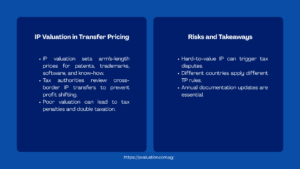
This peculiarity renders cross-border intellectual property valuation especially problematic between MNEs and tax authorities. Whenever a pharma firm sells a blockbuster drug patent to a subsidiary in a low-tax jurisdiction, or when a technology platform sells its core algorithm to a regional player at a small royalty rate, tax authorities in the higher-tax jurisdiction will wonder whether the price actually reflects arm-length value. The Base Erosion and Profit Shifting (BEPS) initiative of the OECD, especially Actions 8-10 and Action 13, was specifically created to bridge the gap between the location of IP value creation and payment, the results of which must be proven by MNEs to reflect true economic substance.
To practitioners, this regulatory landscape implies that the quality of IP valuation documentation is not just a compliance formality – it is the front line of defence during a transfer pricing audit. An appropriately prepared valuation report with recognised methodology and backed by current evidence of the commercial nature of the IP can withstand criticism. An ill-recorded or internally incoherent valuation, however, begs correction – and in most jurisdictions, punishment on top of the tax levied. Learning to compute the mechanics of IP valuation for transfer pricing is thus a key skill to be acquired by a person involved in international tax, treasury, or corporate finance.
5 Key Steps in Cross-Border IP Valuation for Transfer Pricing
Setting a defendable arm-length price in relation to an IP transaction is a complex task that employs a legal, economic and technical analysis. The five steps that follow are a best practice as seen in key tax jurisdictions and are consistent with the OECD Transfer Pricing Guidelines to Multinational Enterprises and Tax Administrations.
Step 1: Conduct a DEMPE Analysis for Intellectual Property Ownership
The deal team must know which entities in the group actually do the work, accept the risk and provide the assets that relate to the IP before any pricing can be determined. These activities are outlined in the OECD framework with the acronym DEMPE: Development, Enhancement, Maintenance, Protection, and Exploitation. A party holding only a legal title to an IP asset and not engaging in any of the DEMPE functions or bearing no economic risk is not entitled to most of the returns. These activities are mapped to particular legal entities via the functional analysis, and it is on the basis of this that all the pricing decisions are made.
Step 2: Identify and Classify Intellectual Property Assets
IP is not uniformly treated in transfer pricing. The OECD separates trade intangibles (those which are directly related to commercial products or services, including patents and software) and marketing intangibles (including trademarks, customer lists and distribution networks). The categories might be subject to varying pricing practices, royalty benchmarks, and regulatory treatment. Before anything is done in terms of valuation, a well-defined and detailed IP register, which identifies each asset by legal owner, economic owner, useful life and commercial purpose, is needed.
Step 3: Select the Right Transfer Pricing Method for IP Transactions
The OECD has identified five major transfer pricing methods, each having varying applicability to transactions involving IP (see Table 1 below). In case of unique, high-value intangibles, the profit split method or the corresponding uncontrolled price (CUP) method used in royalty benchmarks is most widely used. The transactional net margin method (TNMM) or cost plus can be suitable in case of routine IP functions, e.g. contract R&D or distribution of licensed products. The choice of method is not a mechanical science; it involves professional judgment based on the facts of the particular transaction and the existence of good comparables.
Step 4: Apply IP Valuation Methods to Determine Arm’s Length Pricing
After picking a method, the valuer uses quantitative methods to come up with an arm ‘s-length price or range. In royalty transactions, the relief-from-royalty methodology–where the value of the present value of avoided royalty is computed by calculating the value of the royalties paid to own, less the value of the same amount paid to license the IP–has been well established as a strong methodology by tax authorities and the courts. In cases of lump-sum IP transfers, the most common tool is a discounted cash flow (DCF) model, which estimates the economic contribution of the IP at its useful life. An important issue in valuing intellectual property across borders is how the hard-to-value intangibles (HTVIs) should be valued- assets in which the future cash flows are very uncertain at the time of transfer. Tax authorities can seek to reinterpret the ex ante pricing of HTVIs on ex post evidence (actual results), so it is imperative to incorporate contingent payment mechanisms or adjustment clauses into the intercompany agreements under the OECD guidance.
Step 5: Prepare Transfer Pricing Documentation and Defend the Valuation
The last and, in practice, continuing commitment is to keep contemporaneous records that substantiate the pricing position adopted. Most of the OECD-aligned jurisdictions now demand MNEs sufficient in size to prepare a Master File (describing the global group), a Local File (describing local IP transactions) and a Country-by-Country Report(CbCR). Companies can also enter into an Advance Pricing Agreement (APA) with one or more tax authorities in transactions involving high risk to agree on a specified methodology to follow over a specified time, dramatically lowering the audit exposure.
Table 1: Best Transfer Pricing Methods for Intellectual Property Transactions
| TP Method | How It Works | Best Used For | Key Limitation |
|---|---|---|---|
| Comparable Uncontrolled Price (CUP) | Comparisons of the intercompany price to the prices in similar third-party transactions | Royalty fees on licensed IP in case of benchmark data. | Close comparability is required; little data on unique IP. |
| Profit Split | The group profits are allocated according to the contribution made by each entity towards value creation. | Very integrated operations or collaboratively developed IP. | Subjective factors of allocation; complicated documentation. |
| Transactional Net Margin (TNMM) | Makes comparisons of net profit margins of the tested party with those of similar independent companies. | Routine IP, distribution or manufacturing entities. | Not as appropriate for high-value, unique intangibles. |
| Cost Plus | Adds a mark-up to the cost of developing or maintaining the IP | Cost-sharing agreements in R&D; contract research. | Undervalues commercial success of IP. |
| Residual Profit Split | Assigns regular returns initially, followed by sharing of leftover profit of distinct IP contributions. | Complex MNEs with high levels of IP ownership. | Needs trusted UIP contribution recognition. |
Process Flow 1: Step-by-Step IP Transfer Pricing Documentation Process
| Phase | Key Activities | Responsible Party | Output |
|---|---|---|---|
| 1. Functional Analysis | Map value chain; determine who does IP development, enhancement, maintenance, protection, and exploitation (DEMPE) functions. | Tax / Transfer Pricing Team | DEMPE Function Map |
| 2. IP Identification & Classification | Record all intangibles; differentiate between trade intangibles and marketing intangibles; verify legal ownership vs. economic ownership. | IP Counsel + Tax Team | IP Register with TP Classification |
| 3. Benchmarking & Comparability | License databases (RoyaltyStat, ktMINE, BvD); filter by similar royalty rates; make comparability adjustments. | Transfer Pricing Advisor | Benchmarking Report |
| 4. Valuation & Pricing | Select TP method; model length range of arm; record assumptions and sensitivity analysis. | IP Valuer + TP Specialist | IP Valuation and TP Policy Report |
| 5. Documentation & Filing | Make Master, Local, and Country-by-Country Report, and revise intercompany agreements to show pricing. | Tax Compliance Team | TP Documentation Package |
IP Valuation Techniques Used in Transfer Pricing
The income method – especially the discounted cash flow and the relief-from-royalty methods – prevails in IP valuation to a transfer pricing practice on a simple account: it relates the worth of the IP to the economic value it brings, which is exactly what arm-length pricing is intended to capture. In the relief-from-royalty approach, the valuer predicts the revenues that the IP is likely to generate, uses a market-determined royalty rate, discounts the cash flows generated by this, and comes up with a present value. This amount is what an outsider would pay to purchase the IP in full – and, through the intercompany transaction, what the intercompany transaction should capture.
One of the most practically challenging areas of cross-border intellectual property valuation is the sourcing of reliable comparables of royalty rates. To find third-party agreements that are more or less similar in terms of industry, geography, IP type, and commercial terms, practitioners usually use commercial licensing databases like RoyaltyStat, ktMINE and the licensing module of Bureau van Dijk. In reality, perfect comparability is hardly ever attainable, and the valuer has to make adjustments to reflect the difference in exclusivity, geographic coverage, duration and the relative bargaining power of the parties. Those modifications demand not only technical skills, but logical professional judgment as well – and have to be properly documented to be resistant to regulatory attack.
The profit split technique is especially worthy of consideration due to its increased popularity in situations where the global value chains are highly integrated. In situations where two or more related entities contribute significantly, non-routinely, to the value of an IP asset, such as a parent and a regional centre jointly developing and exploiting a platform algorithm, the profit split allocates the group profit on a relative basis. The keys allocated (relative R&D expenditure, headcount, or sales) have to be shown to relate to real value creation and are often questioned in an audit. Properly done, though, the profit split can yield a result that is economically sound and practically justifiable.
Real-World Transfer Pricing Cases Involving Intellectual Property
The case between the United States Internal Revenue Service and Coca-Cola is one of the most educational and most researched cases in the history of transfer pricing and IP valuation. The IRS re-examined over a multi-year period the transfer pricing of Coca-Cola with its overseas manufacturing units, claiming that the royalty rates charged on the use of Coca-Cola formulas of beverages, trademarks, and know-how were less than arm’s-length. The case, which was tried in the US Tax Court, is an example of how an intercompany pricing, which the company has used for decades, can be contested when it fails to represent the entire economic worth of the transferred IP. The result supports the lesson historically, pricing is not a defence to a transfer pricing adjustment per se.
The other landmark case is the fight between the IRS and Amazon, which involved an agreement based on cost sharing that Amazon had signed in 2005 to transfer IP to a Luxembourg subsidiary. The IRS appealed the buy-in payment Amazon paid at the time of the transfer based on the fact that it heavily understated the value of the intangibles contributed, especially the platform technology, customer relationships, and brand goodwill that Amazon had built up during its initial years. The case brought a number of key lessons to practitioners: the need to document all contributions to IP value at the time of transfer, the risk of transferring a fast-growing IP prior to the commercial potential of the IP becoming clear and the examination that tax authorities will bring to bear in the event of an IP migration between a low-tax jurisdiction.
The state aid inquiries by the European Commission into IP arrangements by large technology firms, such as those of Apple in Ireland and those of Fiat in Luxembourg, further complicated the cross-border intellectual property valuation. Such cases indicated that the concept of transfer pricing is not just a two-way affair between a business and a national tax collection agency, but in the context of EU competition law, most outcomes of favourable tax decisions may be considered state aids, which are prohibited. To practitioners, the message is simple: the regulatory climate of IP-intensive cross-border structures has become much more restrictive, and valuations that may have passed the test ten years ago are not likely to pass the test today.
Table 2: Common Risks in Cross-Border IP Valuation and How to Reduce Them
| Risk Area | Description | Jurisdiction Example | Mitigation Strategy |
|---|---|---|---|
| Comparability Gap | Absence of really similar third-party licensing information of unique IP. | Global (all MNEs) | Apply more than one TP technique; record functional analysis. |
| Regulatory Divergence | The arm length standards or methods used by different countries differ. | US vs. EU vs. India | Use local tax advisory; keep track of BEPS legislation. |
| Hard-to-Value Intangibles | Cash flows that are not known in future at the time of transfer; HTVI rules are applicable. | OECD member states | Employ ex ante pricing and contingency payment clauses. |
| Withholding Tax Exposure | International royalty payments can be subject to withholding taxes. | India, Brazil, and many emerging markets | Check on treaties on taxation; reflect on IP holding structure. |
| Documentation Gaps | Inability to record pricing reasons at the current time. | Germany, Australia, Canada | Upkeep Master File, Local File and CbCR according to BEPS Action 13. |
Process Flow 2: Cross-Border Intellectual Property Transfer Process
| Step | Activity | Key Consideration |
|---|---|---|
| Step 1: Pre-Transfer Planning | Determine tax consequences of the IP transfer or licence proposed; determine exit taxation, withholding tax and exposure to HTVI. | Hire tax and legal counsel at the start; not to be implemented until pricing is finalised. |
| Step 2: IP Valuation | Independent valuation based on income (DCF or relief-from-royalty), done by commission; assumptions in the documents. | The valuation should consider the arm’s length pricing during transfer. |
| Step 3: Intercompany Agreement Drafting | Redraft or renew the licence agreement, cost-sharing agreement or IP assignment agreement between related parties. | Consent should be in accordance with the real behaviour of the parties and economic sense. |
| Step 4: Advance Pricing Agreement (APA) (where applicable) | Request APA to the other applicable tax authority to lock in the agreed TP methodology and price over a certain period. | APAs decrease the risk of audit but necessitate a lot of documentation and time to negotiate. |
| Step 5: Annual TP Review & True-Up | Compare actual with forecasted outcomes; make changes to prices within arm’s reach where necessary; revise documentation. | The second most common audit trigger is failure to keep up-to-date documentation. |
Common Challenges in Cross-Border IP Valuation
A major issue which remains in the transfer pricing of ip valuation is the treatment of hard-to-value intangibles. A firm that sells IP early in its development- prior to commercial success has been achieved- makes estimating future cash flows very uncertain. OECD BEPS guidance is increasingly enabling tax authorities to examine ex post outcomes and compare them against the forecasts that were used to determine the initial prices. In case the actual revenues are far higher than predicted, the authority can find that the IP was underpriced at the time of transfer leading to an adjustment. The other way in which companies can safeguard themselves is by creating price adjustment or contingent royalty structures in the intercompany agreement, where they share upside with the transferor entity in case performance is higher than anticipated.
The second crucial issue is the divergence between jurisdictions in the way they implement the arm-length principle and the types of methods they consider to be appropriate in the context of transactions in IP. The United States, as an example, has its own commensurate-with-income standard in Section 482 of the Internal Revenue Code, which permits the IRS to periodically adjust to actual income earned on transferred IP – a criterion that can vary from the OECD standard in significant aspects. India and Brazil have actively used more prescriptive regulations that restrict the approaches to taxpayers. Germany and Australia have special anti-avoidance measures against IP migration. The company that has to work in all these jurisdictions should negotiate an actually complicated system of regulations, and a pricing strategy that will be described as reasonable in one country may not be accepted in another one.
Lastly, the practical issue of locating credible comparables when valuing intellectual property cross-border cannot be overemphasised. There are only a few types of transactions that can be recorded in licensing databases, and many major IP licences have confidential terms. Where data is available, comparability will only be possible with consideration of the licensed territory, the right to sublicense, the restrictions on the field-of-use and the relative bargaining positions of the parties. In this area, junior professionals joining the field must also take time to learn the skills of searching and interpreting licensing databases, as the skill to develop a plausible benchmarking analysis and clearly understand its limitations can be one of the most prized technical skills in transfer pricing advisory practice.
Conclusion: How IP Valuation Supports Transfer Pricing Compliance and Cross-Border Transactions
Intellectual property is now the characteristic property type of the contemporary economy, and the issue of how it should be priced between nations is at the intersection point of tax regulation, economics, and business policy. To practitioners in or moving to an area of practice that borders on international tax, treasury, or corporate finance, the development of a functional command of IP valuation in the transfer pricing and cross-border intellectual property valuation has ceased to be optional and has become a professional necessity.
The following are a few practical implications of the principles and cases presented in this article. First, a strict functional analysis should always be a starting point. The DEMPE structure is not just a compliance formality – it is the structure of analysis which identifies which party has a right to what is returned, and any pricing posture which is not based on a believable DEMPE structure will be hard to maintain in an audit. Second, do not equate IP registration and economic ownership. The legal title may not be associated with actual value creation, and the tax officials are capable of uncovering structures where the two are not congruent.
Third, invest in learning about transfer pricing techniques and how they can be used for various types of IP. Being able to articulately and confidently justify your choice of profit split method as opposed to TNMM, or why you chose a particular royalty rate adjustment, is what makes the difference between a qualified transfer pricing professional and one that is exceptional. Fourth, maintain documentation in a timely. The most frequent audit trigger in transfer pricing is single-most frequently assembled after-the-fact documentation, or documentation not reflective of the actual practices of the parties. Renew your intercompany agreements, your benchmarking analyses, and your functional descriptions at least once a year.
Fifth and lastly, plan ahead for the lifecycle of the IP. An asset that appears easily priced today can be a tough-to-value intangible tomorrow if it gains value at a high rate. Establishing mechanisms of price adjustment into intercompany contracts upfront, as opposed to seeking to renegotiate prices ex post, is a much better course of action. An environment to regulate cross-border IP transactions will only further narrow down as governments struggle to make sure that the economic benefit of intellectual property is taxed where the real value is generated. By being able to know the valuation as well as the regulatory aspects of this landscape, professionals will be in a good position to render meaningful advice that is defendable to the organisations they serve.