IP Strategy for Startups in Singapore:
How to Value & Protect Innovation
Introduction to IP Strategy for Startups in Singapore
Significance of IP Strategy to Startups
The competitive advantages that can never be easily imitated are the most persistent in terms of global talent, capital and market share competition. In a rapidly evolving innovation economy like Singapore, where new competitors can spring up across ASEAN within a night, and established firms with sufficient resources can imitate the product features within a few months, intellectual property is the most effective tool that could be used in building sustainable business value.
IP strategy Singapore is not a luxury that is enjoyed by deep-tech firms with massive budgets on research and development. It is a core science to any startup whose competitive edge lies in what it knows, what it has invented, or what it possesses, – which in the knowledge economy of the contemporary, characterizes practically all companies that are worth building. The innovation of the startup, be it a new algorithm, a unique brand, a secret process, or an edited customer database must be strategically nurtured, appreciated and leveraged.
The price of not taking care of IP in the early days is not just the loss of competitive advantage – it is the erosion of enterprise value in an exponential manner at the times when it counts most: during the process of raising funds, when the investors study every single asset; at the time of commercial deals, when partners and customers examine the business standing; and during the exit, when acquirers and public market investors decide how much the business is actually worth.
The institutional environment in Singapore is one of the most favorable environments to IP startups in the world. The legal system is world-class, there is an advanced venture capital culture, and government agencies, such as the Intellectual Property Office of Singapore (IPOS) and Enterprise Singapore, are actively engaged in the support of IP creation and commercialisation, which provides an outstanding basis. The only thing that startups frequently lack is strategy: a clear action plan on how to transform innovation into a safeguarded, appreciated and monetisable intellectual property.
The contribution of IP to Valuation and Funding
Investors are investing in startups in accordance to their evaluation of the future cash flows and defensibility of the competitive position which will lead to cash flows. IP, in the form of patents that stop rivals from copying fundamental inventions, trademarks that guard brand loyalty and trade secrets that cover proprietary systems, directly improves each of the two dimensions. Startup with the good IP is not only more profitable in the long term, but also more fundable within a short period of time.
Startup IP valuation offers the quantitative intermediation between the ownership of IP and investment thesis. As soon as a founder will be able to provide an independently verified valuation and prove that the company has developed a patent portfolio that is worth S 3.5 million, trademark portfolio worth S 1.2 million, and proprietary software platform worth S 5 million, the discussion of the fundraising will become less of a subjective negotiation and more of an evidence-based deal structure. When investors can observe specific IP assets with specific values, backed by methodologies that are approved and assumptions that are credible, they will be more inclined to invest with conviction, and at the values at which founders are worth.
In addition to raising capital, IP also helps startups achieve higher valuation by generating revenue in other areas such as licensing, which helps lower the risk of IP dependence; acquiring companies, because the acquirer must pay to acquire defensible IP positions that will help them obtain their own competitive advantage after acquisition; and through savings in costs, as the IP-insulated market positions enable the startup to raise less money on customer acquisition and defensive litigation.
So, What is IP Strategy when starting a company?
Definition of IP Strategy
An intellectual property strategy Singapore refers to a strategic, written initiative that manages how a start-up recognizes, secures, appreciates, as well as commercializes its intellectual property assets under the guidance of its wider business goals. It is not fixed, but dynamic how it is changing along with the expansion of the start up, changes in the competitive environment and the development of new IP or its acquisition.
The comprehensive IP strategy Singapore answers four questions that are interrelated. The first one is the identification question: what IP does the startup already have or what type of IP does it plan to develop and how, is it being systematically recognized and recorded? Second, the protection issue: what IP assets should be formally legally protected, where and how (patents, trademarks, trade secrets, copyright)? Third, the question of valuation: what are the IP assets, what purposes and what methodology. And fourth, the commercialisation issue: what will become of the IP – will it be used directly in the products of the startup, or will it be licensed, or collaboratively, or eventually sold?
Lack of intellectual property strategy Singapore does not imply that the startup lacks IP, it implies that the startup has IP which it is not exploiting. Any start up that has a functioning product, a well known brand or proprietary process has IP. The question is, is that IP being treated like the strategic asset it is or is it unmanaged and undervalued as the competitors and the environment damage its value.
Advantages of Strategic Investing in Early Companies
In the case of Singapore startups at an early stage, the IP strategy Singapore provides tangible advantages in all aspects of the enterprise:
Investor signalling: A structured IP strategy provides the investor with a signal that the founders are conscious of their value drivers in their business, and have taken actions to defend them – a quality of governance that is associated with superior deal terms and higher valuations.
Building a moat through patenting and trademarking: Construction of legal barriers by patenting filings and trademark registration slows the competitors and the startup gets the time and market space to be able to develop product-market fit and develop customers.
Licensing of IP that is not core to the startup product roadmap: This can be licensed to a third party to generate royalty income that does not increase costs in proportion to revenue generated.
Partnership leverage: Partnerships with distribution, technology or commercial partnerships come to a better negotiating place when they can show possessed and valued IP that is owned clearly, especially with cross-border partnerships between ASEAN countries where IP terms are highly negotiated.
Exit optionality: Clean well-documented IP portfolios are subject to a premium by the acquirers. Strategic acquirers Large technology and consumer acquirers can set acquisition value to the IP of the target instead of its present revenues, and IP portfolio quality is therefore a direct factor that drives exit pricing.
The most important intellectual property types
The IP legal system in Singapore 4 Singapore has four major types of protection governed by the IPOS through a set of legislation that is consistent with international IP conventions. They all have unique features, tactics, and functional needs that must be familiar to founders in order to safeguard IP in startups.
Patents: Methods and Inventions
A patent allows the holder to have the exclusive right of barring other people to make, use, sell, or import a patented invention within a period of 20 years since the patent was filed. Singapore uses the Patents Act to regulate patents and administered by IPOS. Singapore is also a signatory to the Patent Cooperation Treaty (PCT) which allows startups to seek protection of patents in more than 150 countries and territories with one single PCT application which is critical in startups that have international market goals.
In Singapore, an invention is to be novel (never revealed anywhere in the world), inventive (not obvious to someone possessing the knowledge of the field of interest) and of industrial application (able to be utilized in any industry) in order to be patentable. The law of patenting software is a grey area: pure software on its own is not patable, but software with a technical impact, such as an algorithm of a machine learning algorithm which enhances the performance of a physical device, can be patented.
The most measurable category of IP asset, in terms of startup IP valuation purposes, is the patents. They are scoped by published claims, their term remaining is accurately known and analogs in patent licensing deals can be found in databases like IPOS PatSearch, Google Patents and expert licensing data services. The value of a granted Singapore patent on a core technology can increase the enterprise value of a start-up by S500,000 -S5 million or more, depending on the industry and commercial prospects.
Most Singapore startups will first consider their practical first step to be filing a provisional patent application giving the company a priority date at a fee of about S$160 IPOS filing fees (excluding costs of professional preparation). The tentative application reserves 12 months to work on the technology, and determine whether there is commercial prospect before investing in the full process of patent prosecution.
Intellectual Property: Brand Identity Protection
A trademark is a sign that is unique, such as a name, logo, slogan, colour, shape and sound, used to identify the goods or services of a startup and differentiate them in front of competitors. Singapore trademark registration is under the trade Marks Act and grants exclusive rights in registered classes of goods or services over a period of 10 years starting off with a registration which can be renewed indefinitely.
The trademark system of Singapore is first-to-file: the first to file has priority, irrespective of the prior commercial use. This renders it very important to file trademarks early in the path of Singapore-based startups, especially those that run a consumer-facing brand or are working on a recognisable product name in technology. Singapore trademark application fee is around any S$280-S340 as IPOS filing fee and a standard trademark application process takes between six to twelve months to reach registration without any objection.
In the case of startups that plan to internationalize and expand to other regions, the Madrid Protocol, which Singapore is among the signatories, allows it to register its trademarks in more than 120 countries via a single application submitted to IPOS. This is among the most affordable systems that offer protection to the startup IP within the ASEAN and the broader world. Startups must determine their five to ten most significant export jurisdictions and submit Madrid applications to those jurisdictions as funds on hand will allow.
Copyright: Creative Works
The copyright protection is automatic in Singapore when original works are created – it is not necessary to be registered. The Copyright Act 2021 covers literary work (including source code of a computer program, database, written text), artistic work, musical work, dramatic work, motion picture and sound recordings. In the majority of works, the protection is valid during the period of the lifetime of the author as well as 70 years.
In the case of technology startups, the most accessible and most commonly ignored form of IP protection is copyright in source code. It is not a matter of copyright existent (it occurs automatically) but of its ownership. According to the Singapore law, copyright of a work done by the employee during employment vests in the employer. Copyright in work prepared by an independent contractor however, vests in the contractor unless it is writtenly assigned.
This is one of the IP gaps in Singapore startup due diligence that is most prevalent. Freelance developers, designers, or content developers may not own the copyright to their own site, application, or marketing documents, even if they have contracted with one of the startups, prior to the written terms of the agreement containing no clauses concerning the placement of any IP assignment. This is not simpler and cheaper as the business increases since more complex auditing of all contractor relationships and completing retroactive assignments becomes more complex and costly.
Trade secrets: Secret Know-How
Trade secrets safeguard business secrets that obtain a commercial purpose through the fact that they are not generally known or readily available. Trade secrets do not require any form of registration, as compared to patents, trademarks, and copyright – all the protection relies on the confidentiality measures of the company itself. However, the concept of trade secrets can in theory ensure information protection, provided secrecy is ensured.
To Singapore startups, especially, trade secrets are highly prized in securing: proprietary algorithms and models that cannot be patented or that the firm opts not to divulge to the world by being patented; customer and pricing information that constitutes competitive intelligence; manufacturing or business processes, which confer efficiency benefits; and business strategies, business partners, and product development plans that remain undisclosed.
Proper protection of trade secrets demands recorded confidentiality measures: every employee, contractor, investor, and other party must be allowed to sign a non-disclosure agreement before any confidential data is disclosed; access controls limiting confidential data to those who need to know it; confidential documents must be marked clearly; and separation procedures must apply to returning or destroying confidential information upon the departure of an employee or contractor.
The Case of an IP Strategy and Startups
Competitive Differentiation
The time frame of creating IP protection is smaller than the majority of founders assume. Any prior public disclosure of the invention (such as the product launch of the startup, the pitch to an investor, the publication of an academic article, the display at a trade show, etc.) annihilates patent novelty. Startups that commercially launch their product without a patent application have irrevocably waived a potential patent protection in most jurisdictions even in cases where the invention is new and valuable.
Protect startup IP action early – provisional patent applications, core trademark registration, IP assignment agreement – Low impact, high impact, low cost at the pre-launch stage. The equivalent IP protection that can be set up at S$5,000-S15,000 prior to the product launch would cost S$50,000-S200,000 or more to pursue retroactively, assuming that it can be done so at all. The most convincing case on IP strategy is the asymmetry of early protection to extra-late remediation.
The first to file is in the true sense a competitive advantage in the Singapore startup ecosystem, in which two or more companies may be actively tackling related issues at the same time. The filing of a patent provides priority and generates a right of law that other competitors must either license the startup, develop without the patent, or completely leave the area.
Investor Confidence and Due Diligence
Structured IP due diligence is a common element of investment evaluation by institutional investors in Singapore, whether government-linked (like SGInnovate and Temasek subsidiaries) or foreign (from the foreign venture capital funds which have offices in Singapore). The startup IP valuation and IP ownership documentation are reviewed in an orderly fashion, and the loopholes in the due diligence cause deal friction, valuation discount, and in certain circumstances, a deal collapse.
The most effective practice a startup can perform prior to its initial institutional financing is to perform a pre-emptive IP audit: ensuring that all IP belongs to the company (not founders, employees or contractors, personally); that the important assets have been registered or secured; that any freedom-to-operate issues have been evaluated; and that an intellectual property strategy Singapore has been documented and defendable. Startups who have done this preparation prior to the due diligence initiative by the investor commencing, and not rushing to fill in the gaps found during this due diligence, are able to close deals faster, under less conditions and higher valuations.
Commercialisation/ Scaling
Most of the most lucrative commercialisation avenues open to Singapore startups are conditional on IP protection. Enterprise customers – especially large financial institutions, healthcare providers and government agencies regularly make IP ownership one of the prerequisites to a procurement contract. Lack of copyright or patent on its technology can mean that a startup is not in a position to make bids on high value contracts that can change its growth path.
On like manner, IP is currency of the licensing economy. A start-up keen on expanding to new geographies, new verticals or new product lines without funding the entry with the intensity of capital it would take to do so can license its technology, brand or processes to local partners – only when the assets are well owned and legally defending. Only startups that have invested in protect startup IP as a foundational discipline can have the licensing revenue model as a source of recurring income with low marginal cost.
Introduction to IP Valuation Startups
What is IP Valuation?
Startup IP valuation The systematic and methodologically sound practice of estimating the economic fair value of particular intellectual property assets. It is done by professionals, who are either Chartered Valuers and Appraisers (CVAs) or CFA charterholders or IP valuation specialists through recognised frameworks in compliance with the international valuation standards, such as the International Valuation Standards (IVS) and IFRS 13 Fair Value Measurement.
A believable startup IP valuation results in a written report detailing the scope of the valuation, approach taken in each asset, significant assumptions and their support, sensitivity analysis showing how the value varies in different circumstances, and comes up with a summary of how much of the value is assigned to each of the IP assets identified. This is the most important report that founders resort to when negotiating with investors, acquiring, negotiating licensing, and reporting financial data.
The IP valuation is different to the general company one. The business valuation approximates the aggregate enterprise value; IP valuation allocates certain values of the enterprise value to particular assets. The two should be reconciled, i.e. total enterprise value should be the sum of all of the individually valued IP assets, tangible assets, and residual goodwill. IP asset values versus enterprise value discrepancies will cast doubts on the analytical investigations to be undertaken by investors and auditors.
Startups have to appreciate their IP when.
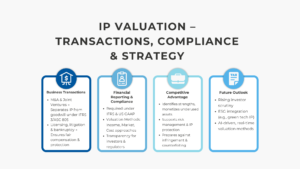
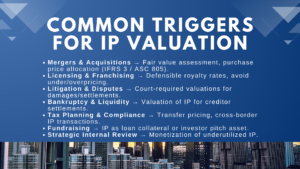
A formal startup IP valuation is especially useful in a number of trigger points:
| Trigger Event | Purpose of Valuation | Recommended Approach |
| Pre-seed / seed fundraise | Support pre-money valuation narrative; establish IP floor value | Cost approach or preliminary income approach; IP audit and registration |
| Series A / Series B round | Independent validation of IP value to anchor investor negotiations | Full income-based valuation (RFR, MEEM); independent expert report |
| Licensing negotiation | Establish arm’s-length royalty rate; quantify value of licensed asset | Relief-from-royalty analysis; comparable royalty rate benchmarking |
| M&A / trade sale | Inform acquisition price negotiation; counter acquirer’s IP attribution | Comprehensive multi-asset IP valuation; IFRS 3 PPA-standard analysis |
| IP-backed financing | Support IP as collateral for IPOS IP Financing Scheme or bank loan | Independent valuation to lender’s required standard; asset-specific report |
| Grant applications | Meet IPOS / Enterprise Singapore valuation documentation requirements | Scope depends on grant programme; often cost or hybrid approach |
The role of IP Valuation on Fundraising.
Credible startup IP valuation has a fund raising effect which works in three channels. The former is anchoring: independent valuation report sets the baseline of pre-money negotiations of the valuation, minimizing the degree to which negotiations are to be anchored by an investor or other company-specific multiples that may not be indicative of the IP strength of the startup.
The second is due diligence compression: a startup that submits a pre-existing, comprehensive IP valuation report at the beginning of the due diligence process of the investor greatly lightens the analytical load of the investor and also shortens the time frame of the deal. The legal and financial advisers of the investor are able to work on authenticating and stress testing the findings of the startup instead of spending weeks finding out the ownership of IP and its value and this is a much more effective process.
The third one is the confidence signalling, indicating that the decision to have an independent startup IP valuation prior to a fundraise is an indication to investors that the founders take their IP seriously, have the value of it, and that they have the governance discipline to use it in a responsible manner. This signal has a disproportionate effect on investor perception of management quality which is one of the two or three most important aspects of early-stage investment decisions.
Valuation Systems of Startup IP
Cost Approach -Initial Stage Relevance
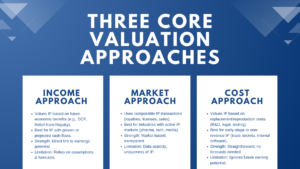
The cost method will determine the value of IP using the sum of money to replace or re-create the asset. It is the most readily available valuation technique in pre-revenue startups since it can be based on the financial reporting of the startup and not guesses of future revenue or absence of comparables in the market.
There are two cost variants used in the startup IP valuation practice. The reproduction cost approach sums up all the expenses recorded in producing the IP to date such as developer wages, research and development resources, patent prosecution and legal expenses as recorded in the books of the startup. The replacement cost method determines today the cost of producing an asset that is functionally equivalent and recreating it in the current market at today’s market rates, with any current obsolescence deducted. When this is with a proprietary software platform, this could entail an approximation of hours of development effort in rebuilding the codebase at current rates in the Singapore market (S$120-S250 per hour of experienced developers) and an obsolescence functional value change.
The cost approach is most suited in databases, assembled labour forces (as a contributory asset in greater valuations), and immature technology assets where revenue history is inadequate to justify income-based techniques. The main weakness of it is that it fails to measure market readiness to pay – in the case of breakthrough innovations, market value can be many times greater than the development cost – and thus it is a lower bound on value but not an overall measure.
Market Approach Comparables
The market method places importance on IP, based on prices witnessed in other similar IP deals – patent sales, brand licence deals, software deals, and franchise deals. In the practice of intellectual property strategy in Singapore, the relevant market information is obtained by searching the specialised databases such as RoyaltyRange, ktMINE, Consor, and IPOS IP Value Lab, in addition to the publicly revealed M&A transactions and academic research on royalty rates.
Market strategy works best where transactions that can be directly compared can be found, such as when a Singapore healthtech company has patents in a field where a similar patents have been sold or licensed at a reported price. Practically, it is difficult to identify genuinely similar transactions in which the IP of a new start-up would be comparable especially in Singapore where the market of the private transactions is relatively small. The market method is then most frequently used to give corroborative checking on income or cost approach conclusions, confirming that the main valuation is within a range of observable market.
In the case of brand valuation in particular, the key market data input is the market-derived royalty rates which are the percentage of revenue that a third-party licensee would pay to use a brand. These rates are widely different across industries: the royalty rates of brands of consumer goods are usually 1-5%, of technology brands 2-6 and of pharmaceutical brands 4-10. The adjustments might be Singapore-specific in circumstances where the local market conditions are not the same as the global standards used in publishing the royalty rate information.
Income Approach- Cash Flow Projections
The most theoretically sound and commonly agreed methodology of valuing startup IP through licensing negotiations, M&A due diligence and financial reporting is the income approach. It calculates IP value by estimating the future economic benefits that the IP is likely to bring about and discounting the benefits to the present value at a risk-adjusted rate.
The main methods that are used are three income-based:
Relief-from-Royalty (RFR): The approach calculates the value of IP by capitalising on the royalty payments that the startup would have made by owning and not licensing the IP. The majority of uses is on brands, patents and technology assets. The process will necessitate a sustainable royalty and revenue estimates throughout the remaining useful life of the IP. This makes RFR especially appropriate to Singapore startup valuations since it bases conclusions on a visible market data – it is therefore extremely defendable to investors and auditors.
Multi-Period Excess Earnings Method (MEEM): The value of an intangible, primary income-generating asset (a customer relationship or core technology asset) is estimated by estimating attributable after tax cash flows throughout the economic life of the asset, and reducing these estimates by contributory asset charges due to all remaining assets supporting such cash flows. MEEM is the most demanding, but also most data-driven method that involves detailed projections of revenues, analysis of margins, and discount rates that relate to assets.
With-and-Without Method: A method that gives a comparison between the present value of the cash flows with and without the IP. Where best suited to non-compete arrangements, regulation licences and favourable contracts, in which the economic effects of the withdrawal of the IP may be directly modelled.
Aligning the IP Strategy and Business Strategy
Market Entry and Expansion
A Singapore intellectual property strategy that fails to align with the geographic expansion plans of the startup will leave the valuable IP unprotected at the right time. The laws of IP are highly territorial, meaning that a Singapore patent, trademark, or even registered design does not carry any protection in Indonesia, Malaysia, Vietnam, or any other country in which the startup is or will operate.
The art of IP-consistent market entry planning involves the founders determining, at every phase of the geographic expansion, what IP will have to be secured in the new market and have the proper applications registered before the product or brand is actually introduced to the market in the target market. To protect its patent, it has to resort to PCT applications to maintain priority rights in the major markets at the time the market opportunity is being checked without incurring the national phase costs. To protect trademarks, the Madrid Protocol applications provide cost effective multi-jurisdiction protection under IPOS.
Singapore is a gateway to the ASEAN region, which is why it is a natural base of the IP strategy in the region. The fact that Singapore enjoys a good rule of law, bilateral investment agreements and good taxation of IP has encouraged the establishment of the country as the IP holding structure of its many multinationally based companies. The infrastructure proposed by the same can be utilized by Singapore startups to organize their IP portfolios to protect, as well as to tax-efficiently.
Licensing Opportunities
One of the best-paying IP commercialisation strategies that can be used by Singapore startups is licensing. Licensing its technology, brand, or processes to other companies – regional partners, complementary businesses, competitors in non-competing markets – a startup can generate recurring royalty revenue on possible marginal incremental cost, extend its reach into markets it cannot serve directly, and can also hasten the adoption of the technology in other markets.
To successfully license IP it must satisfy three pre-conditions: well-documented and well-owned IP (in order to determine the right of the licensor to grant the licence); a defensible valuation of the asset being licensed (to negotiate a reasonable royalty rate); and a properly drafted licence agreement that places the scope of the licence, its duration, exclusivity, sublicensing rights, quality limitations, and termination terms of the arrangement.
Enterprise Development Grant (EDG) and IPOS IP licensing support initiatives assist Singapore based start-ups with financing to invite IP lawyers and valuers to assist the dealings with licensing transactions – making the establishment of a licensing programme less expensive out of pocket.
Defensive and Offensive IP Strategy
The entire IP strategy Singapore involves the defensive and offensive aspects. On the defensive side, the aim is to develop a set of IP rights that will inhibit competitors to copy, imitate, or displace the basic products and business model of the startup. This would involve developing patent protection on the major inventions, vigorously used trademark registrations, and trade secret measures that uphold confidential know-how.
The IP portfolio can be used as a competitive weapon in an offensive manner. Threatening to sue competitors out of infringement – by sending cease-and-desist letters, licensing request, or even suing them – can create money through licence fees, disenfranchise them on important market segments, and create the impression that the startup is a serious IP owner. The brand equity and customer trust are safeguarded by the trademark enforcement measures against brand imitators. Negotiations on cross-licensing with larger competitors are possible to access complementary technologies and also to create cash inflows.
A carefully selected IP portfolio even a small one can be a serious equaliser to Singapore startups competing with other, better-equipped companies. The price of enforcing a legitimate Singapore patent is many times less than the price of countering the entry of a well-capitalized competitor, and proactive defense of IP is among the best payoff defensive investments that founders with limited resources have.
Singapore Startup Ecosystem and Law of IP
Local IP Regime and Implementation
The IP laws of Singapore are one of the strongest and most recognized within the Asian region. Intellectual Property Office of Singapore (IPOS) is the authority over the Patents Act, Trade Marks Act, copyright Act, the Registered Designs Act, and others, all of which are largely consistent with international IP conventions such as the Paris Convention, PCT, Madrid Protocol, Berne Convention, and the TRIPS Agreement.
The advantage of IP enforcement in Singapore is the presence of an autonomous and commercially advanced judiciary that has specific IP expertise in the Intellectual Property Division of the High Court, established in 2021. The Singapore courts have a good history of offering effective solutions to IP infringement such as injunction, damages and accounts of profits among others and the country adherence to the rule of law makes it a confident venue of IP dispute resolution.
In protect startup IP cases, Singapore has specialised IP dispute resolution services, comprising of services of the World Intellectual Property Organization (WIPO) Arbitration and Mediation Center, Singapore, which are cheaper and faster than court litigation in respect of some types of IP dispute.
Support Schemes and IPOS Initiatives.
The government of Singapore offers one of the best rates of support to startups who have chosen an intellectual property strategy Singapore. Key programmes include:
IPOS Global -Start Digital: Assists startups with carrying out IP audits, applications, and granting startups access to IP service providers recognised by IPOS at subsidised rates.
IP Financing Scheme: Facilitates the securitizing of IP by start-ups and SMEs on bank loans, allowing IP to be used as security (such as patents and trademarks), and government schemes to share risks with lending banks who accept IP as collateral.
IP Development Incentive (IPDI): Concessionary tax rates are offered on qualifying IP income of a company that develops IP in Singapore that builds strong incentives to form IP ownership and development in Singapore companies.
Enterprise Development Grant (EDG): Partially (up to 50-70) meets qualifying project expenses of SMEs and startups pursuing IP strategy, valuation and registration projects.
Startup SG Equity: Co-investment scheme: Government co-investment programme, which positively weighs IP-intensive startup proposals in investment selection, boosts the private capital of IP intensive businesses.
IPOS IP Value Lab: The program offers startups access to IP valuation tools, information and advice on commercialisation and IP valuation including the databases of IP transactions and resources on how to value them worldwide.
Top Ten Missteps that Startups make with IP
Waiting Too Long to Protect IP
The largest and the most frequent IP error taken by Singapore startups is to wait to protect their product after it has been launched, the investor deck has been distributed, or the brand has been publicly marketed. At this stage, patent novelty could be ruined, third parties can have registered the startup brand name, and the possibility to secure startup IP by formal registration can be irreversibly shut down or grossly complicated.
The delays are usually caused by both resource limitations and poor prioritisation. Being preoccupied with product development and customer acquisition, it is natural that early-stage founders consider IP protection a step-functional matter, something to care about later, after the company starts making revenue and has a legal budget. However, this perception is precisely the risk-reward calculus with reversing the order, where IP protection is cheapest, most efficient, and most simple at the very beginning, when the technology has not been noticed by other competitors, when investors have not performed due diligence on ownership lines, when the start-up is simply a product with a single stage, and thus before the retroactive IP housekeeping becomes an expensive issue.
The antidote here is a checklist of basic IP launch: at the plain of the product going live, the first investor pitch, or any other external communication of the brand or technology, the startup must have filed provisional patent filings in core innovations, trademark filings in the brand name and logo in Singapore and key markets and IP assignment agreements with its founders and key early team members.
Lack of Surveillance of Infringement
The registration of IP rights is not enough. The IP protection is to be actively monitored and enforced. A trademark not observed as a trademark infringement, and not intervened with in instances of infringement, can be diluted or (in the instance of a trademark becoming generic through extensive unlicensed use) invalid. A patent not followed in terms of copying, can be commercially utilized by the competitors over years to come before startup acts and the startup loses out the damages that otherwise could have been secured had they acted earlier.
Successful IP monitoring of Singapore startups incorporates: the establishment of IPOS trademark watch (or equivalent third-party brand monitoring) to receive notification of similar marks being registered; the provision of patent monitoring service (like Google Patents alerts or commercial patent watching services) to monitor applications and publications in the field of technology of interest; regular internet searches to identify infringement of brand names, logos, and copyrighted material.
Response to infringement should be rational when detected. Inadvertent infringement by small-scale operators often can be dealt with with a cease-and-desist letter. Purposive, commercial-level infringement by financially endowed rivals can warrant serious legal consequences – yet even in this instance the risk of litigation in the presence of a powerful IP portfolio is in most occasions enough to negotiate a licensing deal without incurring the expense or risk of trial.
Inefficient Invention Development
The third significant IP error that Singapore startups commit is the absence of documented invention development process that is as rigorous as it has to be when submitting a patent application. In a patent priority case, that is, between two people who have both registered an invention but the issue is when it was invented, then current documentation of the invention progression is a very important piece of evidence. In the absence of lab notebooks, version control logs, documented design documents and inventor declarations, the startup might not be capable of asserting its priority claim.
There are also documentation failures within the corporate acquisition environment. On acquisition of a startup, the due diligence team of the acquirer will seek to find evidence on the development of inventions to justify the IP valuation and to ensure that the technology does not have remaining rights in the possession of any third parties who may be former employers of the inventors, university research programmes, or government funded research projects.
Best practice on invention documentation contains: keeping dated, signed laboratory or development notebooks (paper or electronic) that capture the conception and reduction to practice of each innovation; maintaining version controlled code repositories, with commit messages that document the history of software feature development; all design documents, prototype records, and test results; an inventor signature on dated inventor declarations that they made their contribution to each innovation they have patented.
Conclusion
Sustainable Growth Strategy Map of IP
The question to the start ups in Singapore is no longer whether the intellectual property issues matter or not but the evidence is everywhere and conclusive that it does, at all levels of funding, at all sectors, and at all growth paths. The question is, how to develop the intellectual property strategy Singapore that will be proportionate, actionable, and in accordance with the competitive position and commercial ambitions of the startup in particular.
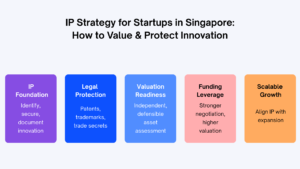
There are five stages of a strategic IP roadmap to sustainable growth. During the formation stage, consisting of pre-launch efforts of the product and before the investors are enrolled, it is on IP identification (identifying all existing and likely IP), ownership hygiene (assigning agreements, examining whether encumbrances exist), and priority filing (provisional patents and trademark applications of core assets). During the seed and early growth stage, attention is narrowed into finishing patent prosecution, establishing the trademark portfolio in key markets, and an early startup IP valuation to inform the story of raising the Series A fund.
During the growth stage – when the startup is planning to raise institutional capital and may contemplate international expansion – IP strategy becomes more advanced: expansion of patent and trademark protection to geographic scope, creation of licensing programme, introducing IP metrics to the board reporting, and creating an extensive IP valuation report to submit to Series B and further. The scale stage formalises: an IP policy, an IP register, a special IP champion and periodic review of the IP portfolio in line with product roadmap planning.
And at the point of exit, be it by trade sale, merger and public listing, the quality, defensibility and documented value of the IP portfolio will constitute one of the most important variables in the price of the deal. Such startups which have nurtured their IP by design, enforced it, and attributed it credibility and managed it in a professional manner will enter into exit processes with a material competitive advantage to those where IP has been an afterthought.
Singapore offers an unparalleled platform to successful IP-based start-ups: a global legal framework, an advanced investment platform, a generous government support programme, and a central location within the fastest-expanding markets in Asia. It is the startups which comprehensively build upon this foundation, through the creation of an intellectual property strategy Singapore, starting on day one, investing in startup IP valuation at the appropriate time, efforting to protect the startup IP in every possible way, and aligning its intellectual property strategy Singapore with its growth aspirations, which will be the ones that mark the next generation of innovation leaders in Singapore.