How IP Valuation Supports Mergers and Acquisitions Due Diligence
A Practical Guide for Finance and Legal Professionals
Introduction to IP Valuation in Mergers and Acquisitions Due Diligence
The acquisition and mergers are some of the most significant decisions that a business can make. The valuations and deal structures of the headlines are a veil of a sophisticated layer of assets that, in many cases, determine an acquisition to be an ongoing enhancing value or a very expensive write-down. Most prominent among them are intellectual property (IP) assets, such as patents, trademarks, copyrights, trade secrets and software, which are now the biggest share of enterprise value in knowledge-based industries. However, even with their importance, IP assets are often under-examined when it comes to negotiation of deals, which leaves acquirers vulnerable to risks that they were not expecting.
It is at this point that IP valuation of M&A due diligence comes in handy. A stringent valuation process of the intellectual property of a target company is not merely a process of putting a figure on an intangible asset. It is the knowledge of the character, enforceability, commercial potential, and strategic fit of each IP asset – and the application of that knowledge to the deal structure, purchase price and post-merger integration plan. It is among the best risk management tools that acquirers and their advisors can have when it is properly done.
This article targets junior and mid-level finance, legal and strategy professionals who are developing awareness of the intersection of IP and corporate transactions. Regardless of whether you are working on a deal team, preparing to work in M&A advisory, or are just interested in learning more about how intangible assets are valued in the context of an acquisition, the concepts, processes, and examples discussed here will provide a helpful basis.
The importance of Intellectual Property in a Deal.
The worth of a company in the previous decades was highly dependent on its physical assets, which included factories, inventory, equipment and real estate. That image has had a tremendous transformation today. Surveys by advisory firms like Ocean Tomo have continued to report that the intangibles now contribute to the enormous market capitalisation in the S&P 500, and it frequently is over 80 to 90 per cent of the overall enterprise value. In technology, pharmaceuticals, consumer brands, and media, the IP is often the major source of commercial appeal of a target company.
To an acquirer, it is not optional but a prerequisite to know what IP assets the target is basing its competitive position on. A drug patent package of patents may be a large part of the price of a pharmaceutical company; a software company may be worth little but its proprietary code and trade secrets; a consumer goods brand may be worth very little except due to a trade name. In both scenarios, when the acquiring party inaccurately assesses the strength, ownership or useful life of that IP, they risk overpaying greatly or even purchasing assets that they cannot make use of.
The role of intellectual property valuation in acquisition situations is enhanced by the fact that IP issues may emerge many years after a transaction has been completed. An acquirer that was unable to detect a pending infringement claim, mis-assignment of an invention, or a licence agreement limiting commercial use is likely to be involved in costly litigation or renegotiations after the closing. The initial line of defence against such outcomes is thorough IP due diligence, which should be based on good valuation principles.
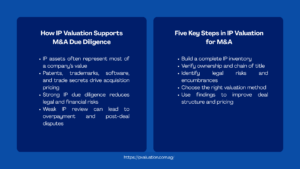
Five Key Steps in IP Valuation for Mergers and Acquisitions Due Diligence
IP valuation in M&A due diligence does not constitute a one-off activity but is a process that is organised and takes place in many work streams. The five subsequent steps are the essence of an evaluation that most transaction advisory teams and IP counsel undertake when evaluating intellectual property in an acquisition context.
Step 1: Build a Complete Intellectual Property Asset Inventory
The deal team needs to create a complete picture of what IP the target company owns, licenses, or uses before any valuation can be done. These comprise of registered rights like patents, trademarks and registered designs and unregistered rights like trade secrets, copyright and know how. The inventory also needs to record IP that the company depends on but does not own – like third-party software licences – since these dependencies influence the capacity of the acquirer to operate after the transaction. Any further due diligence work stream is built on a well-modelled IP inventory.
Step 2: Verify Ownership and Chain of Title for IP Assets
The most crucial threshold inquiry in IP due diligence is ownership. The only asset that can be valued is one that is free of any title encumbrances by the seller. This will involve going through employment agreements, contractor arrangements and assignment records to ensure that all IP was transferred to the company. One of the pitfalls of startups is IP that was created by the founders or contractors prior to appropriate assignment agreements. It is crucial to highlight and address these gaps before they are closed – and may greatly impact deal pricing or structure.
Step 3: Identify Legal Risks, Restrictions, and Encumbrances
After establishing ownership, the due diligence team needs to determine whether any IP has third-party claims, restrictions or disputes. This involves examination of litigation records, patent oppositions, co-ownership, exclusive licences being given to third parties and any security interest registered over the IP. A patent that the target is central to its product line, but is the subject of an inter partes review proceeding, such as one that has a materially different risk profile and valuation outcome than one with a clean prosecution history.
Step 4: Choose the Right IP Valuation Methodology
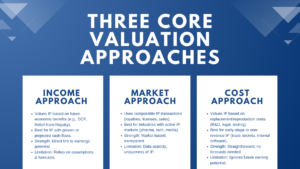
Having a clear idea of what IP is, who owns it and what its risk entails, the valuers can use one or more of recognised methodologies to place a monetary value. The three main methods, the cost method, the market method and the income method, have their advantages and disadvantages depending on the type of IP and the data at hand. In practice, in an M&A setting, the income approach (e.g. the relief-from-royalty or multi-period excess earnings methods) is used to estimate the value of IP most directly due to the contribution of IP to the commercial value. A cross-checking approach is usually cross-checked with a blended approach.
Step 5: Use IP Findings to Improve Deal Structuring and Negotiation
The results of IP valuation cannot be kept within a technical report. They have to feed into the greater analysis of the deal team. Unexpectedly high value concentration in one expiring patent, such as that, may be addressed by the acquirer requesting a price discount, an earnout scheme, or representation and warranty insurance policy. Equally, the discovery of some IP to be licensed solely to a rival can result in structural modifications to the deal – like keeping some assets off the deal-perimeter or agreeing to terminate the objectionable licence prior to the deal.
Table 1: Best IP Valuation Methods for M&A Due Diligence and Acquisition Transactions
| Valuation Method | Best Used When | Key Input Required | Common IP Types |
|---|---|---|---|
| Cost Approach | Early or special IP with paucity of market data. | Past research and development expenditure, reproduction price. | In-house software, company processes. |
| Market Approach | There are similar licensing arrangements or the selling of IP. | Similar transaction information, royalty rates. | Patents, trademarks, branded content |
| Income Approach | IP brings about recognisable and quantifiable revenue. | Projections of revenues, discount rate, and useful life. | Technology patent, customers, licensed technology. |
| Relief-from-Royalty | The market royalty rates can be used to benchmark IP. | Royalty databases in the industry, projections of revenues. | Software license, trade name, patent. |
Process Flow 1: Step-by-Step IP Due Diligence Process in M&A Transactions
| Phase | Activities | Key Output |
|---|---|---|
| Phase 1: Scoping | Define IP perimeter; define all of the asset classes (patents, trademarks, copyrights, trade secrets, software) | IP Asset Inventory |
| Phase 2: Documentation Review | Check ownership, assignment contracts, licenses and prosecutions. | Ownership & Encumbrance Report |
| Phase 3: Legal Risk Assessment | Determine litigation risk, time-to-expire, third-party claims, and freedom-to-operate limitations. | IP Risk Register |
| Phase 4: Valuation | Use cost, market or income techniques; calculate cash flows; compare royalty rates. | IP Valuation Report |
| Phase 5: Integration Planning | Map IP to post-merger approach; find redundancies and renewal priorities. | IP Integration Roadmap |
How to Choose the Right IP Valuation Method in an Acquisition
One of the most technically challenging parts of M&A due diligence is the choice of the valuation methodology in IP valuation. The decision will be based on various factors: the nature of IP being priced, the accessibility of similar market data, the maturity of the asset, the revenue that it produces, and timeframe of the deal process. Those who practice IP valuation seldom use one technique alone, but they triangulate outcomes to two or more techniques to come up with a range of defensible values.
The relief-from-royalty method, which is a type of the income approach, has been a popular instrument in most M&A situations, as it is comparatively clear and understandable. In such a technique, the IP value is determined by the present value of the hypothetical royalty payments that the acquirer would make, avoiding, instead of licensing, the IP. Revenue estimates, royalty rates that are available in the licensing databases, as well as suitable discount rates, are input to generate an estimation of value. This helps it to have some market anchoring that cannot be achieved through pure income projections since it depends on observable royalty rates out of similar transactions.
Although the cost method is less applicable in the mature revenue-generating IP, it is still applicable in certain instances. In the case of internally developed software, proprietary databases or know-how which is not yet commercially realised, a recreation of the cost of development can be a helpful floor to value. It is also a useful cross-check with other methods that may give unexpectedly large or small results. Conversely, the market method – relying on similar IP sales or licensing deals – is frequently challenging to implement because of a lack of publicly available transaction information, especially in niche technologies or in a highly specialised trade secret. The process of selection itself is as crucial as the execution, and it should be well documented to enable it to be audited and displayed.
Process Flow 2: Decision Framework for Selecting the Best IP Valuation Method
| Decision Factor | Condition | Recommended Approach |
|---|---|---|
| Market Data Availability | A similar IP is actively being licensed in the market. | Market / Relief-from-Royalty Approach |
| Revenue Attribution | IP is directly generating revenue streams that can be identified. | Income Approach (Multi-period excess Earnings or DCF) |
| IP Maturity | IP is fledgling, experimental or internally developed. | Cost Approach |
| Mixed Portfolio | Other spans include patents, trademarks and software in a portfolio. | A combined technique that involves a combination of techniques. |
| Time Constraint | Compressed deal timeline | Relief from Royalty as independent; Cost as control. |
Real-World Examples of IP Valuation in M&A Deals
Probably one of the most educative historical cases of IP-based M&A valuation is the 2012 acquisition of Motorola Mobility by Google at an estimated price of USD 12.5 billion. Though Motorola was a mobile handset maker, the strategic logic behind the acquisition was often ascribed to the fact that Motorola had over 17,000 patents, which could be seen as a strong defensive weapon against the growing patent lawsuits Apple and Microsoft had against the Android. The valuation thesis centred on the patents, and when Google later sold the handset business to Lenovo in 2014, it retained most of the patent portfolio, highlighting the significance of those intangible assets to the original deal rationale.
Pharmaceuticals: IP acquisition is especially a high-stakes deal in the pharmaceutical industry. The reason AstraZeneca is acquiring biotech companies (including its acquisition of Alexion Pharmaceuticals in 2021 at around USD 39 billion) is almost solely due to the portfolio of patent-protected rare disease drugs of the target. When it comes to such transactions, the due diligence team needs to model not only current revenues, but also the remaining patent life of each product, the probability of its approval in the pipeline by regulators and the risk of biosimilar competition on its expiry. An optimistic and conservative IP valuation of a pharma deal of this magnitude can be in the billions.
An example to be wary of is that of consumer technology. BlackBerry thought of the strategic sale in 2013, when its trademark and handset patent portfolio continued to have a significant theoretical value. Nevertheless, due diligence by potential acquirers found that the commercial value of the patents was wasting away very fast as the mobile ecosystem was moving out of the BlackBerry architecture. The moral of this story is that IP value is not inertial – it is profoundly connected to the market relevance, competition and technological change rate. A lot of acquirers are disappointed when they base their acquisition decisions on the size of an IP portfolio rather than evaluating its strategic value.
Common IP Due Diligence Risks in Mergers and Acquisitions
Even well-resourced deal teams still face considerable difficulties as they perform IP valuation for M&A due diligence. The awareness of these issues beforehand, and how to address them, is what can be the difference between a sound due diligence process and one that leaves money on the floor or fails to identify a fatal risk.
Information asymmetry is one of the most intractable issues. The target firm is much more familiar with its IP portfolio than the potential acquirer is, and sellers are motivated to portray their IP as most favourable. The most important documents can be held back, irregularities in ownership can be concealed, and the commercial contribution of certain assets can be exaggerated. The due diligence counsel experienced can overcome this by making elaborate IP disclosure requests, performing independent patent searches, comparing royalty rates to third-party databases, and imposing representations and warranties in the purchase agreement that provide the acquirer with recourse in the event of the discovery of undisclosed problems after closing.
The second issue is the tight schedules, which tend to be the hallmark of competitive M&A. In the context of auctions, in particular, bidders might only get a period of two to four weeks to carry out due diligence with respect to all workstreams, including IP. This does not allow time to conduct deep legal analysis, extensive valuation modelling, or sensible freedom-to-operate analysis. The feasible answer is to triage, that is, prioritise the IP that generates the biggest value, the risk that is the most significant, or the foundation of core product lines. The deal team junior professionals can play a great role in developing and sustaining properly structured IP trackers, which enable the senior team to navigate through large amounts of disclosure documents with ease.
A third and more common challenge is the cross-border IP portfolios. In a target company with operations in more than one jurisdiction (as it is typical in a global technology or pharmaceutical acquisition), the due diligence team should evaluate the IP protection levels, enforcement history and chain of title regulations in each country. A robustly guaranteed asset in the United States might not have the same guarantee in markets where counterfeiting or lax enforcement regimes are prevalent, and that geographic risk premium should be reflected in the price.
Table 2: IP Due Diligence Risk Assessment Framework for M&A Transactions
| Risk Category | Example Risk | Likelihood | Potential Impact |
|---|---|---|---|
| Ownership | Inventor rights were not properly assigned to the company | Medium | High – may invalidate IP ownership |
| Litigation | Pending infringement claim against a key patent | Low–Medium | High – affects deal valuation and terms |
| Expiry | Core patent expiring within 2 years post-deal | High | Medium – revenue concentration risk |
| Licensing | An exclusive licence restricts the acquirer’s use | Medium | Medium – limits commercial flexibility |
| Trade Secrets | No confidentiality protocols for key know-how | Medium | High loss of competitive advantage |
Conclusion: Why IP Valuation Is Essential for Successful Mergers and Acquisitions
Intellectual property no longer presents a peripheral issue in mergers and acquisitions – it features in the centre of deal strategy, deal pricing, and risk management in most deals in the knowledge-based sectors. As a professional in the entry or intermediate stages of the M&A industry, a good grasp of IP valuation in M&A due diligence and intellectual property valuation in a buyout will ensure that you are a more valuable asset to the deal team and a more viable candidate for advisory work.
The following are some of the practical lessons to bring to your practice. To begin with, it is important to always begin with the IP inventory – do not even think of valuing what you have not fully determined. A full and properly arranged asset register is the basis on which all further work is derived. Second, ownership verification should be viewed as a threshold that cannot be negotiated. A patent, which the company cannot demonstrate that it possesses, is a good deal of dead air, or worse, a liability. Third, choose your valuation methodology depending on the type of asset, as well as the data at your disposal, rather than just on convenience. An approach which cannot be cross-checked is a weak approach.
Fourth, relate your IP findings to deal structuring. The valuation work, which has not been reflected in determining the purchase price, earn-out design, or representations framework, has not provided its maximum value to the purchase team. Fifth, invest in developing your knowledge of IP fundamentals (patent prosecution, trademark classes, mechanics of licensing, law of trade secrets) since technical knowledge will make you a better decoder of the papers you will come across in a data room. Lastly, keep in mind that IP due diligence is a team effort. Close coordination of lawyers, valuers, technical experts and commercial strategists (all with a common understanding of what the IP means to the business and the deal) brings about the best results.
The intangible resources that companies develop, secure and capitalise will keep forming mergers and acquisitions. People who know how to evaluate and price those assets in a rigorous, practical and strategic way will always be some of the most useful members of any deal team.