How Can Businesses Monetize Intellectual Property?
A practical guide for junior to mid-level finance, legal, and strategy professionals
Understanding How Can Businesses Monetize Intellectual Property?
IP monetisation refers to the transformation of a company’s IP (patents, trademarks, copyrights, trade secrets, or proprietary software) into a monetary asset. Monetisation of IP is important as most businesses have a lot more IP than they exploit. IP assets can be licensed, sold, enter into a joint venture, or even be franchised to generate recurring revenue, new markets, and position them for competitive advantage, without a large capital investment. IP monetisation is an area of commercial strategy that is gaining in significance for those in the finance, corporate development and legal professions.
What Does It Actually Mean to Monetize Intellectual Property — and Where Do Businesses Go Wrong?
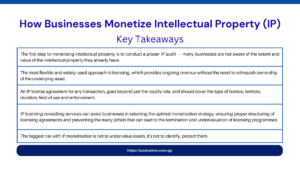
The vast majority of business owners know, feel, and understand that their brand, technology, and content are valuable. Fewer have a clear perspective on what is in that IP portfolio, what assets are covered by IP protection, and what assets are (or are not) potentially making money. However, the first step in the discussion of monetizing any IP is an IP audit – a systematic examination of all of a business’s IP assets, their state of protection, and the business opportunities that exist.
Businesses generally have a large amount of capital which is underutilized. A manufacturing firm could have embarked on improving their manufacturing process over a period of decades that is not patented and never licensed to any other firm – even in a market where the company itself does not have a customer base. A technology company can be the copyright owner of software modules that could be white labelled and sold to other technology firms in related businesses. A consumer business could have trademark rights in areas where there are no retail stores, which may be a great opportunity for licensing or could be an Achilles heel for such companies if they are squatted or infringed. In every scenario, there exists an IP; it is just not an IP that has been created with a strategic vision to make money from it.
The second mistake made by businesses is to mistake IP protection with IP monetisation. Patenting or Trademarking is a defensive measure; it sets up a legal barrier to allowing others to use your product. Turning this right into income demands another batch of commercial choices: who will pay to use this resource, on what conditions, in what markets and via what structure? They’re not questions for the legal function — in fact, they’re exactly the type of questions that practitioners with IP licensing consulting expertise are hired to answer.
What Are the Main Routes to IP Monetisation — and How Do You Choose Between Them?
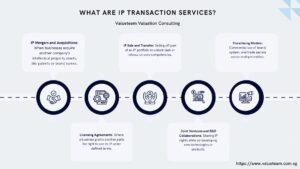
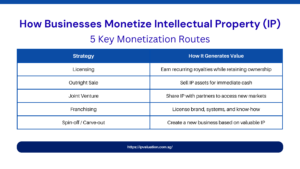
No single right answer exists in regard to the monetization of intellectual property. The right approach is dependent on the type of asset, the company’s strategic goals, its ability to sustain relationships, and the commercial climate in the target market. Each of the five main routes of expansion provides a unique combination of revenue, control, and complexity.
The most common method of doing this is by licensing the asset and then letting some other company profit from it and still owning the copyright. If a patent owner has a patent, they may license the patent to manufacturers in other markets that they do not directly serve. A software provider can offer a license to its partners that allows them to use the software in their own software. Multiple geographic and multiple format distribution of a media business’ content is possible. The underlying principle of the intellectual property licensing for all of these is the same: The licensor gives the licensee a specific set of rights, the licensee pays for those rights, and the licensor and licensee agree to what will happen if the rights are infringed. Value captured is determined by the royalty/fee structure, the exclusivity terms, and the terms of the territory and field-of-use.
Outright sale (also known as assignment) is suitable when the asset is not part of the company’s future plans, when cash flow is needed urgently, or when running a licensing programme is too demanding for the company. The problem with outright sale is that it doesn’t get back: After the sale, the seller cannot claim the value that the IP generates anymore. Therefore, the ability to accurately value an IP at the time of sale is an important factor. Joint ventures can be a middle ground, for example, co-developing or co-exploiting IP with another partner who has complementary technology, market access, or capital, but there are governance issues to consider, and a strong contractual framework to resolve disputes relating to ownership of any new IP that is generated during the collaboration.
IP Monetisation Routes: A Comparison – How Can Businesses Monetize Intellectual Property?
| Monetisation Route | How It Works | Best Suited For | Typical Risk Level |
|---|---|---|---|
| Licensing | Allow third parties to utilise the IP in exchange for a fee or royalty | The process of filing and obtaining patents, trademarks, software, and content. | Low–Medium |
| Outright Sale | Transfer of entry of Ownership in full to a buyer for a lump-sum price | Non-core patents, legacy brands. | Low (once closed) |
| Joint Venture | Co-develop or co-exploit IP with a partner sharing in risk and reward | Research and Development intensive industries; modes of market access; | Medium |
| Franchising | Bundle brand, systems and know-how as a product and sell them as a bundle. | Consumer brands, service businesses | Medium |
| Spin-off / Carve-out | Form an independent entity based on a particular IP asset or pool of assets | Older businesses who still have unused Intellectual Property. | High |
What Are the Five Key Steps to Building a Successful IP Monetisation Programme?
It’s a process and not one or two transactions when it comes to translating IP assets into sustainable commercial return. Companies that take a systematic approach to it, rather than a reactive approach, are more likely to create more value and avoid legal and commercial disputes. The following five steps are common steps followed by experienced IP licensing consulting services across the various industries.
Conduct a Comprehensive IP Audit: However, before any monetisation strategy can be designed, it is important for the business to know what it has. A comprehensive IP audit documents all of the IP — registered (and unregistered) — identifies legal ownership (which can be complicated in businesses that have undergone an M&A or restructuring), determines whether it is valid and/or whether there is a protection period left to run, and provides an initial assessment of commercial relevance. This audit is the initial basis for the IP register, which should be continually maintained and updated.
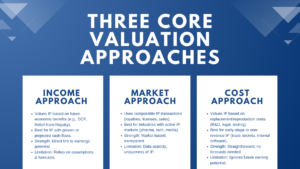
Establish Asset Value: IP valuation is a specialist practice, and involves three methods: the cost approach (which would be the cost to create the asset), the market approach (what other comparable assets have sold or licensed for), and the income approach (what the asset is expected to generate of cash flows in the future in present value terms). The income approach usually is the most applicable for licensing since it includes the royalty rate that is related to the economic benefit that the licensee can gain from using the asset. The valuation process is important: Undervaluing IP in a licensing negotiation means that money is left on the table and overvaluing IP means that deals are signed that never get financed by the licensee and are lost.
Define the Licensing Strategy: The key principle here for IP licensing is specificity – general licensing leads to general agreements – and disagreements. Exclusivity and territorial terms, field of use, sublicensing rights, minimum royalty guarantees, performance milestones, and audit rights should all be decided prior to partner discussions and not at or in the course of negotiations. Exclusive licences will fetch more money, but flexibility of the licensor is limited with these deals, whereas non-exclusive deals will fetch less money but the flexibility of the licensor will be increased.
Identify and Screen Potential Partners: The most valuable IP in the world is worthless in the event the licensee does not have the ability to exploit it commercially. When evaluating a partner, financial strength, market presence, manufacturing or distribution capability and — most importantly— the track record of respect for IP rights are important factors. Companies that have weak IP enforcement regimes must have more improvements in the terms of their contracts and more active monitoring. IP licensing consultants have networks of potential partners, and can help you take a huge step towards identifying them.
Build Monitoring and Enforcement Capability: A contract or licence is not the end; it is the beginning. Well-drafted licensing programs typically include a royalty audit, and the results are almost always some sort of discrepancy – it may be a minor one or rather large. In addition to audits, businesses need to be ready to take steps to protect their IP rights against infringers in both markets where they have active licensees and markets where they don’t have licensees. Disincentive costs are real, but the incentive costs, which are the costs of allowing the market to believe that there are no consequences to the infringement of IP rights, are generally greater.
How Have Leading Companies Built Revenue From Their IP — and What Can Others Learn?
Some of the most valuable lessons to be learned about monetizing intellectual property are from businesses that have incorporated it into their business plan, rather than an add-on.
Qualcomm is the prime example of how patent licensing is a key business model. The company is responsible for the development of the mobile technology standards, and it has a large patent portfolio of core wireless communications technology. Qualcomm doesn’t actually make devices in all the markets, but instead it sells its key patents to almost every manufacturer of devices based on its standardised technology. The company’s royalties on these licences traditionally have earned the bulk of the company’s profit, although the company’s chip design business brings in the bulk of its revenue. The business model of Qualcomm, which guides the company’s product strategy in the field of intellectual property licensing, is straightforward: Once a company’s technology lines up with an industry standard, the economics can be remarkable — provided the company’s IP portfolio is disciplined and valued. The company has had a long career successfully fighting litigation over its licensing solution, which, in itself, is a good rule of thumb: high-dollar IP programs can be litigated, and enforcement is a must.
There’s another example, but it’s from IBM. Over the years, a lot of money had been invested in IBM’s IP, and it was primarily used as a defensive tool. In the 1990s, the company changed its strategy and started to aggressively license its patent portfolio to third parties, making more than one billion dollars annually in licensing revenues at its height. IBM’s programme was unique in its systematic approach, with a set-up of a dedicated IP licensing group, a professional function to audit the royalty payments, and a strategic plan to determine the commercial value of the portfolio’s components for others in the adjoining industries. The lesson for companies with a large IP portfolio but not monetised is that the investment that needs to be made to be able to run a successful, effective IP licensing programme is equally significant: the investment in valuation skills, the investment in legal counsel, the investment in managing the IP partners, and the investment in audit skills, among others, is an investment that must be made before revenue starts to come in.
For software startups that license software platforms to enterprise customers, a good lesson is learned from numerous startups who did not pay enough attention to contractual definitions of use rights. There have been a number of high-profile examples of the type of disputes that have occurred in relation to licenses and their use of software platforms that have significantly exceeded the nature or scope of the software originally envisaged, such as having multiple entities obtain a single entity’s license and use it in a merged business, or having the software deployed in a cloud environment that was not in scope of the original agreement. The issues in each instance could have been prevented in the first place by more careful drafting and audit rights up front. It’s no surprise that scope creep and licence compliance are the most common trouble spots for software in enterprise licensing, as they are. Scope creep and licence compliance are the most frequent trouble spots for enterprise software licenses, and it’s not hard to see why.
What Does the IP Licensing Process Look Like in Practice?
The end-to-end workflow is crucial when it comes to understanding the process of supporting an IP monetisation programme for the first time, and can seem an opaque and very technical one. The most important time that IP licensing consultants can be involved is during the strategy and structure phase where decisions are made early in the process and can have the most impact on the commercial success.
The Six-Phase IP Licensing Workflow – How Can Businesses Monetize Intellectual Property?
| Phase | Key Activities | Output |
|---|---|---|
| 1. IP Audit & Valuation | Compile an inventory of all IP assets; determine ownership, validity and commercial utility; independently evaluate. | IP Register with assessed values |
| 2. Strategy Definition | Outline monetisation goals; choose route (license, sale or JV); identify target markets and partners | The IP monetisation strategy document. |
| 3. Licensing Structure | Identify field of use, territory, duration, exclusive/non-exclusive licence and royalty/fee structure | Term sheet or heads of terms |
| 4. Partner Identification | Screen and shortlist prospective licensees/acquirers; undertake commercial and financial due diligence; and | Target partner shortlist |
| 5. Negotiation & Drafting | Enquire and discuss commercial considerations; involve IP counsel to negotiate and draft licence agreement. | Executed licence agreement |
| 6. Management & Enforcement | Track, audit, and ensure licensee compliance; enforce rights against infringements | Continuous Use Reports and Compliance Reports |
The most frequent problem in the drafting stage is to be as specific as possible without drafting an agreement that would be so rigid as to be unable to allow for the legitimate evolution of the business. The commercial context will change, and licensing agreements are generally long-term (5-10 years is not uncommon). Good contracts address this issue by providing royalty rate escalation based on volume milestones, renegotiation triggers based on technology changes, and procedures for inclusion/exclusion of products in and out of the license. When they do not exist, they are often grounds for conflicts, but are seldom the initial focus of negotiations.
Many IP monetisation programmes silently fail the enforcement and compliance stage of the programme (phase six). Audits of royalties may be technically allowed to happen, but not practically, either due to lack of in-house resources by the licensor, or because there is a reluctance to add costs to arrangements that are otherwise good commercial ones. The practical solution is to make auditing a part of the agreement from the beginning: Make sure it’s done regularly as an annual or biennial process, that the first audit takes place within the first 12 months of the agreement taking effect, and that the results are used as a compliance mechanism, not a confession of guilt. The author has heard it reported from practitioners on the ground that if a licensee is aware that there will be regular audits, then he or she is more diligent in reporting royalties.
Frequently Asked Questions
Which type(s) of IP can be licensed?
A patent, trademark, copyright, trade secret, or know-how may be licensed; however, the legal mechanisms and trade practices vary from one to another. While patents are licensed based on the registered claim, copyright licenses are generally applicable to specific works or categories of works, with the exception of any quality control provisions that might be required to ensure the licensor’s brand equity; trademark licenses require specific quality control provisions, and the more important the asset, the more critical the obligation to keep it secret to maintain the value of the asset.
What is a royalty rate?
Royalty rates usually are determined by some industry standard for similar licenses (the market approach), by the value to be gained by the licensee through use of the IP (the income approach), or by a profit-split method that divides the value between the IP and the profiting commercial contribution of the licensee. Any IP licensing guide for any industry will give you rate conventions of that industry, which will be a starting point; but the rate will also depend on the relative negotiating power of the parties and how exclusive the rights being licensed are.
When is a business a good candidate for IP licensing consulting services?
Best practice is to have a discussion beforehand. The most frequent error is dealing with a prospective licensee without valuation completed or an understanding of the license strategy. By hiring IP licensing consulting services at the audit and strategy phase, the business will be in a better position to negotiate a defensible value and to know the commercial terms that it will be willing to accept.
Exclusive vs Non-exclusive licence?
Exclusive means that the only rights to use the IP belong to the licensee: the licensor cannot be a licensee of anyone else, and in certain jurisdictions, the licensor is not allowed to use the IP within the scope of the rights that he has granted to the licensee. A non-exclusive licence means that the licence can be granted by the licensor to several licensees at the same time. Exclusive licences will attract a higher fee or royalty as the licensee will be buying market exclusivity, not just the technology. They should be selected based on the strategic goals of the licensor and not based on the one that will make more money in the short term.
Conclusion: How Can Businesses Monetize Intellectual Property?
One of the least utilized types of commercial property in most businesses is intellectual property. The situation where a company does not have enough visibility of what IP it has in its portfolio, enough focus on how to leverage that IP to the company’s benefit, and enough operational ability to properly manage an effective IP licensing programme means that the divide between IP value owned and IP value realised is often quite large. There is a huge opportunity, both for organisations and individuals, to fill that gap and, for the worthy, it is a commercial and professional opportunity.
There are 3 helpful steps to move forward in this area. To start, create literacy in the fundamentals of IP protection. Patent, trademark, copyright, and trade secrets, and how they are governed, is the starting point to any commercial IP strategy. This knowledge is available for free and via training courses and qualifications in IP management, from a range of organisations, including the World Intellectual Property Organisation, which has developed published guidance. Secondly, observe actual licensing transactions. In regulated sectors like healthcare, telecom and other areas, many patent licence deals are covered in public filings, or mentioned in specialist industry publications. The only way to develop practical fluency quickly and effectively is to read these documents and take into account the meanings of words such as ‘exclusivity’, ‘territory’, ‘field of use’ and ‘royalty structure’. Third, develop relationships with practitioners. The work experience of IP licensing consulting services professionals, patent attorneys and corporate development specialists on IP transactions is often much more complicated and sophisticated than can be learned in a textbook, and serves to add significantly to their depth of judgment in IP matters. That expertise can be accessed through informational conversations, professional association events, and cross-functional project exposure.
The companies that will be the most valuable in their intellectual property in the years to come are those that regard it as making business sense rather than a legal burden. The people who can assist them in that will be some of the most valuable contributors in the room.