Trademarks and Brand Valuation Certification
Trademarks and Brand Valuation: Measuring Marketing Power
Introduction: Trademarks and Brand Valuation Certification
Trademarks and brands are much more than a logo or even a name, they are symbolic of the identity, reputation, trust, which is the motivating power behind consumer action. In the modern competitive and brand-oriented economy, the worth of a good trademark or brand usually surpasses the worth of physical property. Marketing, design and customer relations have become the common investments undertaken by companies in order to establish brand equity that is sustainable, yet the valuation of such an element is still a challenging endeavor.
This paper discusses the important practices and implications in trademark and brand value, how companies quantify the marketing strength and how they use brand value in financial and strategic planning.
Knowledge of Trademarks and Brands Equity.
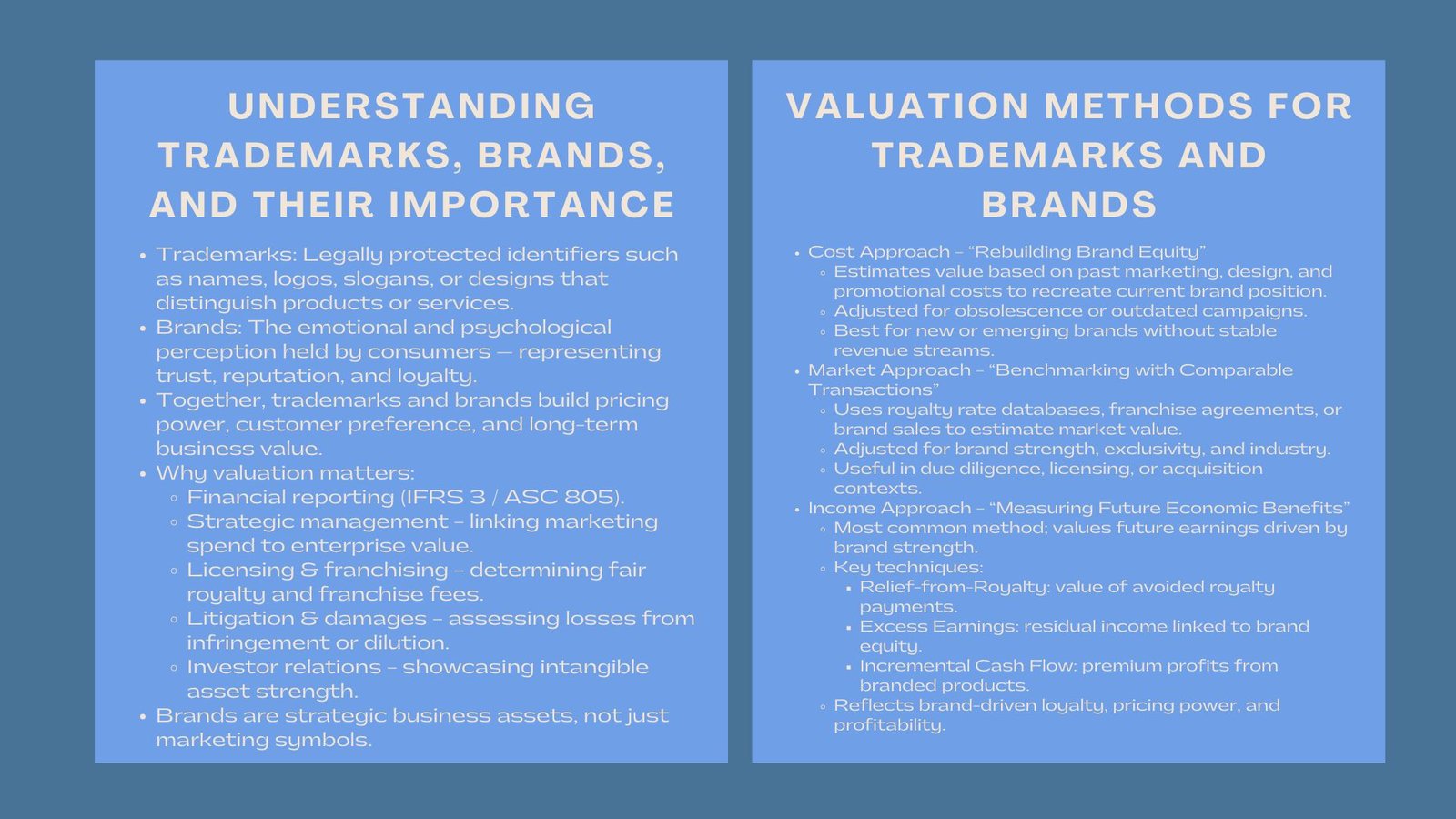
A trademark is a sign, design or an expression that is legally registered and that the various products or services of one company and another. It may be names and symbols, slogans and even the packaging design. A brand, however, is the emotional and psychological connotation that consumers have towards those identifiers. Whereas trademarks are legally exclusive, brand equity conveys the perception of the customer and loyalty.
The combination of trademarks and brands creates pricing power and consumer choice as well as long-term business value. The activities of mergers and acquisitions (M&A), licensing, marketing strategy, and financial reporting are critical because they may be regarded as financially important.
The necessity in Brand and Trademark Valuation.
It is important to value trademarks and brands in a number of situations:
- Financial reporting: Adherence to IFRS 3 or ASC 805 in the process of acquisition and purchase price allocation.
- Strategic management: Knowing the financial effects of marketing investments
- Licensing and franchising: It is to decide on reasonable royalty rates and franchise fee.
- Litigation and damages: The effect of loss in trademark infringement or brand dilution.
- Investor relations: The communication of intangible asset strength to shareholders.
Considering their role in the revenue and retention of customers, proper valuation of brand-related assets gives a more precise image of enterprise value of the entire company.
Valuation Methods of Trademarks and Brands.
The brand and trademark are valuation methods that are based on the three classic methodologies of other intangible assets, namely, cost, market, and income. Both take a varied approach to the manner in which the marketing prowess and law enforcement translate to quantifiable value.
Cost Approach: The Approach of estimating the Cost to develop Brand Recognition.
The cost method helps the company to compute value based on the costs to re-establish or substitute the current market position of the brand. There is previous marketing expense, advertisement, design expenses and promotional expenses.
The obsolescence, inefficiencies or old branding items are adjusted. But, though this approach was a mirror of the past of investment, it might not be well adapted to capture the emotional attachment consumers have with the brand.
The most suitable cost approach is the one that is used in a new or emerging brand with no proven stream of revenues or where the past expenditures serve as a sound proxy of expenditures incurred in building a brand.
Market Approach: Comparable Transactions Benchmarking.
The market approach quantifies the value by using the market evidence of similar brand or trademark transaction. It entails the study of comparable licensing transactions, franchise deals, or brand acquisition to set up standards on pricing and royalty rate.
Among the major sources of data are royalty rate databases, survey of the licensing industries and financial disclosures. There are changes in brand strength, market presence, industry and exclusivity.
It is especially applicable to due diligence and licensing negotiations, as this approach also offers a physical connection to the actual market behavior. An advanced form of this analysis is found in brand valuation comparables and royalty benchmarking for consumer goods and retail sectors, where analysts use market evidence to calibrate fair value estimates for well-known trademarks.
Income Approach: The Measuring of Future Economic Benefits.
Income method is the most popular technique of brand and trademark valuation because it looks at the economic advantages they cause. The rationale is that a strong brand leads to customer preference enabling premium price, retention of market shares, and reduced marketing expenditure in the long-run.
Widely used income-based approaches are:
- Relief-from-royalty method: Tries to value the brand by computing the sum of money that the business would have paid by not licensing the trademark but by owning the trademark.
- Excess earnings method: This method allocates the amount of income that is specifically attributable to brand equity that remains after returning the returns that are related to other tangible and intangible assets
- Incremental cash flow approach: This measures incremental revenue or profit of branded products as opposed to generic equivalents.
The method to be chosen depends on the availability of data and the character of the sources of revenue of the brand. The market research and financial analysis should strongly justify such inputs as the royalty rates, the anticipated sales, brand life, and discount rates.
An example of this approach is reflected in trademark and brand income-based valuation modeling for global consumer brands, where analysts assess the contribution of brand strength to sustainable profit margins and enterprise value.
Significant Forces behind Brand and Trademark Value.
A number of qualitative and quantitative variables affect the value of trademarks and brands:
- Brand strength and recognition: Loyalty, market share, and recognition.
- Legal safeguard: Scope, validity and enforceability of trademark registrations.
- Market position: Competitive force and pricing power.
- Geographical coverage: Local and global brand presence.
- Financial performance: Brand-driven margins, revenue growth, and profitability.
- Marketing plan: Campaign performance and brand communication.
A brand strength scoring model, like ISO 10668 and ISO 20671 standards, is regularly applied by valuation analysts in order to derive these attributes in a consistent manner and correlate with financial performance.
Difficulties in Valuation of Brands and Trademarks.
The models of brand valuation are firmly laid down; however, there are still practical challenges:
- Subjectivity: Measuring emotional and behavioral variables of brand loyalty.
- Data restrictions: Lack of balance between reporting financial information on a brand basis.
- Dynamic markets : A high rate of consumer preference changes or reputation risks.
- Intersection with other resources: There is a challenge in recognizing the brand value without the surrounding IPs, e.g. packaging design or customer relationship.
To cope with these issues, quantitative modeling is used with qualitative brand analysis, with assumptions being clear and supported by market evidence.
Making Business Strategy Brand Valuation.
Brand and trademark valuation is not the compliance, but the management tool. Firms that measure and monitor brand value are increasingly able to allocate marketing budgets efficiently, find out which markets are doing well, and increase investor confidence.
Knowledge of the financial implications of brand equity may assist the executives to justify more marketing spending, licensing portfolios, and new product line extensions or geographical expansions.
Moreover, brand valuation is consistent, which improves communication between the marketing and financial functions to align creative strategy to financial responsibility.
Best Practices of Dependable Brand Valuation.
In order to make claims credible and defendable, organizations are advised to adhere to accepted standards like ISO 10668 that stipulates principles regarding monetary brand valuation. Best practices that are recommended are:
- Cross-validation of results through various valuation techniques.
- Integrating quantitative financial and qualitative brand measures.
- Comparison of benchmarking assumptions with market information and independent research.
- Recording valuation inputs, procedures and basis of the procedures to be audited.
- Frequent updating of the valuations to incorporate changes in the market and strategies.
The practices enhance investor trust and transparency in addition to strengthening analytical rigor.
Conclusion
One of the strongest and clearest types of intellectual property is trademarks and brands. They valuation reflects the economic value of consumer trust, reputation and marketing strength- which are critical success factors in a sustainable business.
Through systematic valuation methods and in compliance with global practices, organizations will be able to convert brand magic into quantifiable financial beats. It has become a necessity to know the value of trademarks and brands, not an option, in the era where intangible assets are increasingly dominating the balance sheets of corporate bodies.
Frequently Asked Questions
Q1. What is trademark and brand valuation?
Trademark and brand valuation is the process of determining the financial value of trademarks, brand names, logos, and other brand-related intangible assets. It helps businesses measure the economic benefits generated by brand recognition, customer loyalty, market position, and legal ownership rights.
Q2. Who should attend a Trademarks and Brand Valuation Certification program?
This certification is suitable for valuation professionals, accountants, auditors, finance managers, intellectual property specialists, legal practitioners, investors, consultants, marketing professionals, and business owners who need to understand how brand assets contribute to enterprise value and business performance.
Q3. What valuation methods are commonly used for trademarks and brands?
Trademark and brand valuation generally relies on three recognized approaches: the Income Approach, Market Approach, and Cost Approach. Common techniques include the Relief-from-Royalty Method, Excess Earnings Method, and comparable transaction analysis. The choice of method depends on the purpose of the valuation and the availability of reliable data.
Q4. Why is brand valuation important for businesses?
Brand valuation helps organizations support mergers and acquisitions, licensing and franchising agreements, financial reporting, investor communications, litigation matters, and strategic planning. Understanding brand value also enables companies to evaluate the effectiveness of marketing investments and strengthen long-term business growth strategies.
Q5. What factors influence the value of a trademark or brand?
Several factors affect trademark and brand value, including brand recognition, customer loyalty, legal protection, market share, pricing power, geographic presence, financial performance, competitive positioning, and future growth prospects. Strong brands with sustainable consumer trust and enforceable trademark rights typically command higher valuations.