IP Valuation for Startups: Growth and Funding
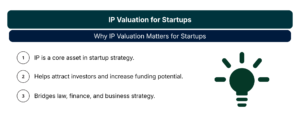
Picture 1 : Why IP Valuation Matters for Startups
Intellectual property has ceased to be a matter of legal formality and become a key pillar of the strategy of startups. Since founders are competing over more and more picky funding, the manner in which the company articulates, defends and explains the value of their ideas can turn a good investor pitch into a flattened one. IP valuation of startups is at the junction of law, finance, and strategy – and it is becoming a central competency of the profession that is engaged in or adjacent to the startup ecosystem.
To junior and mid-level professionals, particularly those in the field of finance, legal or advisory positions, escaping IP valuation may seem overwhelming. Discounted cash flow, royalty rates benchmarking and patent claim mapping are some of the common terms found in due diligence reporting, but there is limited practical context that explains them. The article disaggregates the main concepts, processes, and lessons in the real world that will assist you in working with IP valuation of startups more comfortably, whether you are advising a client, preparing a deal, or creating your own business.
The article includes the valuation of IP, the reasons it is important in fundraising, the actual activities of advisors, the mistakes made by startups, and what can be learned using real cases. It also cites the increasing significance of startup valuation advisory services on its way and investigates the use of IP valuation in start up fundraising at all stages of the capital lifecycle.
What StIs IP Valuation and Why Does It Matter for Startups
Picture 2 : How IP is Valued?
Intellectual property: Phone Ina, a variety of legally protected intangible property: trademarks, copyrights, trade secrets and patents. In the case of many startups, these intangibles are the most significant to the balance sheet, the only material assets in the early days. But unlike machinery or real estate, the value of them is not usually seen at first sight, and explaining their value means analyzing it intentionally. IP valuation of startups is a procedure of determining this value in a strict, documented, and defensible manner.
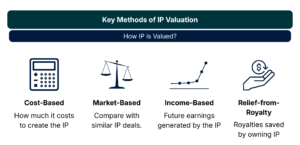
IP valuation has three major techniques, which include the cost approach, the market approach, and the income approach. Both have their advantages and disadvantages with regard to the stage of the startup, the kind of IP and the objective of the valuation. The following table is a reflection of the practical comparison of these methods.
| Method | How It Works | Best Used For | Key Limitation |
| Cost-Based | Values IP to replace or create it by total cost. | Rather early startups, internal R&D resources. | Ignorance to market potential and earning power. |
| Market-Based | Standards of similar IP exchanges. | Inventories of tech giants. | Similar offers are usually limited or secretive. |
| Income-Based | Earnings of the project that can be attributed to the IP in the future. | Licensable or revenue generating IP. | Needs sound financial projections. |
| Relief-from-Royalty | The royalties that are saved through the ownership of the IP is estimated. | Licensable patents, trademarks. | It relies on the choice of the appropriate royalty rate. |
The method used is a very important issue since it is an aspect which is subject to due diligence by investors and lenders. An appraisal based on the income methodology, such as, is more persuasive when a start-up is able to show licensing revenue existing or a believable business roadmap. The choice of the appropriate approach ranks among the initial steps that the competent IP advisor will take, and it is an indicator of how serious a startup takes its IP portfolio.
There are also varying types of IP that have variation in the weight depending on the context. The following table presents typical types of IP and the way they are likely to influence the context of start-up funding.
| IP Type | Examples in Startups | Relevance to Funding |
| Patents | Compounds of drugs, computer software, hardware. | Good indicator of technical defensibility; VCs attach great importance to such. |
| Trademarks | Company name, logos, product name. | Favors brand superiority and esteem. |
| Trade Secrets | Trade secrets, formulae, data models of their customers | Things that are difficult to value but important in analysis of competition. |
| Copyrights | Code, creative materials, training data. | SaaS and media-tech startups have it in their best interest. |
The Role of IP Valuation in Startup Fundraising
Investors do not just finance ideas, they finance defensible ideas. The role of IP valuation in startup fundraising is to provide credible, quantified evidence that a startup’s competitive advantage is real, protected, and scalable. A properly prepared IP valuation report can have a significant impact on a negotiation, a term sheet, and a higher pre-money valuation. On the other hand, an IP position that is not well documented may be a leak that develops lack of investor trust.
Take the example of a U.S. based biotech start-up which had created an exclusive drug delivery system. The founders had originally approached investors with broad terms of presentation of their technology without an official valuation of IP. The reactions of first time investors were reserved. Upon contracting the startup valuation advisory services, the firm came up with a comprehensive income-based valuation of its core patent portfolio, which forecasted royalty income on the basis of licensing standards in the pharmaceutical industry. This piece of writing alone had assisted the startup to raise its Series A at a valuation that was 40 percent greater than its initial bid – because investors were now able to observe in quantifiable terms why the IP was worth safeguarding and developing upon.
The valuation of IP sophistication required in different stages of fundraising differs. Early investors can be content with a rudimentary IP audit and high-level cost valuation. Later-stage investors, especially at Series A and later, will generally demand a more formal report with methodology underpinning, that is, prepared by a qualified advisor. The flow diagram below illustrates the process through which IP valuation is incorporated in fundraising stages.
| Stage | IP Valuation Role | Investor Expectation |
| Pre-Seed | IP audit, low-level cost valuation. | Assurance of existence and registration of IP or registrability. |
| Seed | Income projection, TAM consistency. | IP helps in product differentiation and growth story. |
| Series A | Official appraisal report, similar benchmarking. | Defensible IP that has measured contribution of revenue. |
| Series B+ | Complete IP portfolio valuation, licensing policy. | IP moat, licensing revenue or potential, M&A preparedness. |
| IPO / Exit | Statutory valuation, third party independent sign-off. | Valuation and prospectus or deal Auditable and compliant. |
Five Key Steps in Conducting an IP Valuation for a Startup
Picture 3 : Practical Steps for Startups
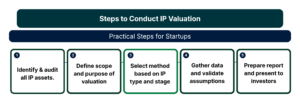
It is valuable to know how a professional IP valuation is to be undertaken so that founders as well as advisors can contribute towards the exercise more effectively. The five core steps, which are based on industry practice and common with startup valuation advisory services all over the world, are listed below. These steps will be taken systematically to minimize the chances of coming up with some valuation that will be questioned, discounted or rejected during due diligence.
Step 1 — Identify and audit all intellectual property assets. An IP inventory that is thorough is the beginning point. This is the process of registering all patents (granted and pending), trademarks registration, copyrighted materials, and registered trade secrets. A lot of startups to their surprise are found to have more IP than they think they have had or that some of their assets are not assigned by any means and so their ownership is still vague.
Step 2 — Determination of purpose and scope of the valuation. Everything depends on purpose: a preparation of a valuation to raise funds has different parameters compared to one to negotiate a licensing or a merger of companies. The scope will specify what assets will be covered, time horizon to be considered, and the level of documentation required. Clarification here saves on time and work in the wrong direction.
Step 3 — Choose and implement the best methodology of valuation. Depending on the type of IP, the available data, and the level of commercial stage of the startup, the most defendable method is picked by the advisor. In the majority of fundraising deals, the income strategy or relief-from-royalty technique is utilized since it addresses the matter of commercial potential directly- the main focus of growth investors.
Step 4 — Receive and verify supporting information. This contains historical financial information, revenue estimation, market size estimates, and royalty rate databases, and similar transaction records. The quality of the underlying data is very important and is the basis of the quality of the valuation. To benchmark rates, the advisors usually collaborate with the finance team of the start up and with external databases like RoyaltySource or Ktmine.
Step 5 — Prepare and defend the valuation report. The final report should be well-written, coherent, and in a professional way. It must reveal any assumptions, the methodology used and sensitivity analysis provided where necessary. The founders and their advisors should also be ready to take investors through the report and ask specific questions, which is a process that is undervalued but very essential in creating confidence.
| Step | Activity | Who Is Involved | Output |
| 1 | IP Identification & Audit | Legal, founders, IP counsel. | IP inventory register |
| 2 | Scope & Purpose Definition | CFO, start up valuation advisors. | Valuation brief / mandate |
| 3 | Method Selection | IP valuation specialists | Methodology (cost/market/income) chosen. |
| 4 | Data Collection & Analysis | Finance department, analysts, patent lawyers. | Similar sets of data, financial models. |
| 5 | Preparation of the Valuation Report. | Valuation advisor in charge of lead, law, reviewer. | Formal IP valuation report |
| 6 | Presentation to investors / lenders. | Founders, CFO, advisors | Investor due diligence pack |
Challenges in IP Valuation and How Advisory Services Address Them
Although the importance of IP has been increasingly realized, IP valuation of startups is one of the more technically challenging aspects of advisory services. A number of challenges occur on a frequent basis, and learning about them permits the professionals to plan the expectations and pre-empt the challenges in the future.
The most frequent one is the lack of similar data which is credible. The IP transactions are usually confidential and undisclosed as compared to the listed shares or commercial real estate. It may require a lot of time and knowledge to come up with an actual similar patent licence deal in the same line of technology, the same scope of claims, and the same geographical area. This is one of the reasons why the use of seasoned startup valuation advisory services is highly encouraged as compared to trying a home valuation. Sector-specific advisors usually have proprietary databases and relationships that substantially reduce this disjunction.
The second challenge is credibility of projection. Startups at the early stages often have no experience in generating revenue and, as a result, valuing them based on income will be based on assumptions that investors can question. An AI-based start-up in the United Kingdom, at least, initially failed to find Series A funding in part due to its IP valuation being based on revenue estimates that it hoped to achieve in three years, or 60% market penetration, which the investors believed was implausible given an unproven product in a highly regulated industry. The startup was able to close its funding round after amending their projections using more conservative assumptions that were based on milestones and getting a supportive market analysis provided by a third-party research company. The lesson: the question of credibility of assumptions is as important as the valuation figure itself.
The third problem is the dynamism of IP itself. Patent claims may be tightened, attacked, or destroyed. Trademark rights can lapse. The disclosure of trade secrets is possible. An IP valuation is a point in time and investors know so. Advisers who deal with this proactively by incorporating risk adjustments and talking about IP maintenance strategies in the report will generate valuations which will withstand scrutiny better. IP valuation is not simply the assignment of a number in raising start-up capital but a narrative of an intelligible risk-sensitive narrative about the intangible asset base of a start-up.
Building an IP-Aware Culture: Lessons for Startups and Their Advisors
Among the most reliable outcomes of startup funding successes and failures, it is inevitable to mention that IP strategy cannot be a postmortem issue. Those founders who view IP as a legal box, to be checked before the company raises funds, are at a structural disadvantage to those who have built IP thinking into their product development, hiring and commercial strategy since the inception of the company. Overall, the IP valuation of startups works better in situations where the resulting IP portfolio has been actively developed and managed value-generatingly.
Take the example of a fintech firm in Canada who came up with a set of proprietary credit risk modelling algorithms. Instead of rushing to patent the technology at once, the founding team took two years to polish the technology and develop a defensible trade secret system internal documentation, access controls, and non-disclosure agreements. By the time they went to seek Series B funding, they could make a presentation that was more than patents, but a full IP governance system that showed institutional seriousness. Investors termed the IP documentation as to be among the exhaustive that they had observed at that point. The company was rounded off at a high valuation. The moral of the story is that IP management discipline, and not ownership, generates value.
In the case of advisory or support professionals, the trick is to ask IP-related questions as soon as possible and as frequently as possible. Under working with a startup client who is about to raise funds, initiate a discussion on the clarity of the IP ownership (are all the assignments up to date?), the IP maintenance (do they have renewal fees?), and IP commercialisation (is the IP generating or can it generate revenue?). These are some of the questions that are inquired at the initial stages and expose problems that might otherwise bring down a deal at the most inconvenient time. Startup valuation advisory services that embed IP review into their broader valuation process — rather than treating it as a separate track — consistently deliver better outcomes for their clients.
Conclusion: Actionable Insights for Professionals
The issue of intellectual property is no longer a niche among lawyers. It lies at the core of the way contemporary start-ups make, communicate and seize value. As this paper has demonstrated, IP valuation of startups is an organized, systematic process that has several strategic functions, such as serving fundraising needs, facilitating licensing deals and acquiring companies.
To develop competence in this area, there are few practical steps that should be given priority by professionals at the junior and mid-level. To begin with, learn how to familiarize oneself with the three most common types of valuation cost, market and income and when each of them is most suitable. Second, understand how to read an IP portfolio critically: ownership, maintenance status, scope of claims and jurisdiction coverage all have an impact on value. Third, realize that the contribution of IP valuation in raising start up funds is a cumulative one since the earlier and more regularly a start up develops its IP postures, the greater its valuation story will be at the next step of funding.
Fourth, the importance of specialised advisory support is to be acknowledged. Credible and investor-ready IP valuation can be a big difference and it can be one of the best-paying investments that a growth-stage firm can make to hire qualified startup valuation advisory services. Being a professional, it is a substantial contribution in itself to be able to determine when a client requires that support and assist him or her in locating it.
Finally, stay curious. IP valuation is at the border of law, finance, technology and commercial strategy. It is an area where extensive knowledge is built over years, but where a good basic knowledge in the field can lead to a career venture capital, corporate finance, law advice, and so on. Those that succeed in the startups will be those whose teams, as well as advisors, are serious about IP. And those professionals who assist them will be in a good position in the future careers.