Patent Valuation: Methods and Applications
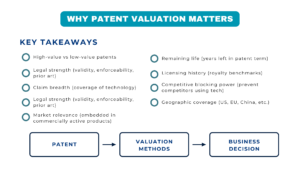
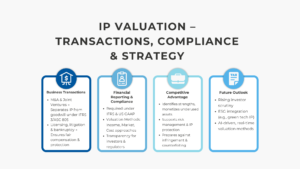
Picture 1 : Why Patent Valuation Matters
In the contemporary economy, intellectual property has emerged as one of the most useful categories of corporate assets. To technology firms, pharmaceutical companies, and similar creative businesses, patents are not only enforced by law, but are absolutely quantifiable as a store of economic value. Nonetheless, in spite of this significance, the field of patent valuation remains a turbid and technically challenging field to several professionals, including those who may be employed in the fields of finance, strategy, and legal. Whether a patent is truly valuable and how it is valued, is a matter of legal and economic as well as business strategy.
The importance of patent valuation cannot be overestimated. Patents are usually the only line item on the balance sheet that is being bargained when companies merge or get acquired. In case of the licensing deals, the royalty rate is pegged on a sound judgment of the earning capacity of the patent. In the event of conflict, which is very common in the patent industry, courts and arbitrators resort to professional grabs to find out the damages that may reach into the hundreds of millions of dollars.
This paper provides a realistic, practical overview of patent valuation: how professionals do it, the processes that drive it, the practical issues that make the work more difficult, and the patent valuation best practices that can get dependable, defendable results. You are a budding analyst to support a licensing transaction, or a product manager considering the IP positioning of your company, or a job seeker trying to learn more about the field, this guide will provide you with the conceptual background and practical sense of direction.
Understanding What Makes a Patent Valuable
Not every patent is made equal. The bulk of patents issued annually are of little commercial use – they defend either small-scale improvements, a specialized technical market, or inventions which the market in general does not use. However, a few of them are real breakthroughs and bring in billions in licensing fees, define entire product lines, or forestall the entry of competition in major markets. To any claims of patent valuation, the critical point of departure is to understand what makes a high-value patent different with a low-value patent.
Patent value is driven by a number of factors. Legal strength, one: a patent that has endured several validity test challenges is automatically more valuable than a patent that has not been challenged. Breadth of claims is important as well, since broadly written, well-written claims guard a broader technological area, and are more difficult to design around. It is probably market relevance: a patent to a technology that is built into a product, with billions of sales per year, is by far more valuable than a patent to a product with a small set of customers. Lastly, life is to be valued; a patent on a 20-year term of which 18 years are still open has a far greater value than one with a remaining term of two years.
Professionals joining the field should consider the value of a patent in two dimensions: the pure technical worth of the invention, and the strategic worth of the invention. Technically small patents can prove to be of massive importance to a specific company should they bar entry by a major player in a high-margin market. On the other hand, an invention of technical brilliance can sell at a very low price since no one is ready to pay to consume it. It is this technical merit and commercial relevance, combined, which all good intellectual property valuation strategies are based on.
Table 1: Key Factors That Influence Patent Value
| Value Factor | Description | Relative Weight |
| Legal Strength | Validity, prosecution history, prior art exposure. | High |
| Claim Breadth | The breadth and defensibility of the claims in the patent. | High |
| Market Relevance | Extent to which secured technology is integrated into commercial products that are in action. | Very High |
| Remaining Life | Remaining years to patent; higher years = high discounted cash flow potential. | Moderate–High |
| Licensing History | Current royalty agreements which set market standards. | High |
| Competitive Blocking Power | Capability to ensure that competitors are not able to use the same technology. | Moderate–High |
| Geographic Coverage | States where they are protected (US, EU, China etc.) | Moderate |
The Three Primary Methods of Patent Valuation
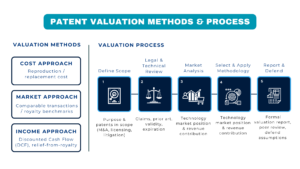
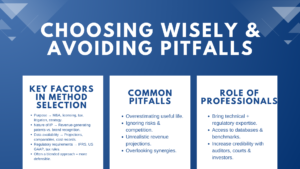
Picture 2 : Patent Valuation Methods & Process
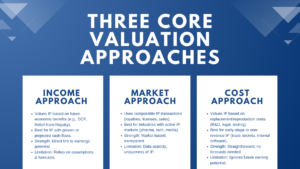
There are three methodological frameworks based on various economic reasoning that professional patent valuers have created and which are widely adopted. The ability not only to select an appropriate method, or to integrate methods, is in itself one of the fundamental skills of the profession, and a key component of the intellectual property valuation strategies. The three strategies include Cost Approach, the Market Approach and the Income Approach.
The Cost Approach is the approach that values are based on the cost of recreating or replacing the patented technology. This may be such expenditure as R&D, developing prototypes, cost of regulatory approval, and legal filing. Although this is easy to calculate, there is a major limitation to this approach, cost, and value are not identical. A firm may invest 5 million dollars in coming up with a technology that in the market is worth 500,000 dollars -or 50 million dollars. Cost-based valuations find most applications in the cases when other valuation is not possible, or as a bottom price in negotiations. Market Approach is a solution to this, considering similar transactions what have similar patents sold in arm-length deals? They can also use proxies in the form of the royalty rates that are set under similar licensing agreements. The issue in this case is the lack of data: it is difficult to find anything truly similar in terms of patents and the specifics of the deals can be classified.
The most popular way of valuing high-stakes patents is the Income Approach, which is the most technically advanced. It approximates the discounted value of the future economic benefits that can be attributed to the patent – usually by a discounted cash flow (DCF) analysis of the projections of royalty streams or incremental profits. One such important contribution is the relief-from-royalty method, which approximates the value of a patent by determining the amount a firm would be prepared to pay to license the technology in the event a firm does not own the technology. Both of these methods involve the analyst making assumptions concerning market size, royalty rates, discount rates, and remaining economic life and that is why the best practices of patent valuation focus on strict documentation and sensitivity testing of all important assumptions.
Table 2: Patent Valuation Methods — Comparison Overview
| Method | Core Logic | Best Used When | Key Limitation |
| Cost Approach | Value = cost to recreate/ replace the technology. | Pre-mature patents; little market information. | Cost ≠ Value; does not pay attention to market demand. |
| Market Approach | Value = cost of related patent deals or royalty standards. | There are active markets on licensing; similar transactions are available. | The lack of data; the comparison is constrained by the confidentiality of the terms. |
| Income Approach (DCF) | Value = future economic benefits of the patent present value. | Patents commercially operative; forecasts of revenues can be made. | Sensitive to discount rate; heavy assumption-dependence. |
| Relief-from-Royalty | Value = royalties paid not to license but to own the patent. | Lessee and Lessor licensing; litigation damages; M and A due diligence. | The rate of royalty that a benchmark is required to pay should be believable. |
Five Key Steps in the Patent Valuation Process
Irrespective of the approach applied, professional patent valuation has a systematic process. Any of these steps omitted or skipped raises the likelihood of coming up with a flawed analysis that cannot stand the test of time, not in a board room, during a licensing negotiation, or even in courtroom. The following are the five steps that outline a rigorous valuation process.
Process Flow 1: Patent Valuation — Step-by-Step Methodology
| Step | Activity | Key Inputs | Output |
| 1 | Scopes and Purpose — Specify the purpose of the valuation (M&A, licensing, litigation, financial reporting) and what patents are being valued. | Patent list, Engagement letter, legal counsel brief. | Valuation scope document |
| 2 | Legal Review and Assessment of Patent — Review patent claims, prosecution history, risk of validity, geographic coverage and expiration date. | Patent applications, legal advice, FTO (freedom-to-operate) report. | IP legal strength summary |
| 3 | Market and Commercial Analysis — Investigate the technology market position, the competition, and how much the products based on this patent add to the revenues. | Revenue information, market research, product road maps. | Commercial relevance report |
| 4 | Select and Apply Valuation Method(s) — Select and apply the method(s), construct financial models, sensitivity analysis of main assumptions. | Financial statements, royalty benchmarks, analysis of discount rate. | Draft valuation model |
| 5 | Report, Review and Defend -Write an official valuation report, Submit that report to peer review and be ready to justify assumptions to an adversary. | Outputs of the model, a record of how it was done, comparables. | Final valuation report |
The second step, which is the legal and technical review, is the least considered by financial analysts. The scope of claim as described in a patent might appear impressive on paper, but might be invalidated by prior art, continuation challenges, or inter partes review (IPR) in the United States Patent and Trademark Office. These risks are not something to be learned on the margins of a believable patent valuation best practices framework. At this stage, analysts are supposed to collaborate with patent lawyers and report their legal risks appropriately in the final report.
The fifth step is the report, review and defend which is especially relevant in adversarial settings like litigation or regulatory scrutiny. The valuation of patents in court is liable to cross-examination and conflicting experts will examine all the assumptions. Those analysts who have developed defensible well-documented models and made intellectual property valuation choices that are consistent with the situation at hand will be in a much better position than those who used superficial benchmarks or unsanctioned assumptions. Valuation is never weak on transparency – it is an indicator of professional rigor.
Real-World Examples and Lessons from Practice
The history of the world of corporate IP transactions has educative moments that point to the colossal stakes involved and the result of bad patent pricing. Two cases can be distinguished because of their magnitude, complexity, and the lessons that can be learnt by the practitioners on all levels.
In 2011, Google purchased Motorola Mobility at a price of about 12.5 billion dollars- most of which is said to have been pegged on the portfolio of about 17,000 patents and 7,500 pending applications that Motorola had. When the deal happened, Google was experiencing a high level of patent exposure on Android ecosystem and Motorola wireless technology patents were a source of defensive patent as well as a source of potential licensing income. The value of the patent portfolio alone, deprived of Motorola hardware business, which Google later sold to Lenovo alone, has been estimated to be between 5 and 7 billion dollars. The case demonstrates the strategic blocking worth of patents, and it explains the importance of royalty worth policies to consider competition instead of royalty worth alone. The Income Approach would have been of great use as the analysts of Google, the final price of acquisition was high in terms of strategic premium over the modeled DCF value.
A more warning picture is shown in the pharmaceutical industry. A giant American biotech company, a composite example, based on multiple reported cases, in the mid-2000s licensed a key drug compound patent to one of the generic companies without having it thoroughly assessed and valued in terms of patent. Licensing fee was calculated depending on an approximate cost-plus estimate as opposed to a strict income-based analysis. When the drug later became a blockbuster, the licensor was now in the position of being committed to a less than market royalty rate with no renegotiation provision, and losing hundreds of millions in potential revenue following the remaining term of the patent. The moral is plain: best practices of patent valuation should include stress-tested income projections based on optimistic, base, and downside scenarios; and licensing terms must have language in regard to renegotiation in case the actual commercial results are significantly higher than the forecasts.
Process Flow 2: IP Portfolio Review for Licensing or M&A Due Diligence
| Phase | Activity | Responsible Party | Key Deliverable |
| Phase 1: Inventory | List all IP register: patents, applications, licences out/in, jurisdictions, expire date. | IP Counsel / Patent Manager | IP asset register |
| Phase 2: Screening | Use a fast scoring system (legal strength × commercial relevance) to single out patents that have a high value at that tier (tier-1). | IP Analyst + Finance | Tiered patent list |
| Phase 3: Deep Valuation | Use Income Approach (DCF / relief-from-royalty) when dealing with tier-1 patents; Cost or Market Approach when dealing with other patents. | Valuation Specialist | Patent-level valuations |
| Phase 4: Portfolio Aggregation | Combine the individual values; elimination of overlaps, dependencies and portfolio synergies. | Valuation Lead + CFO | Portfolio valuation summary |
| Phase 5: Reporting & Negotiation Support | Write formal report; provide scenarios and expert testimony to support deal team where necessary. | Lead Analyst, Legal Counsel | Final IP valuation report |
The patent auctioning of Nortel Networks of 2011 provides another dimension. Nortel reportedly sold its 6,000 or so patents consisting of wireless technologies, internet and semiconductor technologies to a consortium of Nortel led by Apple, Microsoft, and Research In Motion at $4.5 billion when Nortel became bankrupt. The portfolio had been estimated at approximately one billion dollars. That ultimately cost more than four times that estimate, owing to the intense competitive bidding and the strategic imperative experienced by each of the consortium members to ensure that such patents were not in the hands of their competitors. The implication to the patent valuation community is that the market value is highly sensitive to modeled value when bidding in a high stakes auction setting and that any intellectual property valuation strategies used in a bidding process must include the use of scenario analysis of bid behavior rather than financial fundamentals.
Challenges, Emerging Trends, and the Path to Best Practice
Although the significance of patent valuation is undeniable, this field of professional practice is among the most disputed. Patents are not listed on liquid markets and have no observable prices as in the case of real estate or listed equities. All patents are individual, hence they are hard to make comparable. Cash flows in future are very unpredictable – especially when it comes to young technology. And just by a challenge an unsuccessful challenge can be a patent invalidation overnight after a successful challenge hits key claims. Such structural issues imply that even the most rigorous valuation is filled with some degree of uncertainty which should be transparently communicated to the decision-makers.
A patent of the artificial intelligence and machine learning technologies is one of the developing challenges. Such patents are commonly called method patents – they safeguard procedures and algorithms, but not tangible merchandise, which complicates revenue attribution especially greatly. Who is benefiting in an AI patent: the owner of the patent, the purchaser of the product being AI-enabled or both? The best practices frameworks of traditional patent valuation were not developed taking this ambiguity into account and the profession is busy in coming up with new guidance. In recent years, the WIPO and the International Valuation Standards Council (IVSC) have published additional frameworks on digital and intangible asset valuation, and practitioners in the field ought to keep up with the related emerging standards.
Another issue is that of data quality. The Market Approach relies on similar deals, but the majority of patent sales and licensing deals are under non-disclosure. Standalone databases like ktMINE, RoyaltySource, and the IPBC Global database have certain benchmarks, although they are not complete and reporting lags might be high. This is overcome by more experienced practitioners through triangulation without making claims about the superiority of one method over another, but by stating valuations in form of ranges as opposed to point estimates. It is an adult intellectual property valuation strategies of taking risks instead of risk aversion, and it is one of the foundations of professionalism.
Conclusion: Actionable Insights for Professionals
Patent valuation is at the center of some of the most momentous business decisions of the current business world – both billion-dollar deals of M&A and the very licensing deals that set who is making money off underlying technologies. This is because by becoming a professional in patent valuation, people of all levels can have access to legal, financial, strategic, and consulting opportunities. It is a profession that favors those who participate in an analytical discipline and have an authentic intellectual interest in both technology and markets.
Your practice should be informed by five actionable insights in the future:
- Learn the three techniques, yet be able to combine them. The Income Approach is the horse of the patent valuation, yet no one approach to valuation captures all. Triangulation between Cost, Market, and Income approaches – and being clear where they differ – yield more sound and strong conclusions.
- Do not omit the legal assessment. The legal validity of the patent is as good as its commercial worth. The claims of weakness, prior art risk, and waiting challenges have the potential of dramatically devaluing a patent. Never make a final decision on a valuation without the contribution made by a qualified patent attorney.
- Implement intellectual property valuation strategies that are suitable to the situation. A patent valuation prepared due to litigation damages must be documented differently and in a manner of standard of care than one prepared due to internal planning. Never select your methodology without defining the purpose.
- Folk everything and Stress test your assumptions. The most significant characteristic of the best practices in patent valuation is not the one of a model approved through elegance, but the rigour of the documentation. The difference between work done at a professional level and work done by informed guesswork is sensitivity analyses, scenario tables and clear assumption logs.
- Be abreast with the changing standards. The field is evolving very fast with the advent of AI, software, and bioinformatics patents that are breaking down the traditional frameworks. Participate in WIPO, IVSC, and RICC guidance, keep up with the events in the leading patent litigation, and establish a circle of experts in the legal, financial, and technical fields.
The patent valuation professionals that are the best are those that value the quantitative rigour and the contextual judgment that the work ought to have. Patents are not just legal documents they are economic assets that are integrated into competitive, technological, and human reality. It is the complexity of handling them so, and the implementation of good intellectual property valuation techniques that are the challenge and the opportunity that this discipline presents. To those who have the courage to go into true proficiency, there are rewards of money and of money fairly substantial, and the task itself, at the cutting edge of technology and business, is never dull.